
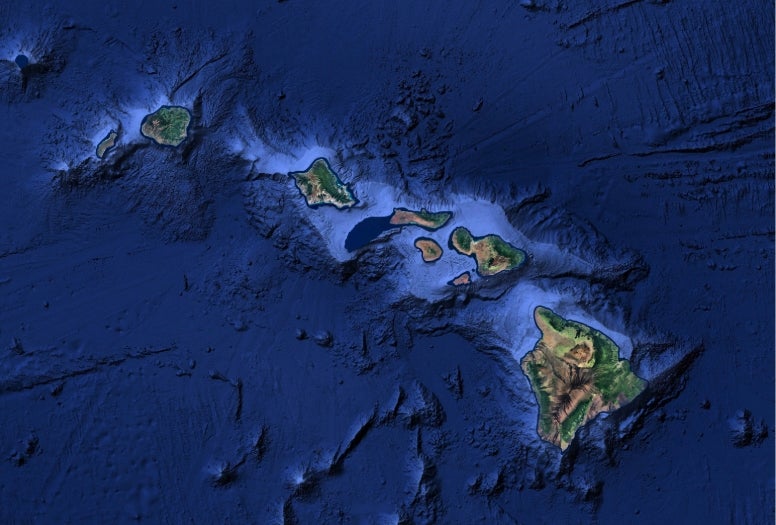
On Earth, everything is moving. The planet spins, the tectonic plates shift and the spin axis wobbles as do the magnetic poles, which makes determining how things move a rather tricky proposition. For Rice University’s Richard Gordon, this problem came up when he was trying to understand the history of the Hawaiian hot spot, the deep-mantle source of the volcanism which created the Hawaiian-Emperor chain of islands and underwater volcanoes. Within the chain is a bend, likely formed approximately 47 million years ago, whose origins geologists are not sure about. Specifically, scientists aren’t certain if the bend was caused by the Pacific plate moving over the hot spot or the hot spot moving under the Pacific plate.
“The debate about what movement caused this bend is quite heated,” said Gordon, the W.M. Keck Foundation Professor in Geophysics, Earth, Environmental and Planetary Sciences. “My former student Daniel Woodworth and I were approaching it from a new angle, relying on a new paleomagnetic pole combined with a dataset that had taken us decades to collect and create.”
As Gordon and Woodworth analyzed the data, which was published in JGR Solid Earth, they found evidence of movement in a much colder and more surprising location — the spin axis of the Earth, the point at the top of the Earth where the imaginary line around which it spins would exit. On a globe, the spin axis would be where the handle connects to the sphere.
“When I was a student, many geophysicists assumed that the solid Earth does not change its location relative to the spin axis,” Gordon said. “Even today, some geologists think that Earth’s orientation relative to the spin axis hasn’t significantly changed in the past 100 million years.”

Since the spin axis of the Earth usually overlaps with the magnetic pole, at least in recent geologic history, researchers can use the magnetic pole as a proxy for the spin axis. This allows them to use magnetic stripes preserved in slowly cooled magmas and lavas to determine movement of the Pacific plate. The stripes point toward the magnetic pole as they are formed and, once solidified, serve as a sort of preserved arrow. As the plate moves, the preserved stripes also move, and the arrow which started off pointing toward the magnetic pole now points to a new location. Researchers know the age of any given stripe and study its shift to understand how the Pacific plate has moved relative to the magnetic pole/spin axis since the stripe was formed.
“Our paleomagnetic analysis shows that just before the bend formed, the Pacific plate jumped south over a geologically short time interval in what would be a relatively quick movement,” said Woodworth, who graduated from Rice with his doctoral degree in 2022. “But if you look at all the drivers of tectonic plate movement — which are fairly well understood — they suggest that before 56 million years ago, the plate was moving steadily north relative to the hot spots. Which means we had two datasets showing different movements.”
Essentially, the Pacific plate appeared to move differently if you looked at it from the point of view of the hot spot compared to the point of view of the spin axis. But while all the data may have disagreed, one thing was clear: The plate couldn’t be moving in multiple directions at the same time.
“It took some time, and a fair amount of cross-referencing with other geological records, to untangle this,” Woodworth said. “We did detect some small movements in the Hawaiian hot spot, but ultimately we had to reconsider the assumption that the spin axis was stationary relative to the solid Earth and its hot spots. Our results indicate that around 56-48 million years ago, the entire solid Earth reoriented relative to the spin axis, which gave us the jump found in the paleomagnetic record.”
If you think of the Earth as a globe, this would be like the globe tilting while the handle stayed still. In this case, the movement of the solid Earth relative to the spin axis was significant enough that Gordon said he thinks it is an example of what geologists called true polar wander.
“This is an exciting finding,” Gordon said. “These data indicate that contrary to some current thought, substantial true polar wander could have happened as recently as 48-56 million years ago.”
And as for the other question they were asking, about the bend in the Hawaiian-Emperor seamount chain? Well, the results strongly favor the hypothesis that the bend was caused by a change in movement of the Pacific plate, not of the Hawaiian hot spot.
This work was partly funded by the National Science Foundation (OCE-1559316).