

Altermagnetism is a new, third type of magnetism of great interest for spin transport applications like computer memory. If properly harnessed, it could combine the benefits of the two existing types of magnetism, ferromagnetism and antiferromagnetism, ultimately reducing or eliminating heat during information transfer and increasing the ability to miniaturize next-generation technologies. Rice University’s Pengcheng Dai recently published a paper in Physical Review X describing the first successful efforts to put a proposed altermagnet material into a single magnetic domain state, allowing the research team to characterize the material’s intrinsic magnetic structure.

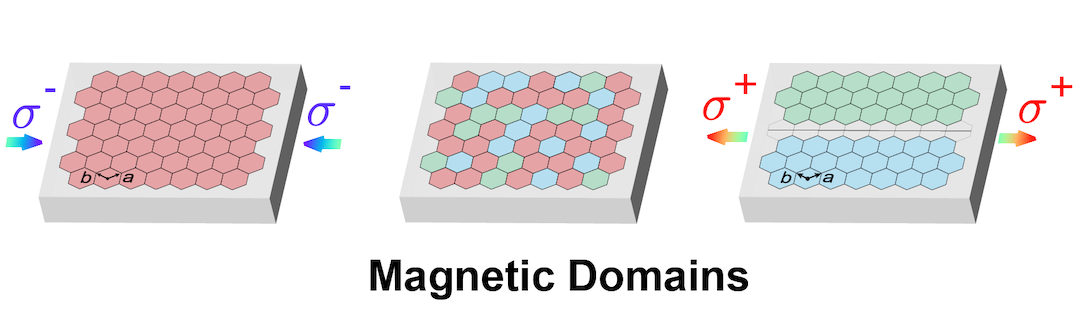
“Altermagnets like hexagonal manganese telluride typically form multidomain structures where the magnetic forces divide into separate equivalent domains that spin in different directions to satisfy the underlying threefold rotational symmetry of the hexagonal lattice,” said Dai, the Sam and Helen Worden Professor of Physics and Astronomy. “The signals from these coexisting domains could overlap, making it hard to know what the underlying magnetic structure actually is. Here, we were able to apply a uniaxial strain, which resulted in a single magnetic domain we could clearly resolve into the underlying magnetic structure.”
Magnetism comes mainly from the magnetic moments of electrons. In large enough materials, the moments will organize into different domains, or groups. Within each domain, the magnetic order points in a particular direction, but this direction can differ between neighboring domains. Physicists like Dai can read the combined signals from these domains, but their overlapping contributions can make different magnetic structures look nearly identical in the data.
To resolve this issue, Dai’s team put manganese telluride under a uniaxial strain, stretching the material in a single direction. This strain successfully isolated a single domain state of the manganese telluride, one that could be resolved using current methods.

“By applying the uniaxial strain, we were able to finally resolve the magnetic structure of manganese telluride,” said Sijie Xu, a Rice graduate student and co-first author. “This also allowed us to see a remarkably sharp feature in the anomalous Hall signal, which describes a lateral voltage generated when an electrical current flows through the material due to its magnetic structure.”
At a low enough temperature — approximately 230 K or minus 45 F — tuning this strain could also reverse the polarity of the anomalous Hall effect by reversing the flow of its electrons. This, Dai explained, is not a typical feature of magnets.
“Essentially, we can use this uniaxial strain to tune the anomalous Hall effect, switching it from one charge to another,” said Zhaoyu Liu, co-first author and researcher in Dai’s group. “Because the magnetic interactions remain largely unchanged, the effect likely originates from strain-induced changes in the Berry curvature.”
Typically, such tuning can be done by changing the temperature, although that is not practical outside of the lab. But this strain control is significant; the team’s predictions suggest that a 1% change in the strain is equivalent to a 150 K change in temperature.
“This work brings us one step closer to controlling altermagnets for next-generation spin-transport applications,” Dai said. “Imagine, for example, a cell phone that responds faster, operates at higher frequencies and generates much less heat while handling memory-intensive tasks and how much longer its battery might last. If we can characterize and harness altermagnetism, that could help make such devices possible.”
This study was supported by the U.S. Department of Energy’s Basic Energy Sciences program (DE-SC0012311, DE-SC0026179), the Robert A. Welch Foundation (C-183, 00730-5021-H0452-B0001-G0512489), the Air Force Office of Scientific Research (FA9550-21-1-0068, FA9550-15-1-0236, FA9550-20-1-0068, FA9550-21-1-0423), the David and Lucile Packard Foundation and National Science Foundation (DMR-2308979), the Gordon and Betty Moore Foundation (GBMF13842), the Enterprise Science Fund of Intellectual Ventures Management LLC, the T.L.L. Temple Foundation, the John J. and Rebecca Moores Endowment, the state of Texas through the Texas Center for Superconductivity at the University of Houston, the NSF Cooperative Agreement (DMR-2128556) and the state of Florida.