

As artificial intelligence becomes increasingly involved in decisions about hiring, education and health care, ensuring those systems are accurate, fair and trustworthy has never been more important.
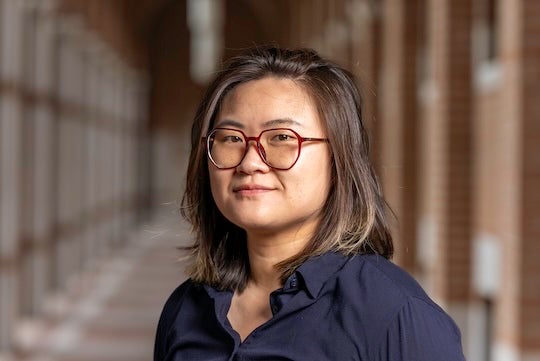
That’s the focus of research by Tianjun Sun, assistant professor of psychological sciences at Rice University, whose work developing better ways to measure human behavior and abilities has earned national recognition from the Academy of Management.
Sun has received the 2026 AOM Research Methods Division Lawrence R. James Early Career Achievement Award, which recognizes early career scholars for distinguished contributions to research methods in the areas of research, practice, education and service.
“I was both surprised and honored,” Sun said. “The Research Methods Division includes many outstanding scholars whose work has shaped how organizational researchers conduct studies and analyze data, so receiving this recognition is incredibly meaningful.”
For Sun, the award also reinforces a principle that has guided her career.
“Good science depends on good measurement,” she said. “Before we can answer important questions about people, organizations or society, we need valid ways of measuring the constructs we care about.”
Rather than studying a single psychological phenomenon, Sun develops the methods researchers use to understand characteristics that aren’t directly observable, including personality, motivation, interests and cognitive abilities. Those measurements inform decisions in hiring, education, health care and public policy.
“If our measurement tools are inaccurate, biased or inadequate, then the decisions based on them can also be flawed,” Sun said. “Ultimately, better measurement helps researchers, organizations and policymakers make better decisions.”
As AI tools become more common in hiring, education and health care, researchers are increasingly asking whether those systems are measuring people accurately and fairly. That’s where Sun’s work comes in.
Much of Sun’s recent work focuses on what she calls “psychometric AI,” an emerging field that combines psychological measurement with AI. Her goal is to ensure AI systems used to assess people are grounded in the same scientific standards that have long guided the field.
Historically, psychometrics and AI evolved largely as separate disciplines, with psychometrics emphasizing measurement validity, fairness and theory, and AI focusing on prediction and automation. Sun’s research brings those fields together to develop AI systems that are both innovative and scientifically rigorous.

One of her recent projects developed and validated an AI chatbot capable of assessing personality through natural conversation while meeting the same scientific standards expected of traditional psychological assessments.
“We are working to make sure that AI-based assessments are scientifically valid, trustworthy and fair,” Sun said. “If these technologies are going to influence important decisions about people’s lives, they need to meet the same rigorous standards that we expect from traditional methods.”
Her research also extends to health care, where her team is investigating whether AI-powered conversational systems can help assess cognitive functioning and detect early signs of cognitive decline. The long-term goal is to develop accessible tools that support earlier identification and intervention.
Looking ahead, Sun said advances in AI will create an opportunity to rethink how researchers assess personality, skills, knowledge and behavior while preserving the scientific rigor that makes those assessments trustworthy.
“My lab is exploring AI-assisted interviews, adaptive conversational assessments, educational technologies, cognitive health assessment and methods for making AI systems safer and more interpretable,” she said. “That combination of methodological innovation and practical impact is what excites me most.”
Sun credits Rice’s collaborative research environment for helping advance the work.
“Rice has been a wonderful place to pursue this research, with strong opportunities for collaboration across psychology, computer science, engineering and data science,” she said. “I am grateful for that environment.”