
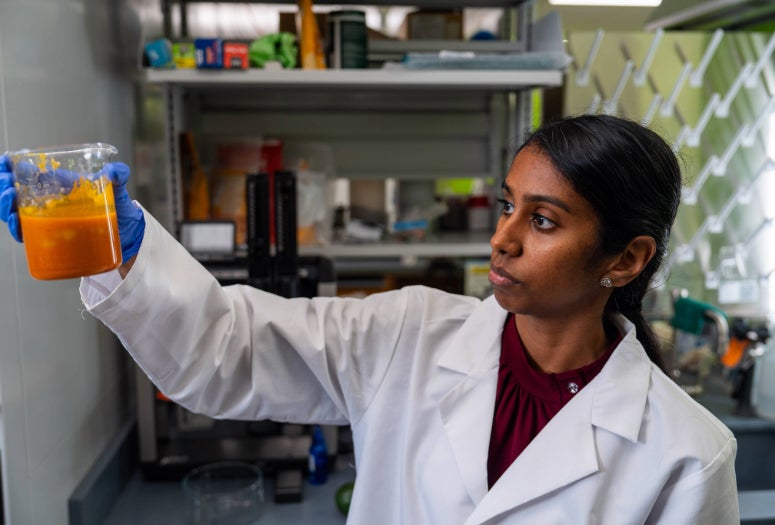
Anyone who has purchased a carton of berries only to watch them spoil before they can be eaten knows the frustration of food waste. For Rice University doctoral alumna Neethu Pottackal ’25, that familiar problem represents something much bigger — an opportunity to use materials science and mechanical engineering to make fresh food last longer and reduce waste across the global food supply chain.
Pottackal is the founder of NIVERA, a startup developing a natural, edible coating designed to extend the shelf life of fresh produce. The technology was based on a doctoral research project she conducted at Rice, where she worked with co-advisers Pulickel Ajayan, the Benjamin M. and Mary Greenwood Anderson Professor of Engineering, and Daniel Preston, assistant professor of mechanical engineering.
Their interdisciplinary research has produced a coating that, according to the company’s testing, can nearly triple the shelf life of certain fruits and vegetables, offering a promising alternative path for packaging and postharvest solutions.
“Anybody who’s bought a box of strawberries or an avocado can relate to it going bad before they can even eat it,” Pottackal said. “But it’s more than just an inconvenience. It points to a massive problem of food waste as well as access to fresh food.”
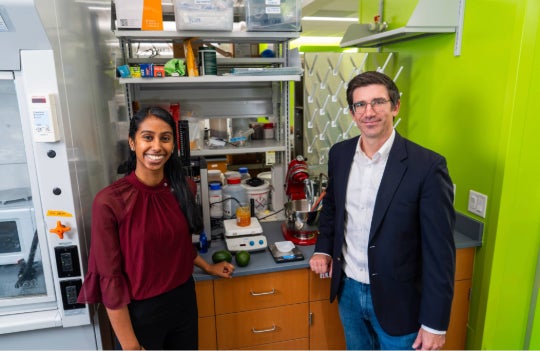
Fresh fruits and vegetables continue to undergo biological changes after they are harvested. They lose moisture, exchange gases with their surroundings and become vulnerable to bacteria and fungi, all of which contribute to spoilage. NIVERA’s technology aims to slow those processes using a thin, edible coating made from naturally derived ingredients, including proteins and fibers. Some of the materials come from agricultural by-products, potentially reducing production costs while putting existing waste streams to use.
The coating creates a protective barrier that addresses three major causes of spoilage: moisture loss, oxidation and microbial growth. It achieves this through a plant-based matrix to provide structure along with other natural components that contribute mechanical stability and antimicrobial properties.
“Working at the intersection of materials science and mechanical engineering, we’re able to approach this problem from different perspectives,” Pottackal said. “We’re looking at not only the materials but how they interact with each other.”
The company is initially focusing on high-value produce, including avocados and berries, where extending shelf life could offer significant economic benefits. Testing with avocados has already shown significant increases in shelf life.
Preston said the research addresses a substantial problem in food production and distribution. According to the United Nations Environment Programme, more than a billion metric tons of food are wasted globally each year, much of it before reaching consumers.
“We’re targeting keeping fruits and vegetables fresher for longer so that they can last all the way from harvest to packaging, transit and supermarket shelves before the consumer can finally purchase and consume them,” Preston said.
For Pottackal, whose interest in food science was shaped partly by her experiences navigating severe food allergies and growing up in different countries and cultures, the research offered a way to combine a personal interest with her scientific training. Her doctoral work drew on complementary expertise from two Rice laboratories. Ajayan’s materials science research helped guide the coating’s formulation, while Preston’s mechanical engineering lab contributed expertise in spray-coating applications and translating laboratory discoveries into practical technologies.
As the research progressed, Pottackal became increasingly interested in exploring the technology’s potential beyond the lab for commercial application, and Rice’s entrepreneurship ecosystem helped her make that transition. She participated in the Liu Idea Lab for Innovation and Entrepreneurship’s Innovation Fellows program and the Rice Venture Scholars initiative. She also competed in university-sponsored startup competitions, securing a $25,000 prize at the Napier Rice Launch Challenge as well as reaching the semifinals at the Rice Business Plan Competition, winning Overall Best Elevator Pitch and the $25,000 Energy, Cleantech & Sustainability Prize.
“Rice has played a big role in shaping me, not just as a researcher but also as a startup founder,” Pottackal said.
NIVERA has since gained momentum. Pottackal was selected for the 2026 Activate Fellowship, which provides more than $300,000 in funding to support scientists and engineers commercializing promising technologies. The company also received a $305,000 Phase I Small Business Innovation Research award from the National Science Foundation, with Preston’s lab participating as a subawardee.
For Preston, NIVERA demonstrates the potential of connecting Rice’s research strengths with opportunities for entrepreneurship.
“The innovation and entrepreneurship ecosystem here at Rice is booming right now,” Preston said. “There are massive opportunities for students to translate their impactful research in the lab to real-world use and implementation.”
NIVERA’s next challenge is scaling its technology and demonstrating that its coatings can deliver consistent performance and economic value beyond the lab. But Pottackal is confident in her strong support system of mentors, including Preston, and excited to advance the next stage of research behind NIVERA.
“I’m really proud of how far we’ve come, and a founder’s journey is not always linear,” she said. “There’ve been many instrumental community mentors, sources of support and opportunities that have helped us grow and transform, both from the research side as well as the business side, and I’m excited to keep growing this company and bringing in more engineers and scientists to work on our mission of improving sustainability and reducing waste at the food-water-energy nexus.”