
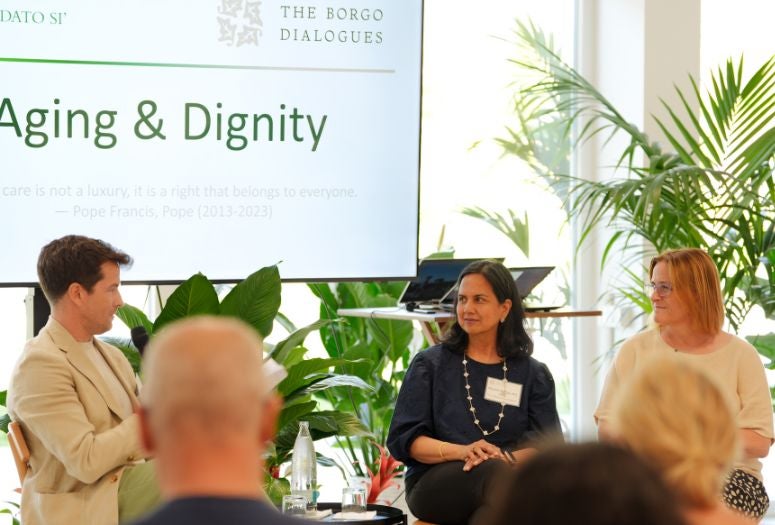
Amy Dittmar, Rice University’s Howard R. Hughes Provost and executive vice president for academic affairs, brought an economist’s and higher education leader’s perspective to the Vatican for a global conversation on how health systems, labor markets and communities can be designed around human dignity.
Dittmar, who is also a professor of economics in the School of Social Sciences and professor of finance at Rice’s Jones Graduate School of Business, was invited to participate in the inaugural Borgo Dialogues in Rome. The convening, held June 17-19, brought together corporate leaders and representatives from international organizations, academia, sports, culture, civil society and the Catholic Church to discuss major challenges of our time through the lens of ethical leadership and the common good.
Rooted in the moral architecture of Pope Leo’s XIV’s encyclical “Magnifica Humanitas,” the Borgo Dialogues were created as the next step in bringing its themes into a community of practice. The dialogues are structured around three core tracks — AI & Humanity, Sport & Community and Aging & Dignity — and ask participants to bring real decisions, not public commitments, into the room.
Dittmar joined Dr. Sharmila Makhija, founding dean and CEO of the Alice L. Walton School of Medicine and Matthew Blake, managing director of the World Economic Forum, for a panel titled “Building Systems for the Common Good: Dignity at Scale.” The discussion explored what would change if dignity were treated not only as a moral aspiration but as a design principle for health systems, workplaces and communities.
For Dittmar, the answer begins with visibility — who is included in the data, institutions, investments and systems that shape health and opportunity.
“I want to start by widening the lens slightly,” Dittmar said. “We’re not just talking about access to high-quality health care — most of the world doesn’t have that as a baseline to begin with. We’re talking about health holistically.”
Dittmar said the cost of invisibility is certainly not only moral but economic.
Information, data needed to combat invisibility
“As an economist, the question of what is the cost of invisibility is really a question about incomplete markets and information asymmetry, which is the bread and butter of my own field,” Dittmar said.
Markets, she said, can allocate capital efficiently only when information is available. When populations are missing from claims data, clinical trials, registries or other systems, insurers cannot price their risk, health systems cannot budget for their needs and physicians cannot find solutions for them.
“The capital goes where the data is,” Dittmar said. “So invisibility doesn’t just mean someone is overlooked, it means an entire pool of capital that could serve them never shows up in the first place.”

That absence weakens the entire system, she added.
“The last cost is the one I think gets underweighted: Data gaps don’t stay contained to the excluded group,” Dittmar said. “Every model, every actuarial table, every clinical guideline built without certain populations in it is a weaker model for everyone, because it’s been trained and tested on a narrower slice of human variation than it claims to represent. So the cost of invisibility isn’t paid only by those who are invisible; it’s a tax on the accuracy of the entire system.”
Dittmar also connected health to human capital and labor markets, noting that health is central to workforce productivity, alongside education and skills.
“When people are invisible to the systems that should catch and manage their health early, that capital depreciates quietly, and it shows up later as a labor market problem rather than a health one,” she said.
How Rice and Houston are studying, advancing solutions
Dittmar pointed to Houston and Rice as leaders in this work. She co-chairs Project Metis, a Houston initiative focused on lifelong brain health to enhance human flourishing, spur economic growth and position the Houston-Galveston region as a global leader in brain health. The initiative spans early life brain development, workplace cognitive health, healthy aging, neuroscience research and commercialization.
She also highlighted the Global Brain Economy Initiative , established at the World Economic Forum in Davos, Switzerland, which connects neuroscience and economic policy to promote long-term growth, workforce resilience and social well-being, as well as a new Nature Medicine Commission on Brain Health for Economic Resilience announced at the Texas Brain Economy Summit.
Dittmar said the same questions of visibility and dignity apply to food insecurity, housing, transportation, health care access and other systems that determine whether people can thrive. In Houston, where Rice’s Kinder Institute for Urban Research provides extensive data on the intersection of health and economic conditions, 39% of households are food insecure — nearly three times the national average — despite many people working full time or holding multiple jobs.
The Kinder Institute also found in its 2026 Houston Area Survey that social cohesion — feeling connected to neighbors and shared values — is a primary predictor of health and safety. Getting people more connected with their neighbors has a health benefit equivalent to raising a household’s income by more than $100,000.
“At Rice, we are committed to leveraging our world-class research to build thriving urban communities at home in Houston and globally, so much so that it is a key driver in our 10-year strategic plan,” Dittmar said. “Rice is unique in its commitment to the public good as a private, secular university.”
Dittmar said designing systems that make people visible to data, to capital and to one another is both a moral obligation and an economic imperative.
“I applaud the Borgo Dialogues and my colleagues for bringing us together for this important conversation.”
Rice’s Shawn Miller, associate provost for digital learning and strategy, participated in all three of the core dialogues, and noted the “rare” opportunity to join global business leaders, policymakers, faith leaders, scholars and even Olympic athletes to discuss the same hard questions. He was especially interested in the discussions on artificial intelligence since Rice has an institutional focus on responsible AI.
“The question isn’t whether AI will transform our institutions, but whether we’re shaping that transformation around human dignity or simply letting it happen to us,” he said. “For institutions like Rice, where we’re focused on responsible AI, the Borgo Dialogues’ call for ‘courageous leadership’ means elevating more voices into this conversation, creating space for real dialogue and deliberation as we expand access and opportunity.”