


Behind every secure online transaction or encrypted message lies a string of completely unpredictable numbers. A team of physicists has now theoretically eliminated a long-standing roadblock, opening the door for next-generation security chips that protect everyday data without slowing down performance.
In a study published in “Physical Review Letters,” a research team co-led by Rice University’s Jun-Jie Zhang and Boris Yakobson demonstrates a new class of materials. The research was conducted in collaboration with Shuai Dong, chair of the School of Physics at Southeast University in China.
These materials are called autferroics and can speed up physical, true random number generators (TRNG) thousands of times while keeping signal clarity at full strength.

Security systems can lag under heavy use or become vulnerable to hacking if the random numbers driving encryption are generated too slowly or with weak signals. Inside these security devices, unpredictable thermal fluctuations within tiny magnetic switches generate the crucial numbers. Standard devices, however, trigger these microscopic jumps far too slowly. Engineers can try to speed them up by shrinking the physical components or applying external magnetic forces. However, doing so degrades the signal and leads to data-reading errors.
Yakobson said the team’s work grew out of exploring fundamental physical behaviors.
“Our broader interest in TRNG, or how to extract entropy from physical behavior and convert it into random bits, focused mostly on charge-fluctuating entities in field-effect transistors,” said Yakobson, the Karl F. Hasselmann Professor in Engineering. “But when exploring the energy landscape of autferroics, especially the lower barrier separating opposite polarizations, Jun-Jie proposed this might lead to faster TRNG. It turned into a very fruitful collaboration with our recent report dovetailing with our previous one.”
By balancing the speed of physical random number generators with the clarity of their signals, the new device principle, in theory, can achieve processing speed yielding high bit-rate with signal clarity and stochasticity. It ensures physical security chips can run at top speeds without introducing electronic reading errors.
Zhang noted that the approach addresses key hardware bottlenecks.
“This research could be useful for computing, data encryption and processing and other information technologies,” said Zhang, a postdoctoral research associate in Rice’s Department of Materials Science and Nanoengineering. “It aims to make true random number generators faster and more reliable.”
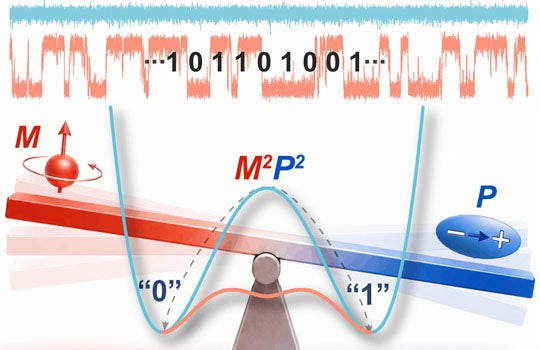
Autferroic materials bypass this issue through a unique “seesaw” interaction between their electrical and magnetic properties.
Rather than coexisting, the electrical and magnetic states actively push against each other. Instead of forcing a direct, high-energy flip from one magnetic state to another, the autferroic switch routes the transition through an intermediate electrical-only step. This alternative path lowers the energy barrier by nearly two-thirds while keeping the magnetic signal at full strength.
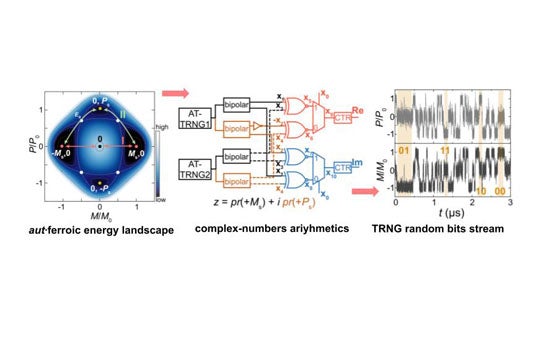
Computer simulations and dynamic modeling performed by the team show that lowering this energy barrier boosts speed from under 100 flips per second to over 400,000 flips per second, ultimately generating over a million random bits every second.
These results passed official National Institute of Standards and Technology benchmark test suites, which serve as the gold standard for measuring randomness.
“Seesaw magnetoelectricity makes low-energy switching easier without weakening the magnetic state, thereby keeping the readout signal strong,” Zhang said. “It provides clear ‘yes’ or ‘no’ signals, not a ‘maybe.’”
The research team also found that applying a constant electric field speeds up the generation process even further. Because this field accelerates the switching without favoring one state over another, the device stays at a perfect 50/50 balance, producing pure randomness with no output bias, hence “seesaw.”
Both electric and magnetic forces can exist in four distinct, equally stable states rather than just standard binary 0s and 1s. This multistate output allows a single tiny component to do the work of several conventional transistors in advanced computing.
By connecting two of these units to simple circuits, the team showed that ordinary microchips can process multistate data and mimic quantum computing by testing multiple outcomes simultaneously. These materials offer a promising secondary benefit for future microchip architecture beyond strengthening digital encryption.
While the findings are currently theoretical based on the computer models of a 2D nanomaterial known as titanium germanium selenide, they offer a practical blueprint for real-world manufacturing applications.
“Four-state autferroic devices can represent more information in a single device,” Zhang explained. “For example, these multistates allow complex numbers, a combination of a real and an imaginary number, to be encoded directly in hardware.”
Structural imperfections in actual devices may slow real-world switching speeds slightly. Still, the study gives engineers a clear theoretical foundation for building the next generation of hardware encryption and low-power computing chips.
The research at Rice was supported by the U.S. Office of Naval Research (N00014-22-1-2753).