
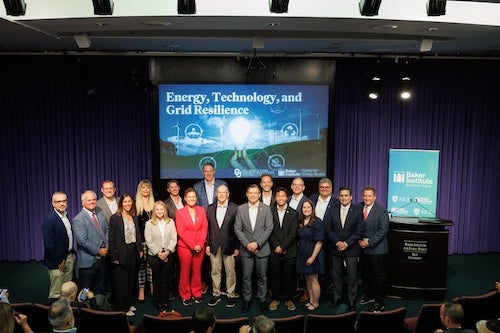
With electricity demand expected to grow because of artificial intelligence, data centers, advanced manufacturing and electrification, energy experts were hosted by Rice University and the University of Oklahoma to examine a central question: How can the nation build an energy system that is reliable, affordable, secure and increasingly sustainable?
The third annual energy conference, hosted by the Center for Energy Studies at Rice’s Baker Institute for Public Policy in partnership with the University of Oklahoma’s Energy Institute, brought together academic, industry and policy perspectives to examine the challenges facing the nation’s energy system and the infrastructure needed to support future economic growth.
Rather than focusing exclusively on an “energy transition” and debating which energy sources should replace others, the discussion is increasingly centered on a more practical question: How do we build and operate an energy system capable of meeting growing demand?
“We have to build generation and transmission,” said John Antonio, dean of the Mewbourne College of Earth and Energy at OU. “We have to build pipelines and other infrastructure. We have to develop new technologies and employ existing technologies efficiently. We have to develop the people who are going to make all this possible.”
Developing that workforce, Antonio said, is a critical responsibility for universities.
“It’s the engineers, it’s the scientists, it’s even the lawyers in the room that make all this possible,” he said. “And I think that’s really the obligation that universities and institutions like Rice and OU have to develop that talent.”
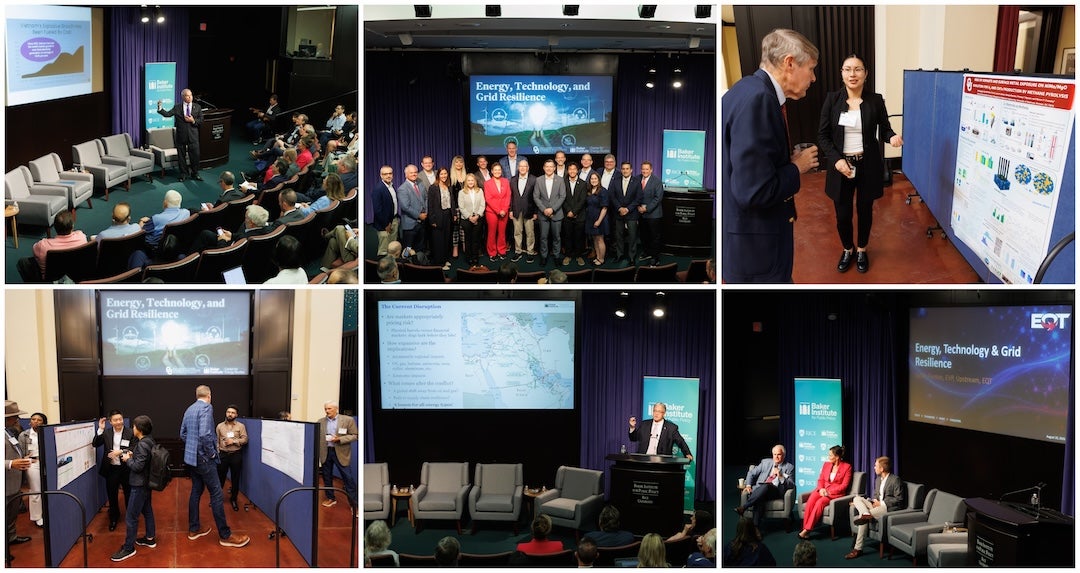
Energy supply chains differ from those of many other commodities, said Ken Medlock, senior director of the Center for Energy Studies. Energy infrastructure is highly capital intensive, meaning that changes to the system require significant investment and often take years to complete.
“Energy is a little different than a lot of other things,” Medlock said. “Whether we’re talking about innovation in the energy space, how markets actually develop, how investment matriculates — largely because of its capital intensity — and that’s something that is often missed in broader conversations around substitution between energy sources and how long it takes to get things to move.”
Medlock emphasized that energy systems cannot be rapidly transformed simply through policy decisions. Because energy infrastructure requires substantial capital and long development timelines, changes to the energy system naturally take time. That makes resilience particularly important.
Disruptions involving the Middle East, the Strait of Hormuz, Russia and Ukraine have tested global energy supply chains. Yet global markets have repeatedly demonstrated an ability to adapt by redirecting supplies, using alternative transportation routes, increasing production and adjusting demand.
Medlock described this flexibility as a form of real option value — the value created by having alternatives available when a disruption occurs. Infrastructure that may appear unnecessary under normal conditions can become extremely valuable during a crisis.
Energy security is also increasingly intertwined with national security, technological leadership, manufacturing and economic competitiveness.
After years of relatively flat U.S. electricity demand, the country is now preparing for potentially significant growth. AI and data centers are among the most visible drivers, but they are joined by advanced manufacturing, industrial reshoring and broader electrification.
When demand is flat, policymakers and engineers can spend considerable time debating how to optimize the existing system. When demand is rising rapidly, the country must simultaneously debate those choices and build new infrastructure, Medlock said.
The connection between energy and technology is becoming particularly important. AI and advanced computing require large amounts of reliable and affordable electricity. At the same time, technological advances can improve the way energy is produced, transported, stored and consumed. The result is a feedback loop: Energy enables technological innovation, while technological innovation enables new energy systems.
Diversification is another important component of energy security. Multiple sources of supply, alternative transportation routes, geographic diversification, inventories, technological options and flexible demand can all make energy systems more resilient.
The growth of U.S. liquified natural gass exports, for example, has increased the flexibility of the global natural gas market. During Europe’s energy crisis following Russia’s invasion of Ukraine, LNG provided an important alternative source of supply.
The same principle applies to oil and other commodities. When disruptions occur, alternative suppliers and transportation routes can help prevent a regional crisis from becoming a global supply shortage.
The Center for Energy Studies also examined the growing energy requirements of data centers and AI.
Medlock presented a newly developed tool designed to help analyze potential data center locations across the United States. The tool incorporates data on existing and proposed data centers, electricity infrastructure, fiber-optic networks, wholesale electricity prices, natural-gas prices, water stress and local public policies.
The analysis demonstrates that data center development depends on much more than access to electricity, Medlock said. Developers must consider transmission capacity, water availability, telecommunications infrastructure, energy prices, local regulations and other elements of the surrounding supply chain.
That same systems-level approach will increasingly be necessary as the country plans for industrial growth, electrification and new technologies.
The conference ultimately challenged the idea that the nation’s energy future can be reduced to simple choices such as natural gas or renewables, reliability or sustainability or existing resources versus emerging technologies.
Different countries and regions will make different decisions based on their natural resources, infrastructure, economies and energy needs. What works in one country may not work in another.
The broader challenge, speakers said, is to bring together energy resources, infrastructure, technology, investment and human talent to build a system capable of supporting economic growth while remaining reliable, affordable, secure and increasingly sustainable.
During the conference, graduate students from Rice and OU presented research posters, showcasing their research into energy issues as the next generation of experts. Learn more about student programming at the Center for Energy Studies.