
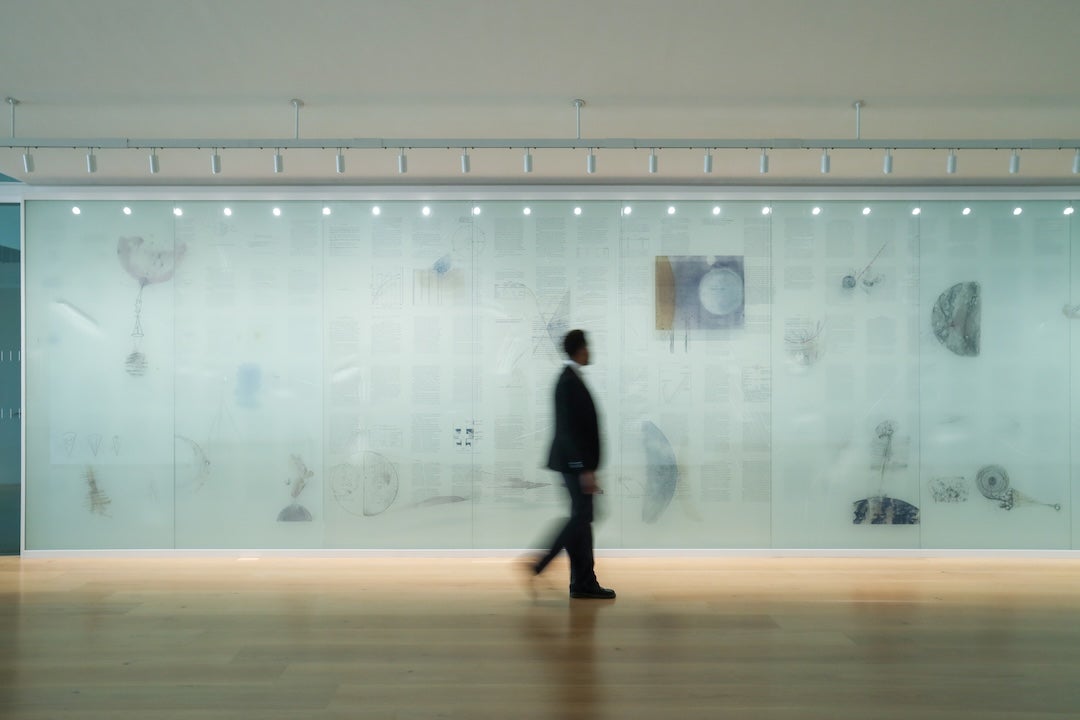
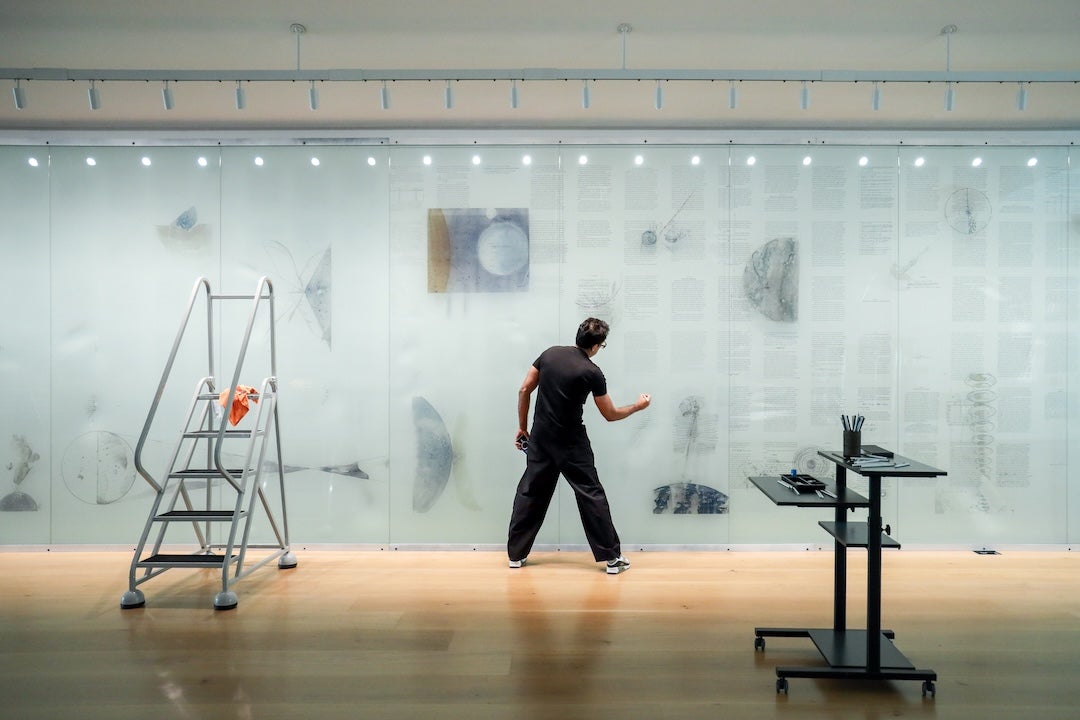
Pages from a once-classified U.S. government document appear and fade from view on glass walls at renowned museum, the Menil Collection, as part of artist Jitish Kallat’s installation, “Wall Drawing/Redux A119.” Researchers from Rice University collaborated on this dynamic display, helping to bring the installation to life.
Their work is central to the museum’s “Wall Drawing Series: Jitish Kallat” exhibit, on view through Aug. 8, 2027, at the Menil Drawing Institute. The collaboration with Kallat and the museum presented Rice researchers a unique challenge: to use materials science to help an artist tell a story about secrecy and disclosure through light and transparency.
“Materials science often focuses on making things lighter, stronger or more efficient, but this project showed us that materials can also help turn an abstract idea into something people can see and experience,” said Pulickel Ajayan, the Benjamin M. and Mary Greenwood Anderson Professor of Engineering.
Making secrecy visible
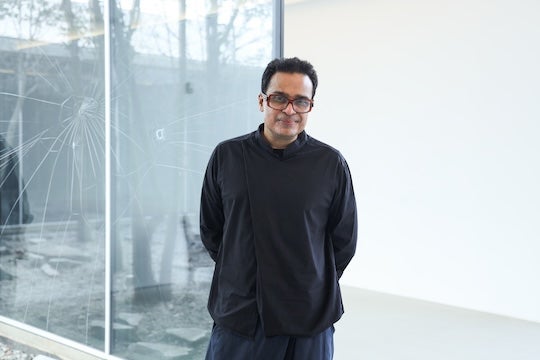
Born in Mumbai where he lives and works, Kallat is a leading figure in contemporary art with a body of work that includes drawing, painting, sculpture, photography and time-based media. His art often intertwines history, science and philosophy.
Reflecting those interests, Kallat’s installation at the Menil is based on Project A119, a Cold War-era U.S. government proposal to detonate a nuclear bomb on the moon. Details of the project were later declassified and released in a 190-page document titled “A Study of Lunar Research Flights — Volume I.” Kallat aimed to inscribe all the pages of the document onto glass walls.
The document’s history of classification and declassification shaped the installation with some text remaining visible while other text is obscured. The changing transparency creates what Kallat describes as “a constant shift between the condition of the wall and that of the window.”
Creating that shift required Rice researchers to control how much light could pass through the glass.
“The challenge was to control the transparency of the material while preserving the artist’s idea,” said Robert Vajtai, research professor at Rice. “Engineering became part of the storytelling.”
Finding a material that worked
Rice became involved in the project in early 2026, when the museum contacted Ajayan after learning about the Ajayan Research Group’s research on thermochromic polymer blends — materials that change their properties in response to temperature.
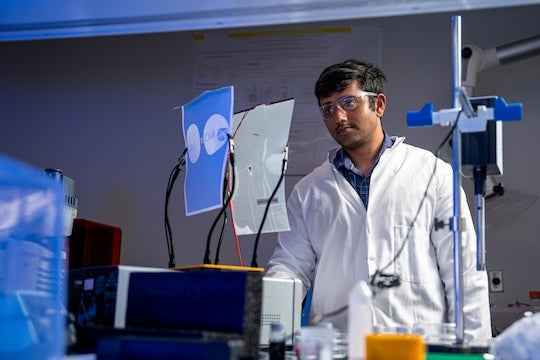
For Kallat’s work, the researchers turned to electrochromic material, which alters its optical properties when electricity is applied, allowing for greater control over visibility.
They then explored a polymer-dispersed liquid crystal material that contains tiny droplets of liquid crystal embedded in a plasticlike medium. The researchers developed a method to control its opacity and the amount of light passing through it.
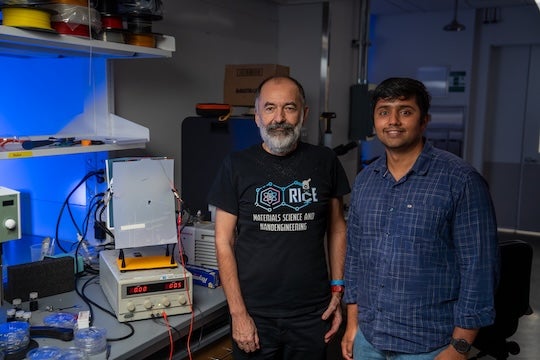
The Rice research team conducted experiments in their on-campus laboratory, where they built a miniature version of the system to test different methods for controlling transparency.
The Menil Collection’s commercial partners used the strategies developed at Rice to fabricate the material at a scale suitable for the installation. The resulting system became a centerpiece of Kallat’s work.
“This project changed how I think about materials science,” said Gautam Chandrasekhar, a doctoral candidate in Rice’s materials science and nanoengineering department who contributed to the project under the guidance of Ajayan and Vajtai. “The goal was not simply to improve a technical measurement. We had to find a way for a material to help communicate an idea.”
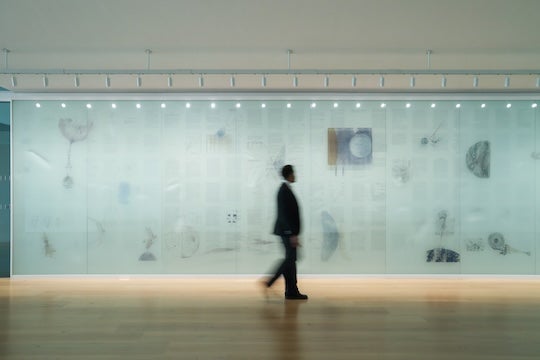
This collaboration integrated Kallat’s artistic vision with the materials science expertise of the Rice researchers.
“I value this collaboration tremendously and look forward to future opportunities,” Kallat said.
The project’s location in Houston also held special significance for Kallat as it linked the installation’s lunar theme with the city and Rice.
“There was something quite resonant about developing a work around Project A119 in Houston, a city so deeply connected with the history of space exploration, and finding collaborators at Rice, where the late President John F. Kennedy made his historic speech about going to the moon,” Kallat said.