
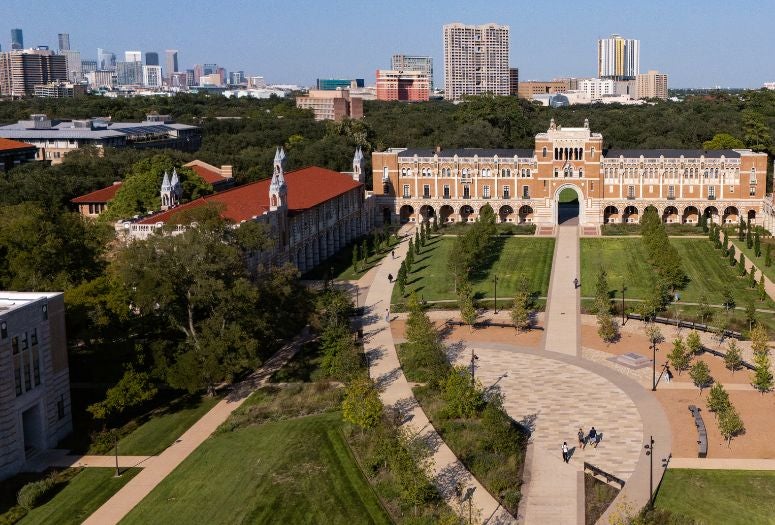

Rice University has launched a transformational universitywide AI initiative to recruit 75 faculty members working across disciplines, invest in a new, state-of-the-art facility that advances research and industry collaboration, and expand AI-related courses and degrees, accelerating the institution’s emergence as a global leader in advanced computing and responsible AI.
Rice has already recruited 35 faculty members in recent years whose work centers on AI across several schools, marking the halfway point in the faculty hiring effort. An additional 40 faculty will bring the total number of AI-focused faculty hired this decade to 75. These new researchers build upon Rice’s historical strengths in AI and computing.
Faculty investment is one element of a much broader commitment to AI at Rice. The university is simultaneously expanding the physical infrastructure supporting AI with The Arc, a new facility in the Ion District innovation hub. The Arc will include the planned AI Foundry, a place which is currently being developed where research scientists, industry leaders and partners, postdoctoral scholars and students can collaborate.
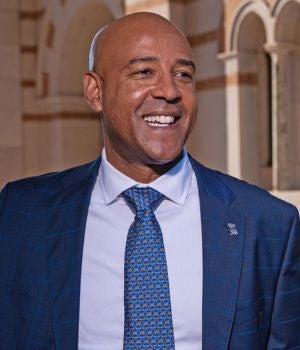
“Artificial intelligence is reshaping virtually every field of research and sector of society. Rice is uniquely positioned to help shape that future,” President Reginald DesRoches said. “We have an opportunity to build a community of scholars who will advance the foundations of AI, apply it to consequential challenges, and help ensure that these technologies are developed and used responsibly.”
AI hiring is part of Rice’s broader strategy to grow its faculty while strengthening areas where the university has the potential to achieve worldwide impact. Since 2021, Rice has hired more than 200 tenure-track faculty as part of an ambitious expansion of its academic and research enterprise. The AI initiative builds on that momentum with a coordinated, interdisciplinary cluster designed to deepen expertise across schools and departments.
Responsible AI is a central priority of Momentous: Personalized Scale for Global Impact , the university’s 10-year strategic plan. The plan calls for strategic faculty growth and specifically identifies cross-disciplinary cluster hiring as a way to build depth and breadth in areas vital to Rice’s future.
For decades, Rice faculty have made foundational advances that helped establish core building blocks of modern machine learning. Rice researchers were early pioneers in robotics, neural network approaches and large-scale scientific computing. As AI has become more powerful and pervasive, Rice has also emerged as a leader in responsible AI and the study of how it shapes society. This combination of foundational innovation, application-driven discovery and ethical leadership places Rice in a distinctive position to help shape the future of AI, university leaders said, and it is coupled with the institution’s location and close industry partnerships in Houston, a global city at the forefront of AI development and deployment in health, energy, sustainability, resilience and education.
New AI faculty members will be recruited through coordinated hiring, with searches led by committees representing multiple schools. The hires have connected, or will connect, AI with disciplines ranging from engineering and computing to the natural sciences, social sciences, business, humanities and arts, and music. The four cluster areas are foundational AI; two applied AI areas including AI for health and AI for energy, the environment and resiliency and responsible AI: society and ethics.
The Ken Kennedy Institute, led by computer scientist Lydia Kavraki, serves as a nexus for foundational and use-inspired research in AI and computing. The institute has rapidly expanded its role as a catalyst for collaborative research, bringing together over 140 faculty members across 21 departments and five schools. Its Research Cluster Initiative supports multidisciplinary teams pursuing ambitious work in areas including generative AI, scientific machine learning, computer vision, trustworthy and responsible AI, human-centered physical AI, AI and computational biology for human health, AI for climate risk and urban resilience, and AI for genetic design. The institute will continue to connect faculty doing foundational and research-inspired AI research across the clusters.
The university’s AI efforts for faculty, staff and students are centralized through the Rice AI Hub, a resource for strategy, policies, training opportunities and teaching support. The hub reflects Rice’s commitment to thoughtful, universitywide collaboration as AI continues to evolve.
New space and collaborations drive Rice’s AI leadership
The Arc at the Ion District is a nearly 200,000-square-foot research and innovation hub scheduled to begin construction in Houston’s Ion District this fall. Rice will be a lead tenant, with nearly 80,000 square feet of office and laboratory space dedicated to research and collaboration in areas including artificial intelligence, data science, robotics, computational engineering and energy. The Arc is designed to connect Rice’s research enterprise with Houston’s rapidly growing innovation ecosystem and accelerate the translation of discoveries into real-world applications.
Rice is also advancing planning for the AI Foundry, a new component of the university’s expanding AI ecosystem that will be housed at The Arc and create faculty and industry partnerships to connect research, experimentation, education and innovation around emerging AI technologies.
Playing a key role in guiding these efforts will be Chris Jermaine, chair of the Rice AI Advisory Committee, the Victor E. Cameron Professor of Computer Science, chair of the Department of Computer Science and special adviser to the provost on AI.
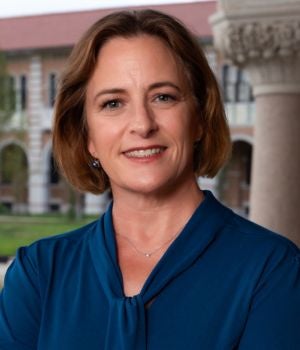
“Hiring exceptional faculty is essential, but it is only one part of the equation,” said Amy Dittmar, the Howard R. Hughes Provost and executive vice president for academic affairs. “We are building the people, places and partnerships needed to advance AI from foundational discovery to societal impact.”
Rice’s AI strategy notably emphasizes responsibility. The university’s researchers are addressing questions of trust, privacy, fairness, security and the societal implications of AI alongside advances in algorithms, computing and applications. Rice is a member of the U.S. AI Safety Institute Consortium, with the Ken Kennedy Institute helping lead the university’s engagement in efforts to advance safe and trustworthy AI.
In addition, the new Rice Program on Technology and Responsibility, a collaboration between the George R. Brown School of Engineering and Computing and the School of Humanities and Arts, aims to prepare students and faculty to develop, govern and shape technology. The program also includes undergraduate research, community engagement and workforce development.
Interconnected cluster approach drives teaching and research
To guide hiring, schools and departments have identified the four cluster areas that Rice is well positioned to lead nationally and internationally.
Foundational AI, which is led by Rice Engineering and Computing and the Wiess School of Natural Sciences, encompasses the technical research that enables all AI applications. These faculty address AI theory and methods, optimization algorithms, computer systems for AI, scientific machine learning, and the mathematical foundations that underpin intelligent systems.
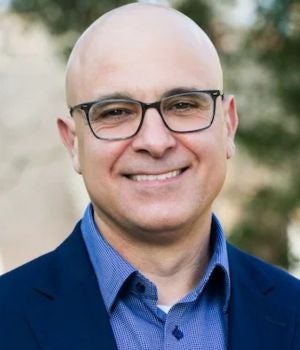
“Our vision is to push the boundaries of foundational AI while applying these tools to address critical global challenges in health, sustainability and resilience,” said Luay Nakhleh, the William and Stephanie Sick Dean of Engineering and Computing. “By embedding ethical principles directly into our research and teaching, we are preparing the next generation of leaders to ensure AI technology remains safe, transparent and beneficial for society.”
In fall 2027, the school will launch a Master of Artificial Intelligence program for recent computer science graduates and working professionals with technical backgrounds. It has offered aBachelor of Science in AIsince fall 2025.
Applied AI encompasses research that deploys AI to advance discovery, improve human welfare and address societal challenges. It is deliberately broad, reflecting the pervasive applicability of AI methods across all of the clusters. There are two applied clusters – AI for health and AI for energy, the environment and resiliency – that bring together Rice Engineering and Computing, the Wiess School, the School of Social Sciences and will engage other schools including the Jones Graduate School of Business and Virani Undergraduate School of Business (Rice Business) and the School of Humanities and Arts.
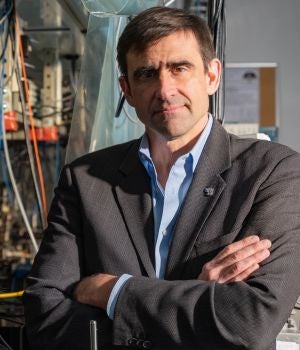
“Integrating artificial intelligence across our scientific disciplines allows us to accelerate discovery in ways that were previously unimaginable,” said Tom Killian, dean of the Wiess School. “Whether we are modeling complex molecules to discover new cancer therapies or analyzing massive datasets to find habitable planets beyond our solar system, these advanced tools empower our researchers and students to tackle some of the most critical foundational and applied challenges in science today.”
The impact of AI health-related research is growing rapidly, with major implications for how healthcare is delivered, monitored and personalized across the lifespan as well as for biological discovery, university leaders said. AI is both the enabling engine and a focus of fundamental innovation, leading to a level of precision in biological design that will shape the future of medicine and sustainable technologies, they said. Applications include drug discovery, pharmacology and amyloid diseases such as Alzheimer’s and Parkinson’s. This cluster will notably examine how humans interact with AI tools in the healthcare setting, including understanding tangible adverse outcomes. Examples include how to most effectively design AI tools used in healthcare, how to design the new digital healthcare environments to enhance patient outcomes, and how teams of humans and artificial agents work best in collaboration to enhance patient outcomes and safety.
AI for energy, the environment and resiliency will advance what humans make, transform how and where they live and design for resilience. It will affect sustainable energy solutions, materials and manufacturing processes; influence healthy, adaptive and data-driven environments on Earth and beyond; and aid the development of technologies and infrastructure for environmental, societal and space-related challenges such as geohazards and extreme weather. In addition to these Earth-related areas, this cluster will also address how the foundational sciences are being transformed by experiments and observatories that generate data at unprecedented scale and speed, university leaders said. From cosmological surveys pursuing dark matter and exoplanet searches for signs of life to particle accelerators probing the physics of the Big Bang, discovery now depends on extracting physical insight from enormous and high-dimensional data sets. Artificial intelligence and machine learning are essential tools for dealing with this complexity, and they are central to fundamental scientific research, leaders said.

Responsible AI: society and ethics addresses the essential challenge of ensuring AI systems are trustworthy, fair, interpretable, safe, resource efficient and aligned with human values. This is a foundational requirement that must be integrated into AI research from the beginning rather than a secondary concern to be addressed after technical innovation, university leaders said. Rice will demonstrate that technical excellence and ethical responsibility strengthen rather than constrain one another, they said. This cluster includes the Shepherd School of Music, School of Social Sciences, School of Humanities and Arts as well as Engineering and Computing and will address the cultural and social influences of AI; the impact of AI on the artistic, ethical and societal implications for the creative, digital and performing arts; and a study of the critical histories and influence of AI.
“Understanding the human and societal dimensions of artificial intelligence is just as critical as developing the technology itself,” said Rachel Kimbro, dean of the School of Social Sciences. “Our faculty and students are leading essential research on how AI shapes workforce dynamics, healthcare delivery and public policy to ensure these powerful systems serve the public good.”
Rice’s intentional growth
“The initiative represents another step in Rice’s larger transformation into a university with greater scale and reach while preserving the collaborative culture that has long defined the institution,” DesRoches said.
“As Rice grows, we are being intentional about where we invest and how we build,” he said. “AI is one of the defining technologies of our time. By bringing together exceptional faculty, a strong interdisciplinary research community, world-class facilities and Houston’s extraordinary innovation ecosystem, Rice has an opportunity not simply to participate in the AI revolution but to help define its future.”