
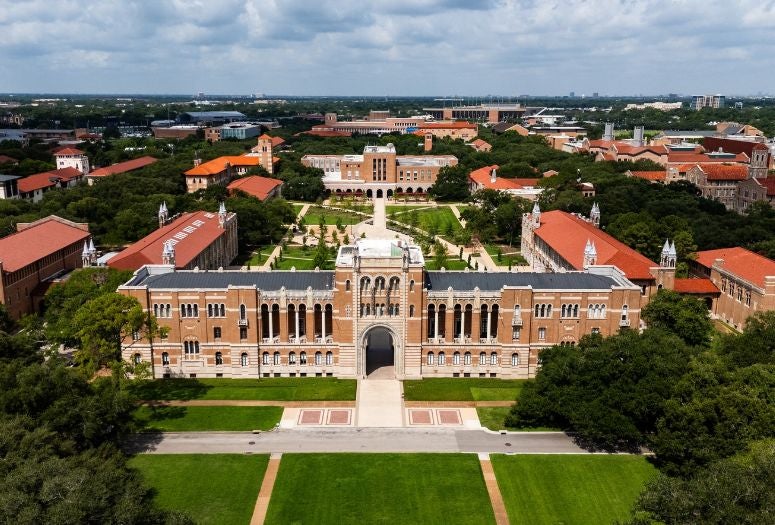
Rice University has joined a new alliance as a founding academic partner to advance plans for a Gulf Coast National Laboratory dedicated to accelerating the commercialization and deployment of energy and industrial technologies at scale.
The Gulf Coast National Lab Alliance (GCNLA) brings together industry leaders, academic institutions, investors, workforce organizations and regional stakeholders to secure resources and partnerships necessary to move proven technologies from research and development into real-world industrial applications. The GCNLA builds on five years of work led by the Greater Houston Partnership and the Houston Energy Transition Initiative (HETI) to position Houston as the global leader in developing and deploying energy systems and solutions for the future.
One of the most significant challenges facing American innovation is the “Valley of Scale,” where promising technologies struggle to reach commercial deployment because industrial-scale testing is costly, complex and risky. The proposed Department of Energy national laboratory would help bridge that gap by providing shared pilot facilities, integrated process-scale testing at scale, and public-private partnerships. These resources would help reduce barriers to commercialization and strengthening U.S. energy security and industrial competitiveness.
“Universities are essential to turning breakthrough research into solutions that drive economic growth and benefit society,” said Rice President Reginald DesRoches. “By connecting world-class research with the industrial capabilities needed to bring new technologies to scale, this initiative can strengthen the Gulf Coast’s innovation ecosystem and advance American leadership in energy, manufacturing and advanced technology.”
The Texas-Louisiana Gulf Coast is home to one of the nation’s largest concentrations of energy and industrial infrastructure. Together, the Gulf Coast accounts for nearly half of U.S. refining capacity, while Texas produces approximately 43% of the nation’s crude oil. The region's extensive network of refineries, petrochemical facilities, pipelines, ports and engineering expertise provides an opportunity to test and integrate emerging technologies under real-world industrial conditions.
"The United States has extraordinary research capabilities, but too many promising technologies struggle to cross the gap between proof-of-concept and commercial success," said Jane Stricker, executive director of the GCNLA. "Our mission is to bring together the organizations and leaders needed to create a scale-up platform that enables technologies to move from innovation to industry faster, more cost-effectively, and at a scale that strengthens U.S. energy security, industrial productivity and supply-chain resilience."
The proposed laboratory would complement existing U.S. Department of Energy national laboratories by serving as the nation's premier scale-up and deployment platform for energy and industrial technologies. Key areas of focus include subsurface technologies, produced water management, industrial process engineering and scale-up, and strengthening domestic supply-chain resilience.
"The Houston region has long been where energy innovation meets industrial execution," said Steve Kean, president and CEO of the Greater Houston Partnership. "By bringing together industry, academia and government partners, we can reinforce the Gulf Coast's position as the nation's leading energy and industrial hub while advancing U.S. competitiveness and energy security."
The Alliance is currently inviting energy and industrial companies of all sizes, academic institutions, investors, workforce organizations and regional partners to join. Members will participate in working groups, roundtable sessions and workshops designed to further refine the resources and capabilities needed to advance the mission and priorities of the proposed Gulf Coast National Laboratory.
"A strong and adaptable workforce is essential to America's ability to compete in the industries of the future," said Renu Khator, president of the University of Houston. "By bringing together industry, educational institutions and research organizations through the Gulf Coast National Lab Alliance, we can create new pathways for students, researchers and skilled professionals to participate in the commercialization and deployment of next-generation technologies, ensuring long-term economic growth and maintaining U.S. leadership in energy and advanced manufacturing."