

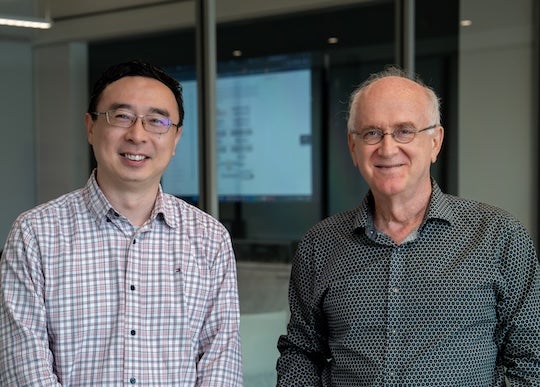
Rice University materials scientists Boris Yakobson and Ming Tang are part of a multi-university team selected for a Multidisciplinary University Research Initiative (MURI) award of up to $7.5 million from the Office of Naval Research.
The five-year project will study how energy travels and changes form inside solid materials during the earliest stages of a reaction. These events unfold over extremely small distances and in fractions of a second, making them difficult to measure and model.
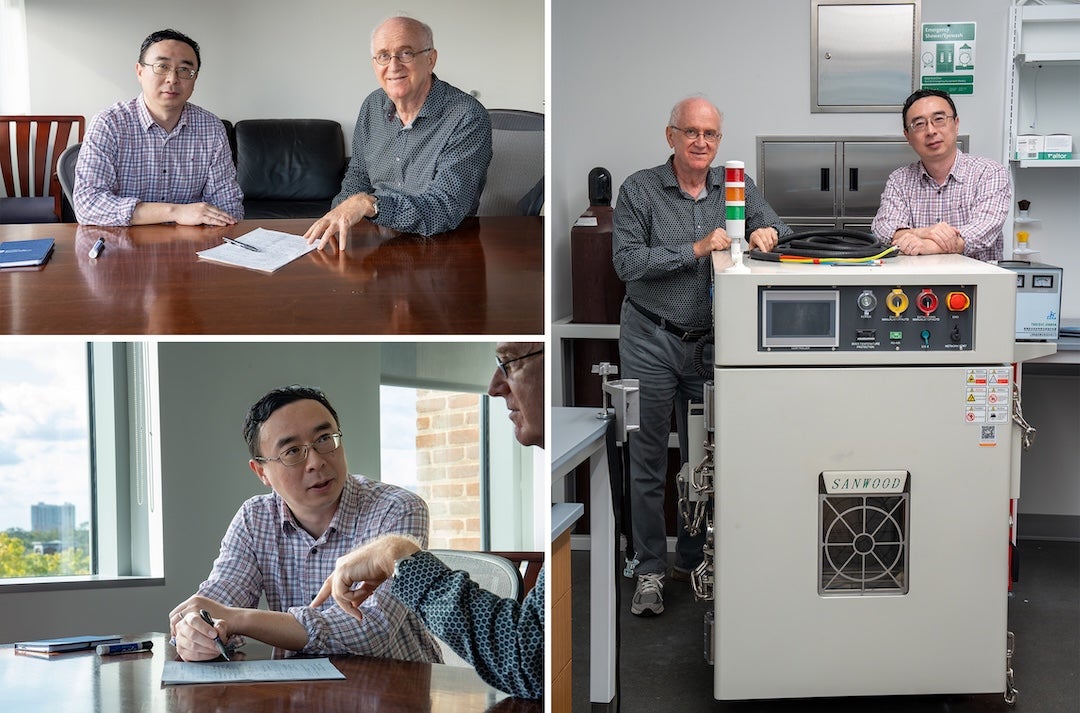
Yakobson, Rice’s Karl F. Hasselmann Professor of Engineering and a professor of materials science and nanoengineering and chemistry, will develop computational and theoretical frameworks to describe how vibrational and electronic excitations transfer energy between molecules.
“We want to understand the fundamental mechanisms of energy transport in condensed matter at extreme conditions,” he said. “The rate of energy release is defined by microscopic, molecular-level mechanisms ⎯ how energy from one molecule is transported to the next. That sequence creates the heat or compression wave that drives a reaction, and understanding that chain of events is a key goal of this project.”
Tang, an associate professor of materials science and nanoengineering, will use X-ray measurements to connect energy transfer at atomistic scale with the behavior of real materials under shock conditions. His group develops tools that help explain how microstructures form and evolve and how those changes influence performance.
The project, titled “Understanding multiscale nonequilibrium energy transfers in the initiation of energetic materials,” is led by University of Iowa and includes a total of 6 co-principal investigators from Stanford University, the University of California, Berkeley and Pennsylvania State University.
MURI awards support research problems that span multiple scientific fields and require coordinated work across institutions.