

Rice Innovation passed a $1 million milestone in funding campus discoveries as it awarded its latest One Small Step Grants to three promising spinoffs: Bionostic, Stealth Newco and Omnos.
The One Small Step Grant program gives university scientists the financial boost needed to move breakthrough health and technology inventions out of the lab and into the everyday marketplace.
Emerging from the research laboratories of Rice University professors Michael King, Omid Veiseh and Chong Xie, this round marks the fifth group of startups backed by the initiative since its September 2023 launch.
“One Small Step has supported the launch of 7 companies across the past four cycles,” said Nafisa Istami, Senior Innovation Manager who leads the program, “this cycle’s applicants are a demonstration of the strength of entrepreneurial potential across campus which we’re excited to support and see grow!”
After a competitive evaluation process, the three outstanding ventures were selected to receive $75,000 each from a pool of 19 applicants from across campus.
Leading the awardees is Bionostic, cofounded by CEO Alexandria Carter and chief technology officer Jace Willis.
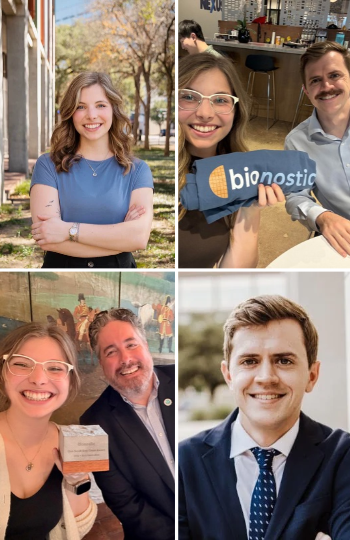
The startup builds on biomedical research developed in the laboratory of King, the E.D. Butcher Professor of Bioengineering and Cancer Prevention and Research Institute of Texas Scholar. Currently, the team’s research uses ATLAS, a superhydrophobic microwell platform, to grow 3D tumor models with the goal of providing researchers and drug developers with a more predictive way to test how a specific cancer responds to treatment.
“It might seem a bit dramatic to use the term ‘Valley of Death’ to describe the gap in the technology pipeline from laboratory research to commercial product. It does capture how academic discoveries can stall before reaching the clinic due to lack of support and resources,” King said. “All of my lab bioengineering members are motivated by a deep desire to see their research make a difference in people’s lives, and programs like One Small Step are exactly how we will get there.”
Carter, a fifth-year bioengineering doctoral student in King’s lab, is also an Innovation Fellow at Rice’s Liu Idea Lab for Innovation and Entrepreneurship, an initiative that equips top doctoral and postdoctoral researchers to translate campus research into real-world solutions.
“Support from Rice Innovation’s One Small Step Grant comes at a key point as we move the technology from published academic work toward a validated product,” Carter said. “With this award, we are so excited to have the ability to generate the data needed to expand ATLAS beyond prostate cancer and toward partnerships with clinical collaborators here in Houston.”
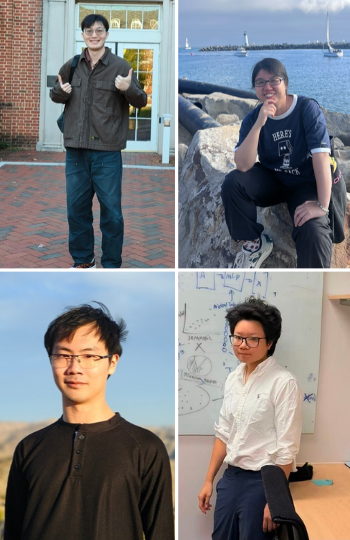
The second grant awardee is Omnos, a spinoff working to restore sight for people living with profound blindness. Emerging from the laboratory of Xie, professor of electrical and computer engineering and bioengineering, Omnos is building Loomiq, a high-density neural electrode platform designed without complex thin-film microfabrication.
The technology aims to restore functional sight to individuals with profound blindness by delivering high-resolution electrical signals to the visual system. The interdisciplinary venture is led by Rice researchers Xavier (Xiang) Fan, Yuxuan Liu and Yusui Li, along with Xinyuan Yan of Baylor College of Medicine.
“Receiving the One Small Step Grant is especially meaningful because it has shown us firsthand how committed Rice is to building a community supportive of entrepreneurship and innovation,” said Yan, a doctoral student whose research sits at the intersection of neural engineering and advanced fabrication with the long-term goal of scalable therapies for neurological disorders. “This support helps us refine Loomiq’s manufacturing process, strengthen device testing and move beyond the laboratory to potentially benefit millions of people by helping restore functions such as vision and speech.”
Rounding out the grant cohort is Stealth Newco, a company advancing targeted biologic skin care using programmed producer cells and the first consumer company to receive the One Small Step grant. The venture is led by fourth-year bioengineering doctoral student Elizabeth Kelley and originates from the laboratory of Omid Veiseh, professor of bioengineering and chemical and biomolecular engineering, director of the university’s Biotech Launch Pad and Cancer Prevention and Research Institute of Texas Scholar.
“We’re appreciative of this One Small Step funding,” Veiseh said. “It allows us to develop what we believe could be a clinically transformative skin care solution for skin aging.”
Stealth Newco’s platform harnesses living cells to synthesize and release precise therapeutic compounds for complex skin conditions.
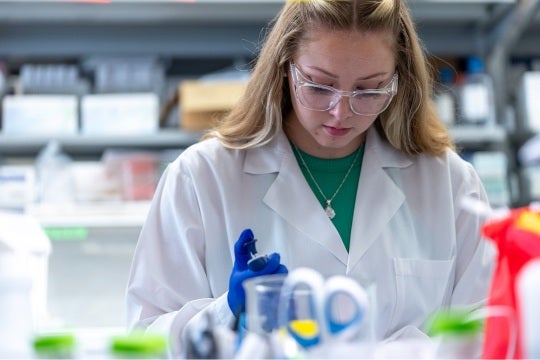
“We are honored to receive the One Small Step award that will help us bridge the critical gap between our promising lab-based academic research and real-world commercial development,” Kelley said. “Stealth Newco leverages the regenerative power of engineered human cells to create biologically identical formulations, aiming to translate advanced bioengineering techniques into an accessible, consumer-ready platform. By targeting skin concerns at the cellular level, whether that is scarring, hyperpigmentation or skin aging, we are building something truly unique that sets a new standard for science-backed, transformative skin solutions in the consumer market.”
Recipients were evaluated and selected by an independent, diverse committee of industry experts, entrepreneurs and investors. For more information about the One Small Step Grant and Rice Innovation, please visit innovation.rice.edu.