
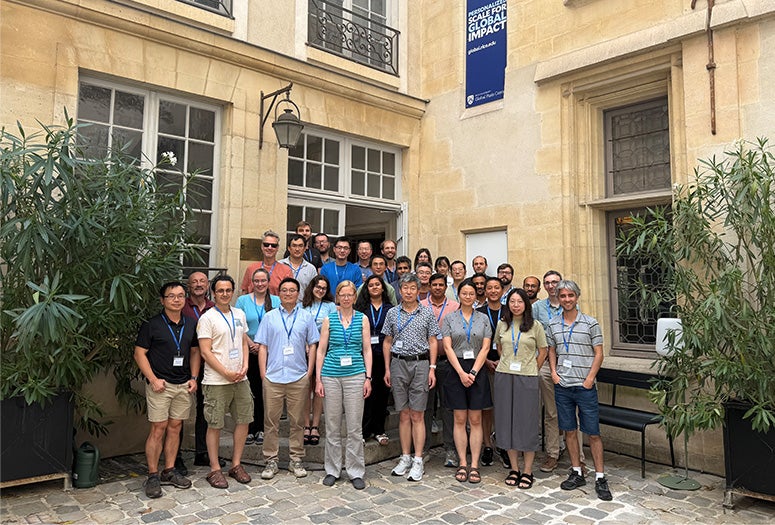
When protons collide at nearly the speed of light, the particles streaming out can move in coordinated patterns that physicists once expected to see only in far larger collisions of heavy nuclei. That puzzle was the focus of the 5th International Workshop on Emergent QCD Collectivity Across Scales: From Small System Collisions to Jets held June 29 through July 2 at the Rice Global Paris Center.
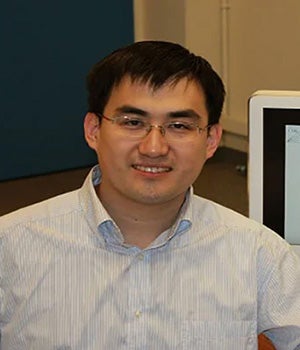
Wei Li, a professor of physics and astronomy at Rice, organized the workshop with Prabhat Ranjan Pujahari, an associate professor of physics at the Indian Institute of Technology Madras, and Matthew Nguyen, a staff research scientist at École Polytechnique. Xiaoyu Liu, a postdoctoral associate in physics at Rice, also served on the organizing team.
The workshop series began in Copenhagen in 2017 and has since met in Wuhan, China; Houston, where Rice hosted the 2019 edition; and Qingdao, China. Its field is quantum chromodynamics (QCD), the theory of the strong force that binds quarks and gluons into protons, neutrons and other particles. In recent years, collider experiments have detected signs of collective behavior across a surprisingly wide range of events from proton-proton and light-ion collisions to events containing jets, the narrow sprays of particles that form when quarks or gluons scatter at high energy. Those results have blurred boundaries that once organized the field, which led this year’s organizers to expand the program from small collision systems to jets and other probes that span multiple scales.
“Rice Global’s support let us bring about 35 physicists from a dozen countries together at the Paris Center for four days of real debate on one of the open questions in our field,” Li said.
To keep that exchange lively, organizers limited attendance to invited participants and built sessions around provocative talks and open discussion in place of comprehensive result reporting. Their stated goal was clarity: identifying which observations hold up, which questions remain unresolved and which bold ideas deserve testing in future experiments and theory. Sessions covered hydrodynamic and kinetic models alongside newer approaches that use quantum correlations and entanglement to describe how many particles behave together. Participants came from institutions including CERN, the Massachusetts Institute of Technology, Lund University, Utrecht University, Sophia University and Shandong University.
“The workshop was co-organized by Rice, IIT Madras and École Polytechnique, and it has become the foundation for a lasting three-way collaboration,” Li said. “We are already planning a follow-up workshop and developing student exchanges and the Paris Center is the natural hub for that partnership.”
According to Li, conversations have also begun about opportunities for Rice students through an international internship program at École Polytechnique, which currently hosts a student from IIT Madras. Aryaa Dattamunsi, a doctoral student of Pujahari's who attended the workshop in Paris, is conducting research at Rice this fall.
The travel runs in both directions over the coming months. Pujahari will visit Rice in October and Li will be at IIT Madras in November, extending a partnership that Rice Global India continues to build between Rice and Indian institutions. Learn more about both on Rice Global’s homepage.