

By Kelly Peters,
Special to Rice News
As artificial intelligence rapidly advances, researchers and health care professionals are exploring new ways to apply AI tools and technology to the most complex challenges in health and medicine. A central question that emerges is whether those innovative tools are built and integrated in ways that are ethical, interpretable, and trustworthy.
Answering that question requires an interdisciplinary lens that considers broader impact beyond the technology itself. Patient perspectives can help reflect critical needs and experiences when involved in co-designing future technology, and researchers, clinicians and policymakers can work together to establish guardrails for responsible AI development.
These themes and considerations were central to the Ken Kennedy Institute’s fifth annual AI in Health Conference at Rice University. The forum convened over 400 visitors with the goal of bridging health and life sciences expertise across disciplines and institutions at a local, national, and global level—welcoming guests from 19 states and 12 countries to Rice University’s campus and BioScience Research Collaborative.
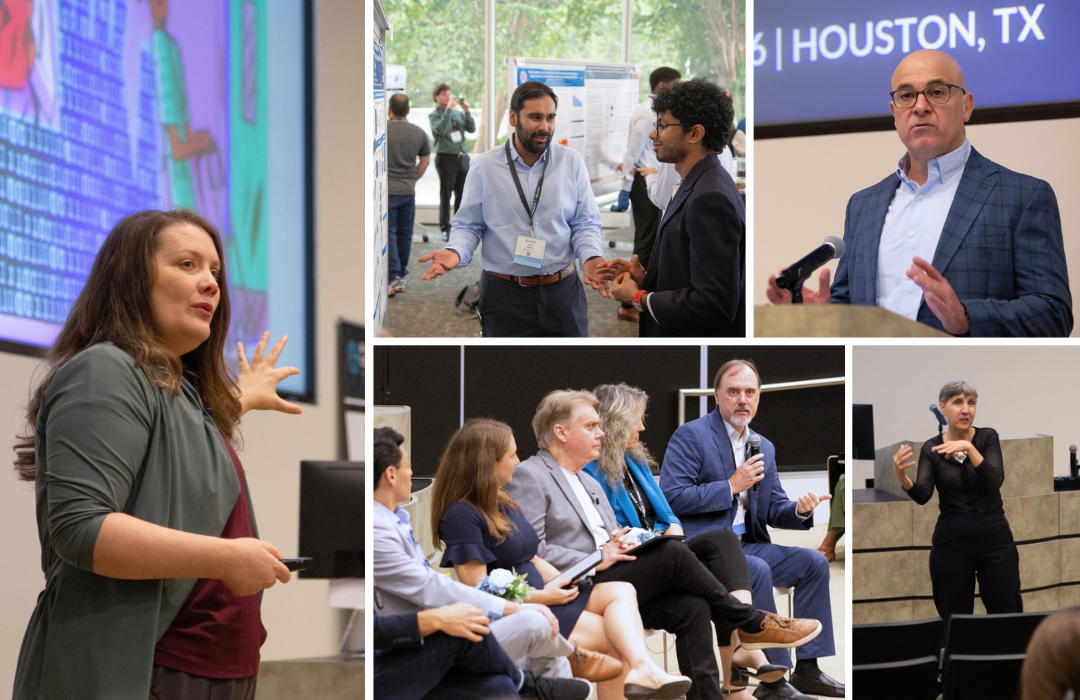
“The goal of this gathering is to discuss not only what AI and technology can do, but how we can apply those capabilities thoughtfully and responsibly to improve patient care, advance medical innovation, and benefit public health,” said Lydia Kavraki, director of the Ken Kennedy Institute. “The AI in Health Conference brings experts together and helps identify opportunities for collaboration across health and medicine.”
The three-day event emphasized the importance of human judgment and challenging assumptions, setting the tone that AI-accelerated health research and medical innovation demands a human-centered approach and an understanding of societal impact from conception to implementation.
“We all have a role in the future of AI in Health as creators and users of technology who can help decide how it is used, where it is applied, and who it serves,” said Luay Nakhleh, William and Stephanie Sick Dean of the George R. Brown School of Engineering and Computing, who delivered opening remarks for the fifth annual conference. “We’re presented with both a technological challenge and a human one.”
The conference raised discussions on responsible AI and ethics to the forefront of this year’s program, with a central track on the ethical, legal and social impact of AI for health and medicine. Keynote speakers included University of Copenhagen’s Timo Minssen on international regulation for medical AI, the Light Collective’s Andrea Downing on evidence-based patient advocacy and safety frameworks, the Hastings Center’s Nancy Berlinger on the mindset of designing AI for human flourishing, and Rice University’s Kirsten Ostherr on humanistic principles for health AI.
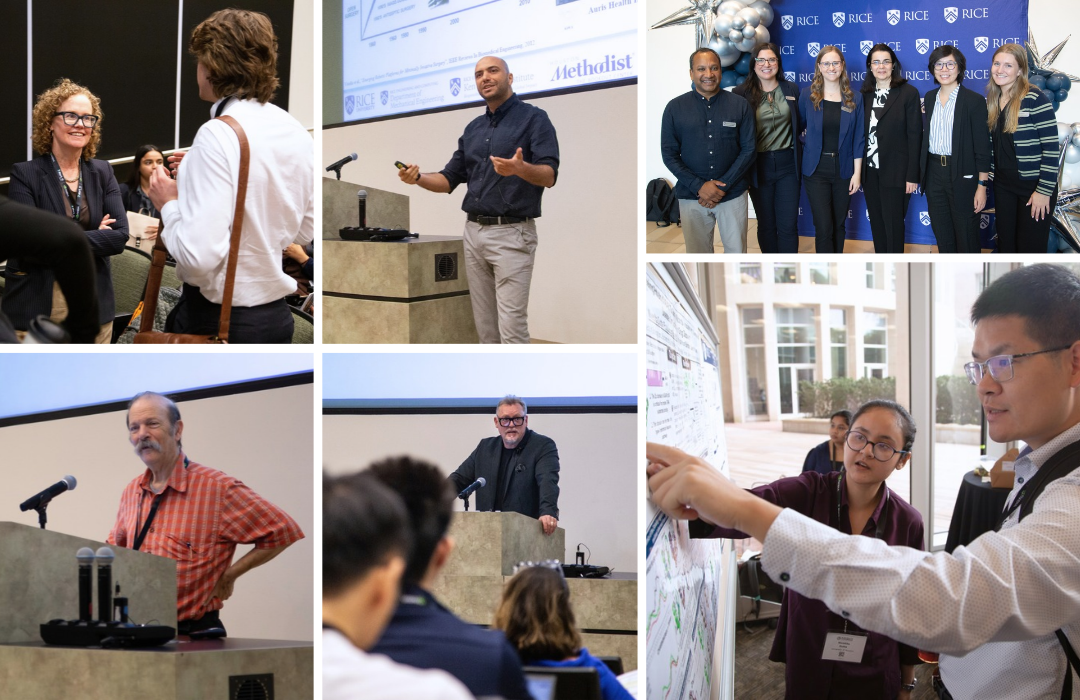
These sessions blended a focus on technology and humanity, organized through support from the National Endowment for Humanities and partners across Rice University, including the Baker Institute’s Science and Technology Policy Program, the Medical Humanities Research Institute, the Technology, Culture, and Society Initiative, and Rice’s Creative Ventures Funds.
“When applied to highly critical and human spaces like healthcare, AI presents multifaceted challenges that require interdisciplinary perspectives,” said Ostherr, founding director of the Medical Humanities Research Institute and Gladys Louise Fox Professor of English and Creative Writing at Rice.
The conference also explored industry trends and applications in medical robotics, AI for disease genomics and interpretable AI in health through tracks featuring researchers from leading universities and companies, including Johns Hopkins University, Microsoft Research and NVIDIA.
Rice engineering and computing faculty Farshid Alambeigi and Todd Treangen also joined the speaker lineup, with Alambeigi highlighting advancements in surgical robotics and Treangen discussing approaches to preparing health data and AI research for external collaboration—underscoring how academic, industry and clinical partners can work together for research translation.
Rice computer scientist Vicky Yao played an integral role in program development alongside the Ken Kennedy Institute as conference co-organizer and planning committee chair. With a robust committee, Yao and the Ken Kennedy Institute selected 19 technical talks to demonstrate emerging research on foundational models, multimodality, clinical analytics, and responsible system design. The committee also selected over 60 students and early-stage researchers to showcase their work during the annual poster session at the AI in Health Conference.
In addition to the invited speaker sessions, technical talks and student posters, the Ken Kennedy Institute collaborated with partners in industry and the Texas Medical Center to host supplemental workshops, including a program on computational biology and microbiome research with Rice University faculty Todd Treangen and Lauren Stadler.
“What the Ken Kennedy Institute has done with this conference is provide a space for researchers to meet clinicians; for engineers to meet social science scholars and humanists; for entrepreneurs to meet health system leaders; and for students to meet people who can shape their careers to influence the future of AI in Health for years to come,” said Nakhleh.
Recorded sessions from the 2026 AI in Health Conference are available online at the Ken Kennedy Institute YouTube channel.