
A number of Rice University researchers presented at the recent CERAWeek conference, focusing on alternative energy sources that pointed toward a world less dependent on oil and gas and more conscious of its carbon consumption and impacts.
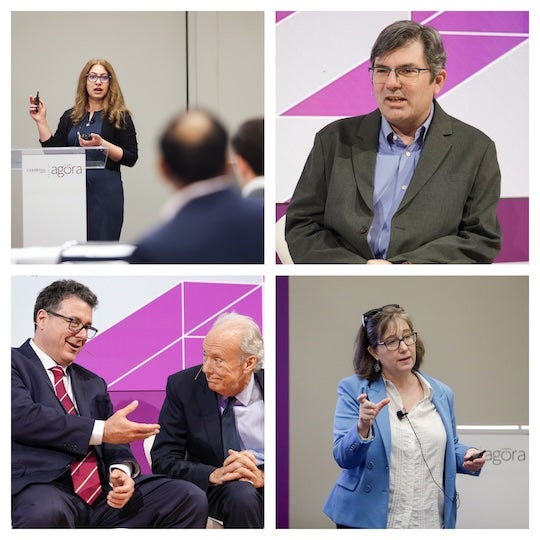
Sahar Bakhshian, an assistant professor in Earth, environmental and planetary sciences, gave a comprehensive overview of geological carbon storage, in which captured carbon dioxide gas from industrial projects is stored in rocks rather than released into the atmosphere. “Rock as a porous media are a great candidate for long-term CO2 storage,” Bakhsian said. In her session, she explained the different options for rock storage as well as the requirements and risk mitigation required for a successful program.
Rachel Meidl, fellow in energy and sustainability at Rice’s Baker Institute for Public Policy, was on a panel exploring advanced plastics in a circular economy, which looked at the role advanced recycling methods play in the carbon cycle. Meidl highlighted the importance of understanding the entire carbon life cycle when making environmentally conscious decisions. “Sustainability looks different everywhere,” Meidl said. “We must integrate the entire carbon cycle into our decision-making.”
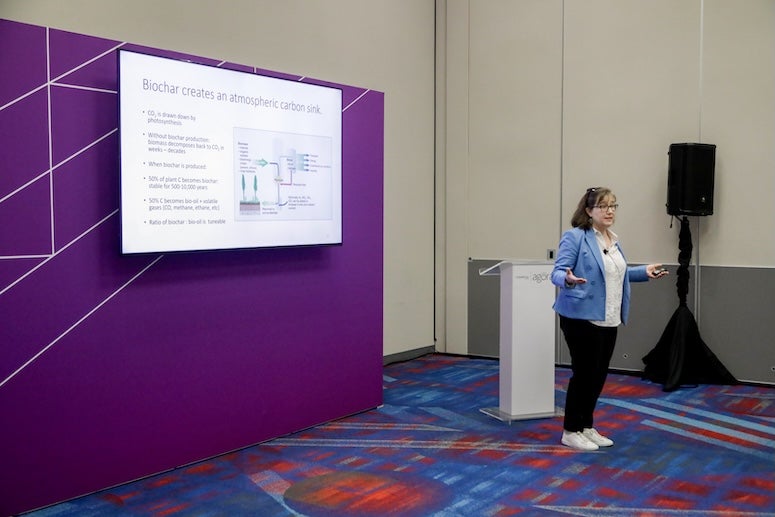
Carrie Masiello, director of the Sustainability Institute, gave an overview of biochar, which is created when organic matter is heated in the absence of oxygen. This popular carbon offset technique is scalable, durable and easy to quantify. The resulting biochar can, in some cases, be added to soil to improve soil quality or change rate of soil formation. “This method is socially well accepted and can reduce the release of CO2 into the atmosphere for between 100-1000 years,” Masiello said.
Jonathan Ajo-Franklin, the Trustee Professor of Earth, Environmental and Planetary Sciences, presented on a panel about the current state of geothermal energy and technology. The panelists discussed the heat challenges presented by geothermal sites, the possibility and challenges of adapting current heat-resistant technology to geothermal work and the recent advances and opportunities within the feel. “There’s a role for geothermal in a low carbon future,” Ajo-Franklin said.
Finally, Matteo Pasquali, director of the Carbon Hub, spoke on a panel for advanced materials with low-carbon intensity. The topics included graphene, which presents a “paradigm of bespoke functionality versus the industrial approach,” Pasquali said. “It will require us going back to the mindset of development and polymer development.”