
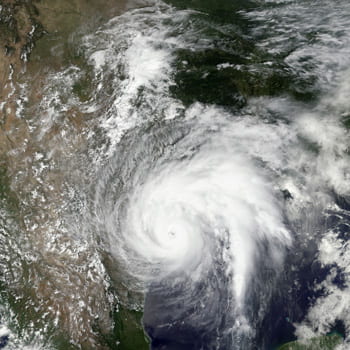
As the 2026 Atlantic hurricane season approaches, the National Oceanic and Atmospheric Administration is forecasting a below-normal Atlantic season while warning that even quieter years can still bring destructive hurricanes, dangerous flooding and costly storm impacts for coastal communities. NOAA predicts eight to 14 named storms, including three to six hurricanes and one to three major hurricanes of Category 3 strength or higher during the season, which runs from June 1 through Nov. 30.
Experts at Rice University are available to discuss hurricane forecasting, flood mitigation, infrastructure resilience, disaster recovery, climate adaptation and the social and political impacts of major storms.
Flooding and hurricane risk
Philip Bedient
Herman and George R. Brown Professor of Engineering and director of Rice’s Severe Storm Prediction, Education and Evacuation from Disasters (SSPEED) Center
Bedient is a nationally recognized expert in hydrology and disaster management. He has developed radar-based flood alert systems, led multi-institutional collaborations through the SSPEED Center and played a key role in evaluating and responding to major U.S. floods and storms, including Hurricane Harvey.
Together with Rice's Jim Blackburn, the SSPEED Center developed the Galveston Bay Park Plan, an in-bay barrier and park system designed to provide enhanced storm surge protection and navigation and environmental benefits for the highly vulnerable west side of Galveston Bay.
Jim Blackburn
Professor in the practice of environmental law, co-director of the SSPEED Center and faculty scholar at Rice’s Baker Institute for Public Policy
Blackburn focuses on the rapid intensification of hurricanes. He can explain how global warming is increasing storm and flood risks and can discuss sustainable hurricane protection strategies involving dikes, levees, gates, nature-based solutions and carbon credits. He can also address equity in flood protection across the Houston region.
Avantika Gori
Assistant professor of civil and environmental engineering
Gori is an expert on hurricane climatology and coastal hazards. She leads several NASA- and National Science Foundation-funded projects that aim to better understand how climate change and urban development are exacerbating hurricane and flood risks in coastal cities. Her research integrates physics-based models, big datasets and statistical/AI methods to improve risk quantification.
James Doss-Gollin
Assistant professor of civil and environmental engineering
Doss-Gollin is an expert on extreme rainfall, urban flooding, the resilience of infrastructure to natural hazards and flood-risk management. His research explores probabilistic hazard modeling and its applications, including rainfall frequency estimation, physics-informed machine learning for flood simulation and power grid resilience to climate extremes.
He combines physical modeling with statistical and machine learning methods to better characterize risk under changing environmental conditions. He is a member of the SSPEED Center and leads the Advancing AI for Climate Risk and Resilience cluster at Rice.
Policy, community resilience and disaster recovery
Ed Emmett
Fellow in energy and transportation policy at the Baker Institute
Emmett can speak on building community resilience to natural and human-made disasters. He served as Harris County Judge and the county’s director of Homeland Security and Emergency Management during Hurricane Ike and the unprecedented rains of Hurricane Harvey. As the chief executive of Harris County, Emmett was one of the most prominent officials guiding the community through the most significant disaster in the city’s history.
Mark Jones
Joseph D. Jamail Professor in Latin American Studies and fellow in political science at the Baker Institute
Jones can speak on government responses to storms, the political dynamics of hurricane and flood-related policies and public opinion regarding these issues.
Jim Elliott
David W. Leebron Professor of Sociology and co-director of Rice’s Center for Coastal Futures and Adaptive Resilience (CFAR)
Elliott is an expert in social inequities, disaster impacts and recovery. His research on wealth inequities stemming from local disasters has informed legislative initiatives in the U.S. Congress and reports from the Federal Emergency Management Agency’s National Advisory Council. His research investigates toxic exposures from flooding and hurricanes and managed retreat as a form of climate adaptation, often after major hurricanes.
Maggie Tsang
Assistant professor of architecture
Tsang can speak to the posthurricane challenges cities face related to the built and natural environments. She has expertise in landscape, ecology, urbanism and infrastructure, and she co-founded Dept., a landscape architecture and urban design studio based in Houston.
Climate mitigation and adaptation
Dominic Boyer
Professor of anthropology and co-director of CFAR
Boyer studies climate mitigation and adaptation. After Hurricane Harvey, he led a National Science Foundation-funded project that examined the emotional and social toll of repeated flooding on Houston residents’ decisions to stay or leave the city. He now investigates how green stormwater infrastructure could support climate resilience in underserved neighborhoods of northeast Houston.
To schedule an interview with Rice’s experts, contact media relations specialists Alex Becker at alex.becker@rice.edu, Kat Cosley Trigg at Kat.Cosley.Trigg@rice.edu and Andrew Bell at andrew.bell@rice.edu.
You can find all of Rice’s expert alerts online.