
When a process needs a burst of heat, a steady supply may not be enough. Storing thermal energy and delivering it quickly are challenges for applications such as sterilization, cleaning or starting up distillation systems.
To solve the problem, Rice University engineers turned to laser physics. By applying optics principles to heat transport in fluids, their new system accumulates heat and releases it on demand.
Published in Cell Reports Physical Science, the method, called active heat Q-switching, acts like an active heat dam. It uses two thermally connected channels carrying liquid in opposite directions to retain thermal energy then release it in a pulse.
“The connection to pulsed lasers is the ability to control energy storage and release. In our thermal system, we do that by controlling how moving fluids exchange and carry heat,” said Alessandro Alabastri, assistant professor of electrical and computer engineering and corresponding author of the study who coordinated the research.
In laser physics, “Q” stands for quality factor, a measure of how well an optical resonator retains energy. Q-switched lasers store energy in their amplifying material and release it as a short, intense light pulse. The Rice team adapted the broader principle of controlled storage and release to thermal energy.
“Imagine humming steadily into a room where sound keeps bouncing back and forth, building up energy,” Alabastri said. “If you could suddenly open a big door, that accumulated sound would escape in a brief, powerful burst. Our system does something similar with heat: Instead of sound bouncing between walls, heat travels back and forth between two streams of flowing water until we change how the flows interact and let it escape.”
In the thermal device, carefully matched flows allow heat to pass back and forth between the channels, so heat remains inside longer than the water takes to pass through. This high-Q state allows energy to accumulate. Changing the flow in one channel or reducing the heat transfer across the channels disrupts that internal recirculation, creating a low-Q state in which the stored heat leaves more quickly.
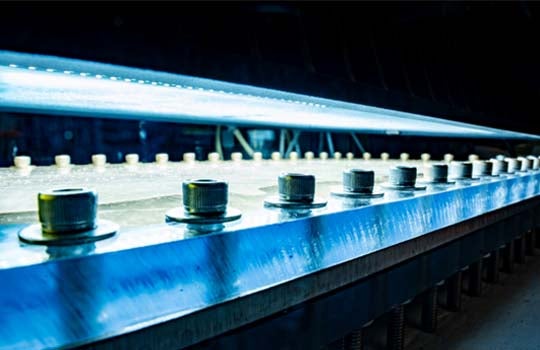
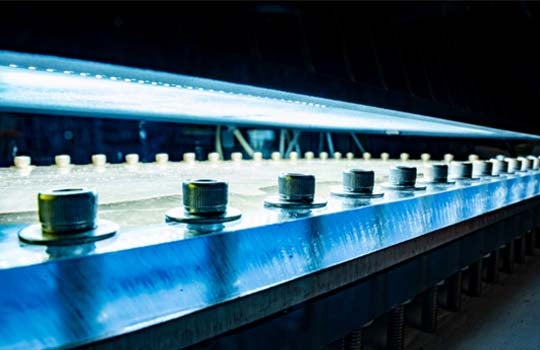
The team tested the concept in a custom-built, benchtop water device heated by an LED lamp. After about five hours of steady heating, the researchers increased the flow rate of one channel. Its peak heat output rose to about five times its output before switching, while the heating input stayed constant.
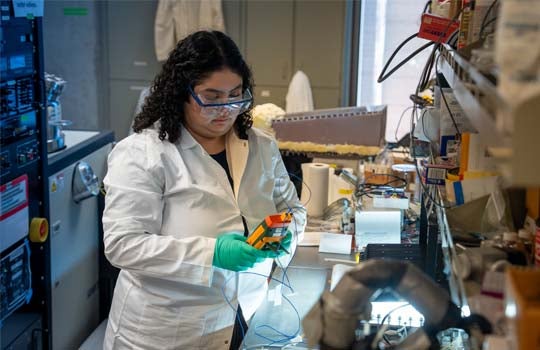
“We kept the heating source steady and changed the flow in one channel. That was enough to release stored heat as a burst,” said Aleida Machorro-Ortiz, a graduate student and co-first author who built the device and conducted the experiments.
Computer simulations reproduced the water experiment and predicted greater amplification in designs using liquid metal as the working fluid. Under the modeled conditions, a liquid-metal system could briefly deliver about 20 times the steady heating power supplied to it by drawing on previously stored energy. Modeling also suggests that stacking multiple channel pairs could increase stored energy and heat delivery per unit of device footprint.
“The extra power in a burst comes from heat that has already accumulated. Releasing that energy over a shorter time lets us concentrate heat delivery while keeping the heating input steady,” said doctoral alumnus Qian Ye, a co-first author who led the theoretical analysis and simulations.
While initial experiments used water, active heat Q-switching provides a framework for other working fluids and device scales. Potential future applications include using solar or industrial waste heat for processes that need controlled heating pulses and managing temperatures in microfluidic devices
“We have demonstrated the principle in water. The next challenge is making this control reliable over repeated cycles and adapting it to the heat demands of a particular application,” said Naomi Halas, University Professor, the Stanley C. Moore Professor of Electrical and Computer Engineering and corresponding author who supervised the experiments.
The demonstrated method keeps the water liquid throughout storage and release without relying on melting and freezing a storage material.
Flow control provides a way to trigger heat release using the same channel structure.
“For thermal storage to be useful, the heat has to be available when a process needs it and at the right rate,” said Geoff Wehmeyer, associate professor of mechanical engineering and co-author of the study. “Controlling the flow gives us a way to adjust that delivery within the same device. That flexibility could help connect steady heat sources to processes with changing heating demands.”
Looking ahead, the same principle could find applications in everyday technologies, from dishwashers that need short bursts of heat for sanitizing to solar-powered systems that turn seawater into drinking water. In such potential applications, the key idea would be to accumulate thermal energy gradually and release it when it is needed most, rather than requiring the heat source itself to deliver a sudden surge of power.
Doctoral alumnus William Schmid is also a co-author of the study.
This work was supported by the National Science Foundation under grant No. 2346014; the Robert A. Welch Foundation under grants C-1220 and C-2224; the U.S. Department of Energy’s Solar Desalination Prize; and Mexico’s SECIHTI scholarship program under award No. 2021-000014-01EXTF-00140. Study: Ye et al., “On-demand thermal power amplification enabled by active heat Q-switching,” Cell Reports Physical Science 7, 103593 (2026). doi:10.1016/j.xcrp.2026.103593