
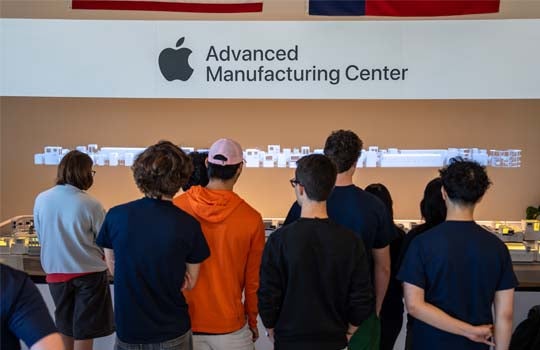
For most undergraduate students, advanced manufacturing is an abstract concept that happens behind closed doors in industry. But last week a group of materials science and nanoengineering students from Rice University’s George R. Brown School of Engineering and Computing got a behind-the-scenes look into this world as part of the first university group to step inside Apple’s new Advanced Manufacturing Center in Houston.
“In the classroom, we teach our students how atomic and molecular structures dictate material performance,” Rice materials scientist Lane Martin said. “Walking through a modern facility like Apple’s Advanced Manufacturing Center grounds those principles in reality. Our students get to see how tiny material choices translate directly into high-yield, automated manufacturing.”
The visit gave students in Rice’s Department of Materials Science and NanoEngineering an immersive experience with the machinery and processes shaping today’s high-tech production.
“As a freshman, it was really cool,” Caleb Ni said. “We went into this workshop where we were able to design our own solder printing process, and we were able to see our results on a solder paste inspection machine almost in real time, so we could adjust our process.”
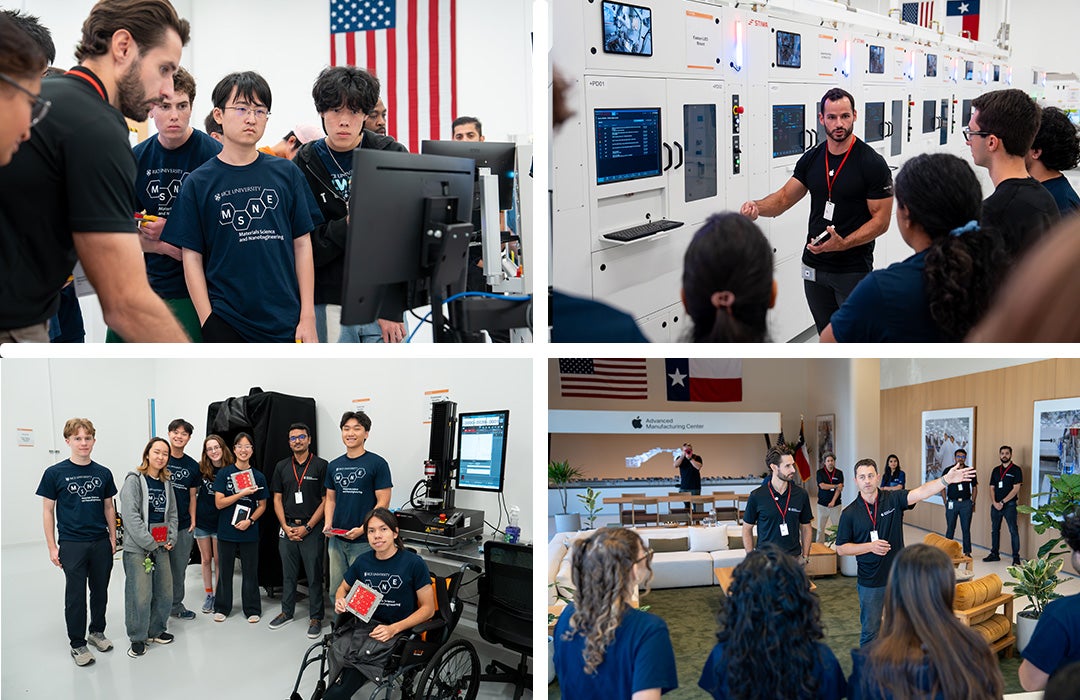
Apple’s Advanced Manufacturing Center is a 20,000-square-foot facility inside the company’s larger production facility in Houston that builds its advanced artificial intelligence servers. The center offers students as well as small- and medium-sized businesses hands-on training in many of the same advanced manufacturing processes Apple uses to build its own products.
Opened in August, the facility is the company’s second site of its kind in the U.S. Its opening reflects the broader expansion of Houston’s advanced manufacturing industrial presence and the growing connection between local university researchers and high-tech industrial operations.
During the visit, Rice students learned how Apple brings the various components that go into their devices together in what is called the surface-mount technology process. Students were then given the chance to optimize parts of that process in a hands-on experience.
“At Apple, we believe education empowers people to explore new ideas and build new skills,” said Hayden Starkey, manager of Apple’s Advanced Manufacturing Center. “Opening the center to students like those at Rice lets us put that belief into action, giving them hands-on access to the same training and expertise our own teams rely on.”
At Rice, these students study topics like nanoscale materials, semiconductor devices and structural design.
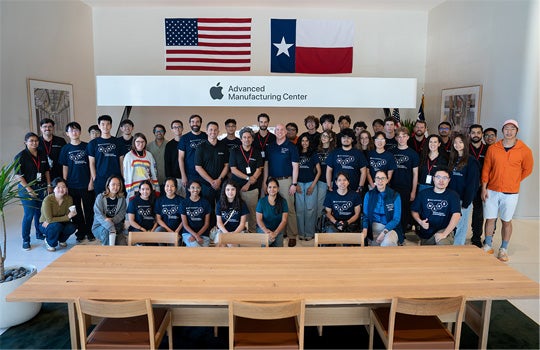
“Connecting our students with top-tier industry facilities is crucial for their development as researchers and engineers,” said Martin, director of the Rice Advanced Materials Institute, the Robert A. Welch Professor of Materials Science and NanoEngineering and professor of chemistry and physics and astronomy. “Seeing live automated lines helped them connect lab research to large-scale factory workflows. They saw how decisions made at the microscopic scale govern mass assembly, reliability and technology supply chains.”
Closing the divide between university research and commercial factory production remains a key challenge for the technology sector. Providing direct access to active production environments helps Rice prepare graduates to solve these hardware and materials challenges early in their careers.
“Advanced manufacturing requires advanced skills, and that’s a two-way investment,” Starkey said. “When Rice students work alongside our engineers, they connect what they’re learning in the classroom to real manufacturing challenges, and we get to help build the kind of talent pipeline that strengthens American manufacturing for years to come.”
“Whether it’s understanding how to bring together many different materials and components into a final device or controlling microscopic defects at high production volumes, these experiences show our students where the field is heading and prepare them to tackle the complex manufacturing and materials challenges they will face in their careers,” Martin said.