
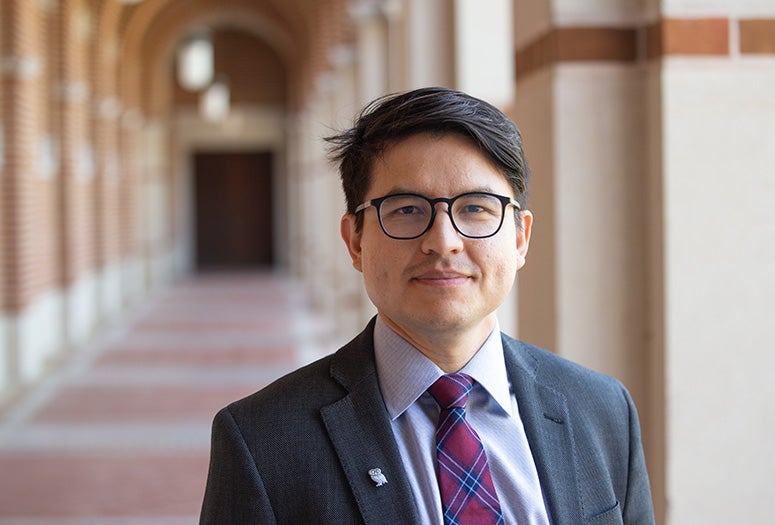
César A. Uribe, Rice University's Louis Owen Assistant Professor of Electrical and Computer Engineering, has been selected for the Air Force Research Laboratory (AFRL) Visiting Faculty Research Program (VFRP), a competitive initiative that brings university researchers into Air Force laboratories to collaborate on high-impact research aligned with national defense priorities.
This summer, Uribe will develop new mathematical and computational tools to better understand complex networks, including communication systems, sensing networks, logistics systems and command-and-control structures. His proposed project, Optimal Transport for Comparison, Coarsening and Alignment of Complex Networks, uses ideas from optimal transport and Gromov-Wasserstein methods to compare networks, simplify them while preserving their most important features and align related structures across different systems.
The AFRL VFRP is designed to foster collaboration between academic researchers and Air Force scientists and engineers, helping connect university research expertise with pressing defense challenges. In Uribe’s case, the work is motivated by the need for better tools to analyze large, dynamic, partially observed networks that are sometimes affected by uncertainty or disruption. Traditional graph analysis methods can struggle in such settings, especially when networks change over time or their components cannot be directly matched. His research aims to address those challenges by focusing on the deeper structure of networks rather than only on labels or surface-level features.
The project includes three interconnected goals: predicting how networks evolve, reducing large networks into smaller, more manageable versions without losing essential structure and identifying meaningful correspondences between networks that vary in size, quality or completeness. Together, these directions could support faster analysis, more robust data fusion and more informed decision-making in complex operational environments.
“This opportunity is especially exciting because it creates a bridge between foundational mathematics and real-world challenges,” Uribe said. “My goal is to develop tools that can help us compare, simplify and align complex networks in ways that are both mathematically rigorous and practically useful. These kinds of problems arise in many important systems, and I am honored to have the opportunity to work with AFRL researchers on questions that have both scientific depth and real impact.”
Uribe’s work brings together optimization, machine learning and network science to address problems that are increasingly important in modern technology and national security. By the end of the summer visit, he said he expects to produce prototype methods and software tools for scalable network analysis, including approaches for coarsening large networks, aligning subnetworks and quantifying uncertainty in those comparisons.