
As researchers work to close long-standing gaps in women’s health, a Rice University doctoral student is using principles of mechanics to shed light on one of the most fundamental aspects of early motherhood: breastfeeding.
Chihtong “Lily” Lee, a researcher in mechanical engineering in the lab of Raudel Avila, is applying a model-driven approach to uncover how mechanical and electrical changes occur within the breast during feeding and how those changes can be measured noninvasively to improve maternal care.
Breastfeeding is a dynamic and complex biological process, and much of what happens is invisible. Clinicians can track outcomes, such as how much milk an infant consumes, but the physical mechanisms driving those outcomes are still poorly understood. Lee’s research aims to bridge that gap, offering new insight into the underlying processes that could ultimately lead to better support for mothers and infants alike.
“We’re trying to understand mechanistically how a lactating breast behaves over time,” Lee said. “By capturing both the mechanical deformations and the electrical properties of the breast during breastfeeding, we can begin to build a more complete picture of what’s happening beneath the surface.”
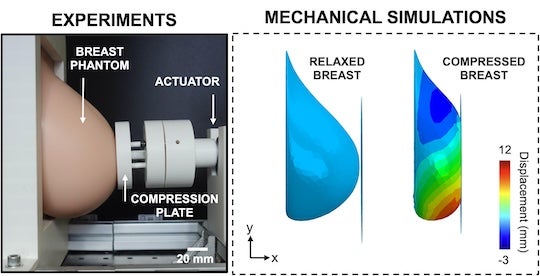
To do this, Lee combines medical imaging data with computational modeling. Using open-source MRI datasets, she reconstructs detailed 3D representations of different breast types — accounting for variations in density, composition and size. These complex models simulate how tissue responds to compression, movement and other forces experienced during breastfeeding.
But because such models can be computationally intensive, Lee also develops simplified “digital twin” models — streamlined geometric representations that approximate the same behavior.
“If we see consistent patterns across both our complex and simplified models, that gives us confidence we’re capturing something real,” she said. “It allows us to study a wide range of scenarios quickly while still grounding our results in realistic anatomy.”
The goal of Lee’s work is not just theoretical understanding but practical application. By identifying measurable signals tied to milk flow and tissue behavior, her research could inform the development of noninvasive technologies to monitor breastfeeding in real time, helping mothers better understand how much milk their baby is receiving and reducing uncertainty that often leads to early cessation.
“A lot of mothers stop breastfeeding earlier than they intend because they don’t have clear information,” Lee said. “If we can provide data-driven insights in a noninvasive way, we can help reduce that anxiety and better support mothers.”
The research could also have implications for detecting and preventing conditions such as mastitis, a painful inflammation of breast tissue, by identifying early deviations from normal mechanical or electrical behavior. More broadly, Lee sees the work as part of a larger push to expand research in women’s health.
“There’s still so much we don’t fully understand,” she said. “Building these models is a first step toward generating the kind of data and insight that can drive new technologies and better care.”
For her work, Lee was recently awarded a prestigious travel fellowship from the American Academy of Mechanics. The award will support her participation in the 2026 United States National Congress on Theoretical and Applied Mechanics, a major conference held every four years that brings together leading researchers across the field. The fellowship will provide mentoring opportunities, workshops and networking sessions. For Lee, the experience represents both a milestone and a launching point.
“This will be my first mechanics conference, and it’s an incredible opportunity to learn from leaders in the field and connect with other researchers,” she said. “Being part of this fellowship cohort feels like stepping into the next stage of my career.”
Lee said she also looks forward to gaining feedback that could help refine her models and expand the impact of her work.
“It’s easy to get deep into your own research,” she said. “Presenting to a broader audience helps you see new perspectives and push the work in the right direction.”