
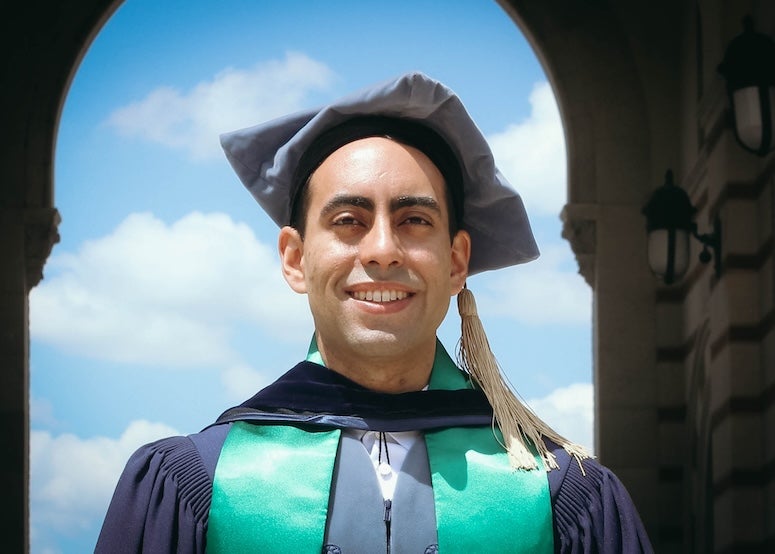
Less than a year after earning his doctoral degree in chemical and biomolecular engineering from Rice University, Thiago J. Pinheiro is already helping tackle one of the fundamental challenges facing fusion energy — using some of the world’s most advanced computing tools.
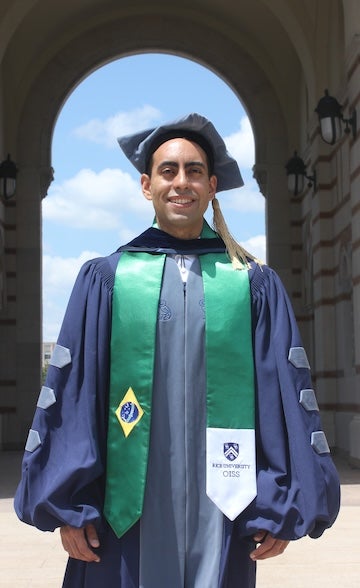
Pinheiro is now a postdoctoral research associate at Oak Ridge National Laboratory where he studies the atomic-scale behavior of molten salts and other materials relevant to energy technologies. He recently played a key role in a collaboration among ORNL, Cleveland Clinic and IBM that performed the first known quantum computing calculations on molecular structures in a molten salt relevant to fusion energy.
The research used a combination of classical high-performance computing and IBM quantum computers to study FLiBe, a mixture of lithium fluoride and beryllium fluoride considered a leading candidate for the liquid “blanket” surrounding the fusion reaction in future reactors. That blanket could be used to produce tritium, a rare hydrogen isotope needed as fuel for many proposed fusion systems. Understanding how tritium interacts with FLiBe at the molecular level is an important step toward producing and recovering enough of it to sustain fusion reactors.
For Pinheiro, the project was a natural extension of the research foundation he developed at Rice.
“Rice played an essential role in preparing me for this work,” Pinheiro said. “The rigorous training I received in thermodynamics, molecular simulation, quantum mechanics and computational materials science gave me the foundation to contribute to a project that brings together fusion science, quantum chemistry, supercomputing and quantum hardware.”
The study used a “quantum-centric supercomputing” approach, dividing complex calculations between classical and quantum computers. Researchers examined several molecular configurations of FLiBe, including its interactions with tritium, to explore whether the combined approach could accurately describe the salt’s electronic structure and binding behavior. The work is part of a broader effort to determine where emerging quantum technologies could complement classical supercomputing in solving difficult materials problems.
Pinheiro, the study’s second author, generated representative atomic structures of molten FLiBe using molecular dynamics simulations. Those configurations and their classical baseline energies provided realistic starting points for the electronic structure calculations that followed, including those performed using quantum hardware.
“My role was to generate physically meaningful atomic environments that could serve as the foundation for the subsequent calculations,” Pinheiro said. “It connected my expertise in molten salt simulations with a much broader effort spanning fusion science, quantum chemistry, high-performance computing and quantum computing.”
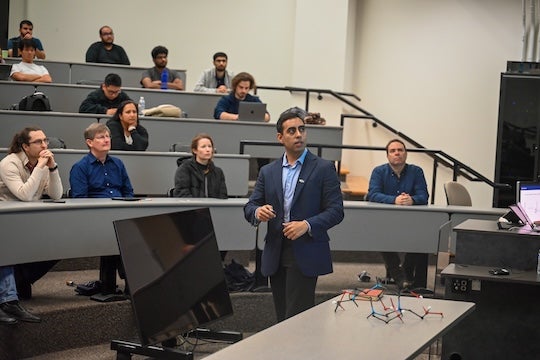
At ORNL, Pinheiro combines density functional theory, molecular dynamics simulations, machine learning force fields and statistical mechanics to predict how materials behave at the atomic scale. His Rice doctoral training prepared him not only to use those computational approaches but also to move between disciplines, as increasingly complex scientific problems demand expertise from multiple fields.
He credits Rice professors Walter Chapman, Philip Singer and Dilip Asthagiri (now at ORNL) with helping shape his development as a researcher. Courses in quantum mechanics taught by professors Gustavo Scuseria and James Shee also gave him a deeper understanding of electronic structure theory and the principles underlying both conventional quantum chemistry and emerging quantum computing methods.
“That background allowed me to collaborate effectively with researchers across several areas of computational science and to contribute to exploring both the capabilities and the current limits of quantum computing technologies,” Pinheiro said. “For me, this study represents a direct continuation of the path I began at Rice: using fundamental molecular-level science and advanced computational tools to address important challenges in materials research and society more broadly.”
“Thiago exemplifies what we hope our doctoral graduates will carry with them from Rice: deep expertise in the fundamentals, intellectual rigor and the ability to work across disciplines to solve consequential problems,” said Sibani Lisa Biswal, chair of the department of chemical and biomolecular engineering at Rice. “It is exciting to see him applying that foundation so early in his career to emerging technologies, such as quantum computing, that could shape the future of energy research.”