
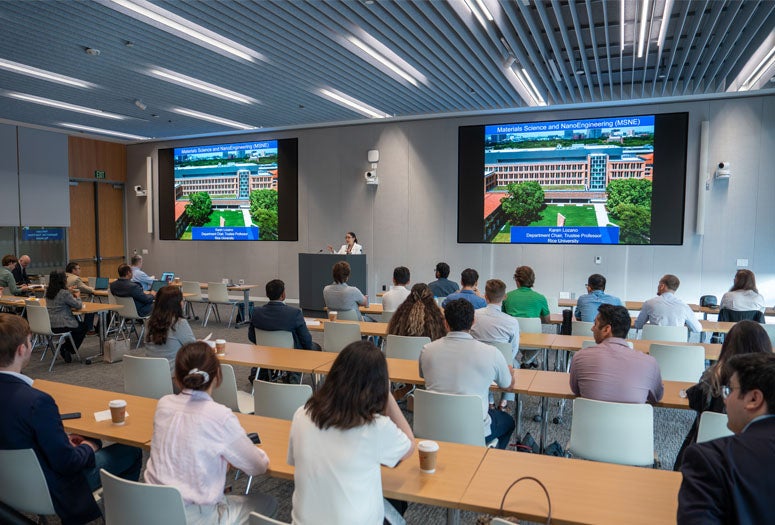
Rice University’s Department of Materials Science and NanoEngineering (MSNE) at the George R. Brown School for Engineering and Computing convened academic leaders, department chairs and researchers from across the state for the inaugural Texas Materials Consortium Sept. 18.
The landmark gathering, inspired by successful collaborative models like TAMEST (Texas Academy of Medicine, Engineering, Science and Technology), establishes a unified statewide strategy to drive advanced research, leverage state-of-the-art infrastructure and secure large-scale collaborative funding across Texas institutions.
“Texas has extraordinary strength in materials science and engineering, but we have not previously had a statewide forum dedicated to bringing that collective expertise together,” said Karen Lozano, Materials Science and NanoEngineering Chair and trustee professor at Rice.
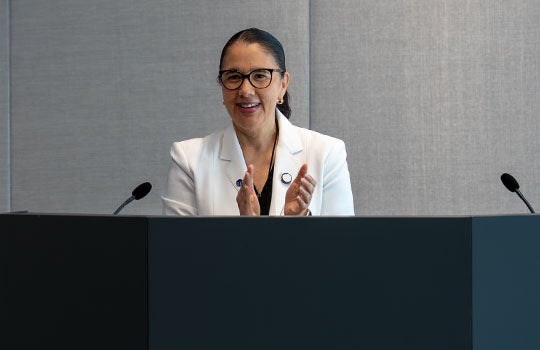
The Materials Consortium is focused on creating direct pathways for collaboration and discovery. Designed to enable Texas institutions to collaboratively tackle global challenges by translating scientific discoveries into real-world solutions, the consortium establishes a supportive structure to facilitate ongoing cross-institutional alignment.
“This Materials Consortium gives us an opportunity to openly discuss the opportunities and challenges facing our field, identify areas in which our institutions can complement one another and develop a shared vision for advancing materials research, education and innovation across Texas,” Lozano said.
During the summit, participating academic leaders focused on critical strategic specializations essential to future innovation, including sustainable manufacturing, nanomaterials advancement and energy storage solutions.
Many of the day’s speakers focused heavily on equipping students with cutting edge technology in order to foster collaboration across aisles and build the most effective future workforce possible.
“Our students are central to this effort,” Lozano said. “Through this consortium, we are building a strong statewide network of future leaders who will advance materials science and drive innovation across Texas.”
By connecting classrooms and labs across Texas, the Materials Consortium also gives students and early career researchers rare, multicampus experience that accelerates both scientific discovery and workforce readiness.
Planned initiatives include a statewide network of shared research equipment, joint proposals for competitive national grants and expanded mentorship programs for emerging scholars.
“We appreciate that Rice is leading the first Materials Consortium,” said Jincheng Du, chair and University Distinguished Research Professor of Materials Science and Engineering at the University of North Texas. “It’s a great opportunity to build momentum on advancing material science and related fields together with other Texas institutions.”
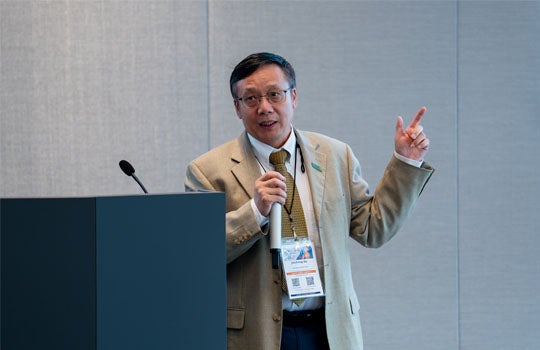
He stressed the importance of the opportunity for the state as a whole.
“Texas is uniquely positioned to build one of the nation’s strongest materials science and engineering ecosystems,” Du said. “As advanced manufacturing, energy, aerospace, semiconductors and critical materials become increasingly important to our economy and national competitiveness, it is essential that we strengthen collaboration across our universities.
“This consortium provides a platform for universities across Texas to work together in developing the workforce, research capabilities and innovations that will drive future economic growth.”
In the coming months, multi-institutional working groups will begin executing the Materials Consortium’s initial road map, focusing on joint proposal development, shared facility protocols and student exchange initiatives.
“This inaugural meeting is only the beginning,” Lozano said.
Looking ahead, the participants say they hope to expand the reach to drive continuous technological breakthroughs, workforce development and long-term academic partnerships.
“We want to build a strong and enduring Texas materials community, one that accelerates discovery, prepares the next generation of scientists and engineers and positions our state to lead in addressing some of society’s most consequential technological challenges,” Lozano said. “By sharing expertise and capabilities, developing joint research initiatives and creating opportunities for students to engage across campuses, we can accomplish far more together than any one institution could accomplish alone.”
These concerted efforts help to ensure that Texas is positioned as a premier materials science and nanoengineering hub for years to come.