
Texas’ next era of economic growth may depend as much on water as it does on energy, technology or capital.
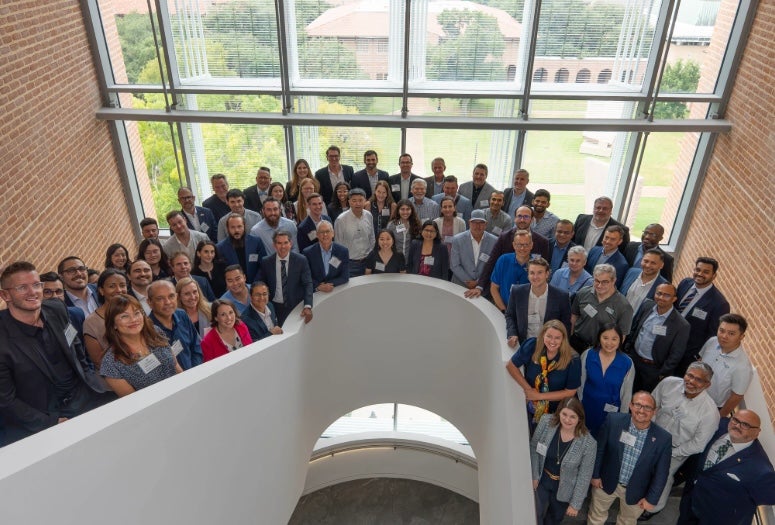
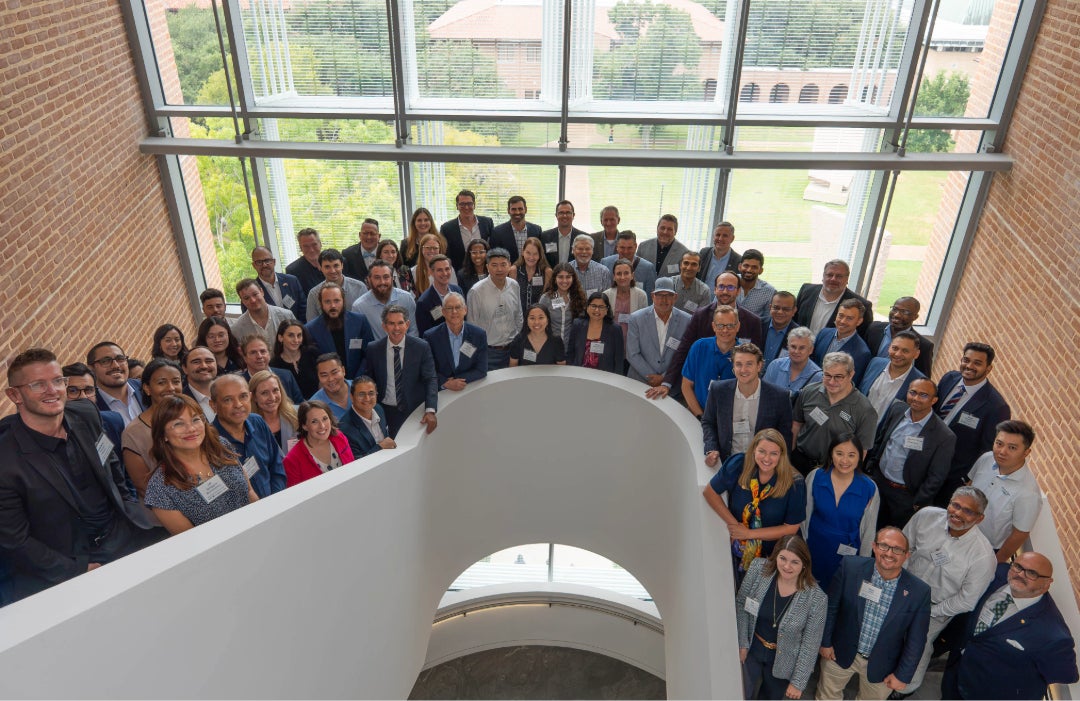
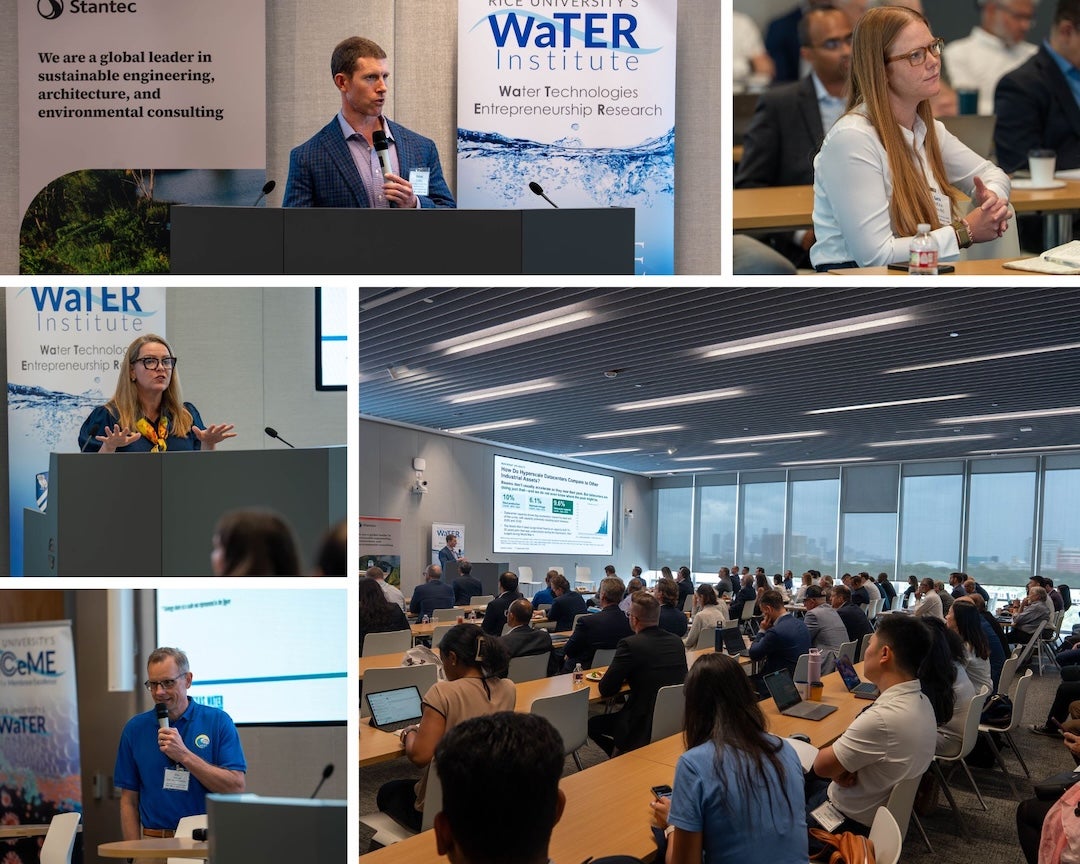
That reality was at the center of the Water Nexus Conference, hosted by the Rice WaTER Institute at Rice University, where more than 120 utility leaders, researchers, government officials, entrepreneurs, corporate water teams, engineers and investors gathered to examine how the state can meet rising demand while confronting water scarcity, aging infrastructure and rapidly changing industrial needs.
Now in its second year, the conference focused on water issues while connecting the people, technologies, policies and investment needed to solve them. Sessions ranged from statewide water planning and produced-water reuse to artificial intelligence and data centers, advanced treatment technologies, commercialization and infrastructure finance.
“Our population is heading from 34 million toward 50 million, more than 500 data centers are in the pipeline, and over half of that capacity sits in areas already under high water stress,” said James Rees, executive director of Noverram and co-facilitator of the conference. “The easy water is gone, but it is a solvable problem. The Rice WaTER Institute provides a highly credible research and innovation platform where companies and founders can test solutions to assist with commercialization. If we can prove in Texas that corporate capital, municipal networks and university research can deliver measurable water outcomes together, we have a model that replicates across the United States and into every water-stressed market in the world.”
For Eric Willman, executive director of Rice’s WaTER Institute and conference co-facilitator, that need to connect traditionally separate worlds is precisely what gives the conference its value.
“We had people from government, nongovernmental organizations, academia, early technology providers, venture capital and private equity,” Willman said. “We had all members of the solution set coming together.”
The program reflected that range. Texas Water Development Board director Ashley Morgan discussed long-term state water planning, while other panels addressed utility management policy and conservation, produced water and treatment and the water and energy demands of data centers.
City of Houston leaders also participated in the panels, bringing the perspective of one of the nation’s largest public water systems directly into conversations about infrastructure, strategy and innovation. Willman said their presence was particularly important because Houston’s day-to-day operational challenges, from repairing leaks to planning for long-term growth, grounded broader discussions in the realities facing large utilities.
“A lot of times, when you go to universities, you end up at a research conference where it’s only research,” Willman said. “When it comes to water research, this was a great place to talk about all angles of the problem, as opposed to just the research and the technology solutions.”
A water challenge tied to Texas’ growth
The scale of the challenge emerged early in the conference.
During Morgan’s opening keynote, she described a state preparing for decades of population growth and rising municipal water demand. Texas plans water supplies on a 50-year horizon, and the draft of the 2027 State Water Plan includes thousands of strategies and projects carrying billions in capital costs.
There will be no single answer. Strategies include conservation, reuse, reservoirs, groundwater, aquifer storage and recovery and desalination. Morgan also pointed to produced water — the enormous volumes brought to the surface during oil and gas production — as a potentially important future resource if Texas can solve questions surrounding treatment, transportation and regulation.
Produced water has become one of the most urgent topics in the field, Willman said, alongside the rapidly growing water and energy demands associated with AI.
“AI and produced water seem to be what people really want to talk about these days,” he said. Produced water, he added, has shifted from “a long-term strategic discussion” toward a much more immediate conversation about what technologies are needed, what quality of water can be produced and where that water can ultimately go.
Rice researchers are already deeply involved in those questions. Willman pointed to the Rice Center for Membrane Excellence as an example of how the university is helping determine not simply whether water can be treated but which approaches make practical and economic sense.
“That’s a big part of why we have this conference,” Willman said, “to be part of the overall conversation as opposed to working on technology in a silo or in isolation.”
AI puts a new spotlight on water
Few topics generated more interest than the expansion of AI and the data centers supporting it.
Gabriel Collins, the Baker Botts Fellow in Energy and Environmental Regulatory Affairs at the Center for Energy Studies at Rice’s Baker Institute for Public Policy, examined the electricity and water demands associated with AI infrastructure, emphasizing that the impacts vary dramatically by geography, cooling technology and local conditions.
“Even if water isn’t necessarily the biggest issue at the end of the day with AI, it’s probably one of the more salient ones for getting people’s attention because it’s so hyperlocal,” Collins said in his keynote address.
He explained that a data center relying heavily on evaporative cooling can consume large amounts of water, while air cooling can substantially reduce direct water use at the cost of greater electricity demand.
“If you want to evaporatively cool a modern cluster of 300,000 GPUs, you’re going to use a tremendous amount of water,” Collins said. “But if you go the other way and air cool it, you’re going to use more power.”
His conclusion captured one of the conference’s broader themes: Water can no longer be considered separately from energy, infrastructure and economic growth.
Willman said Collins’ presentation demonstrated another strength of hosting the conversation at Rice.
“His talk really was grounded in data to make good policy decisions,” Willman said. “Having all these different levels of expertise hearing that same information and looking at that same information I think was really empowering.”
From research to implementation
Technology ran throughout the conference, from produced-water treatment and desalination to membranes, electrochemical processes, PFAS removal and circular water systems. But another recurring question was what happens after a promising technology works in the lab.
A Rice-focused panel featuring Willman and Rice researchers Qilin Li and Jacques Mathieu alongside entrepreneurs Alec Ajnsztajn and Ryan DuChanois as well as Satish Tripathi, managing engineer for the city of Houston, examined the path from university research through regulation and commercialization.
Exchanges like this benefit Rice researchers as much as industry, Willman said, because it helps faculty, postdoctoral researchers and students understand the practical constraints surrounding the problems they hope to solve.
“It’s really a great way for Rice to understand the problem and then not just come at the problem with a solution that isn’t appropriate for the challenge at hand,” he said.
Rees echoed that point from the industry side.
“No single party delivers water resilience alone,” he said. “It takes the whole supply chain, from innovation and design to investment and implementation. Water resilience is the foundation of strong communities and economic growth, and Texas, the U.S. and other countries cannot grow without it.”
Building — and financing — what comes next
Even when Texas knows what infrastructure it needs, paying for it remains difficult.
The conference closed with investors, entrepreneurs and industry leaders examining how public funding, private capital and new business models might help close that gap.
“Institutional investors have set aside hundreds of millions of dollars for water and openly admit they are seeking opportunities where to invest,” Rees said. “The gap is not capital, it is bankability, and our job within the water sector should include how to package water projects in language that infrastructure investors can underwrite.”
That mix of science, policy, utilities, business and finance is central to Rice’s role in the water conversation. Located in Houston — a global center for energy, industry and infrastructure and also home to a major municipal water system — the university sits at the intersection of many of the pressures shaping the future of water.
For Willman, Rice also offers something less tangible but equally important: a hub where people with different roles and priorities can work through difficult questions together.
“What Rice can contribute is a place where people who don’t always speak the same language — science, policy, utilities, business and finance — can come together and figure out what it will take to move solutions forward,” Willman said.