
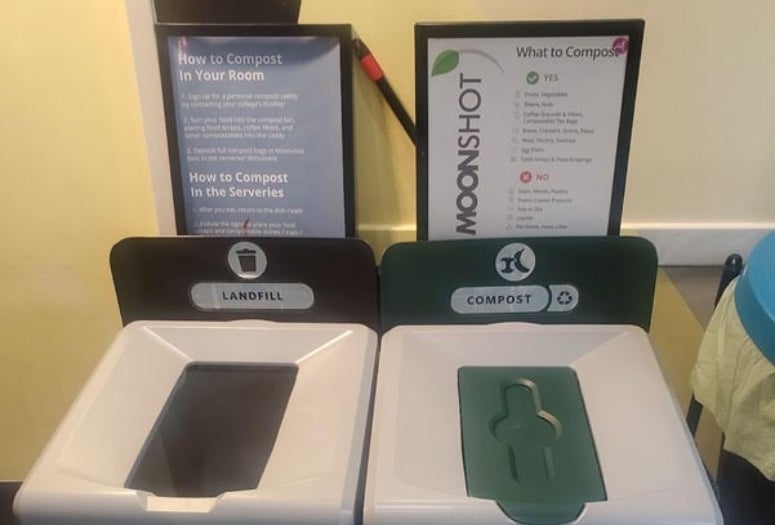
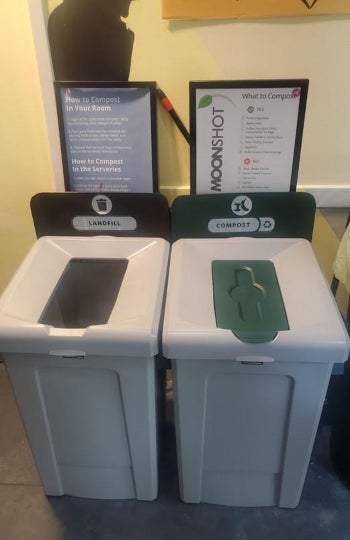
Rice University has reached a major milestone in its campus sustainability efforts, composting more than 2 million pounds of food waste since launching its composting program nearly six years ago.
The achievement reflects a growing campuswide commitment to treating food waste not as trash but as a resource. Through a partnership with Moonshot Compost, a Houston-based company focused on food waste recovery, Rice has diverted food scraps from landfills and transformed them into compost that supports healthier soil and reduces greenhouse gas emissions.
According to the dashboards that track composting activity across 15 campus locations, the university’s composting efforts have avoided more than 2.02 million pounds of carbon dioxide emissions — roughly equivalent to planting more than 100,000 trees or taking the emissions associated with 1.5 million miles driven off the road. The West Servery leads all campus locations in composted food waste with nearly 370,000 pounds.
“Surpassing 2 million pounds of composted food waste is a powerful example of what happens when student leadership, campus operations and community partnerships come together around a shared sustainability goal,” said Richard Johnson, senior executive director for sustainability and professor in the practice of environmental studies in sociology. “This milestone is about more than keeping food waste out of landfills. It shows how Rice can use its campus as a living laboratory to turn everyday actions into measurable environmental impact.”
The composting initiative began in November 2020, driven by student leadership and supported by the offices of Sustainability and Housing, Dining and Hospitality. Moonshot Compost provides the infrastructure and logistics to collect food waste from campus serveries and graduate housing, helping Rice scale the program across the university.
Student involvement has remained central to the program’s growth. EcoReps — a student-led, peer-to-peer sustainability initiative embedded in Rice’s residential colleges — along with sustainability interns help manage bin placement, improve signage, track data and lead outreach efforts that encourage participation across campus.
“This program succeeds because students have taken ownership of it from the beginning,” said Kristianna Bowles, associate director for sustainability. “Their leadership has helped make composting visible, accessible and part of daily campus life. Every bin, every sign and every conversation help build a stronger culture of sustainability at Rice.”
Food waste is a significant environmental challenge. Federal agencies estimate that food makes up about one-quarter of landfill waste and is among the most discarded materials in municipal landfills. Once buried under other waste, food scraps break down without oxygen, producing methane, a potent greenhouse gas. Composting allows food waste to decompose differently, creating a useful soil amendment while reducing emissions associated with landfill disposal.
At Rice, composting is part of the Rice Living Lab Program, which uses the university’s campus, operations and infrastructure as a platform for experiential learning, applied research and sustainability innovation. Through the living lab model, students, faculty and staff work together to address real-world environmental challenges while advancing practical solutions that can improve campus life and inform broader sustainability efforts. The work also reflects a key driver of Rice’s Momentous strategic plan: generating sustainable futures through research, education and action that create meaningful impact on campus and beyond.
“Rice’s composting program demonstrates the value of connecting sustainability education with campus operations,” Johnson said. “Students are not just learning about environmental challenges in the classroom; they are helping solve them in real time, right here on campus.”
The composting efforts are enhanced by innovation, such as the MetaFood X project that was the brainchild of Housing, Dining and Hospitality and was piloted in the Sid Richardson College commons. The project uses a front-of-house component that allows students to scan their plates after they’re done eating and before putting the scraps into the compost bin. AI scans leftover trays of food from the servery lines to help estimate how much is left. This allows dining staff to better scale their batch cooking of different dishes. Rice is currently exploring how to roll out MetaFood X to all serveries this fall.
Johnson added that the 2 million-pound milestone underscores Rice’s continued progress toward a more sustainable campus and highlights the role that collaboration, data and student engagement can play in creating meaningful environmental change — one compost bin at a time.