
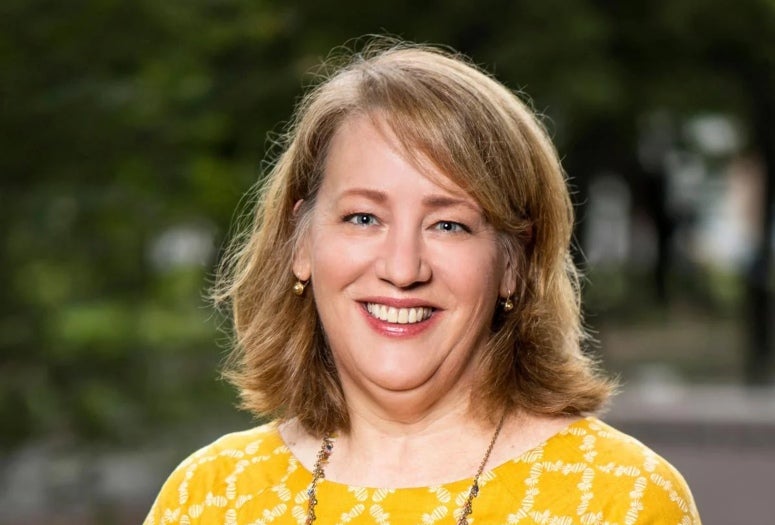
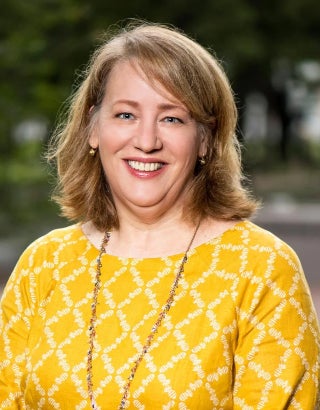
For more than 25 years, Katie Cervenka has poured her energy, creativity and heart into Rice University. As assistant vice president for corporate and foundation relations, she has played a central role in developing robust partnerships with private foundations — primarily in the form of research support — and with companies, where relationships include research as well as recruiting, licensing and professional development. Her last day at the university is March 31.
Q: What is your favorite time of year at Rice and why?
A: I always enjoy the start of the fall semester. After the quiet of summer, it’s energizing to see the troops of new students during O-week, moving like schools of brightly colored fish across campus, followed by the rest of the students as the semester gets underway. There is something magical about that renewal, year in and year out.
Q: Share your most memorable, stand-out moments during your time at the university.
A: My favorite moments have to do with either academic partnerships or trying something new.
One of the first things I worked on was getting Rice on lists to participate in competitions. I had a friend at Caltech who helped me with getting us on the list for Packard Fellowships. Our first Packard Fellow was Tom Killian, who is today dean of natural sciences. Our second Packard Fellow was Doug Natelson, and I still smile remembering how excited he was to be selected.
Very early on I met Rich Baraniuk, who had started a project called Connexions, an alternative to writing and publishing a textbook, the year before I arrived. Both he and I remember our first meeting so well — in his office, around his little round table. Today, Connexions has of course grown to become OpenStax. Being part of its evolution and getting to work so closely with former dean of engineering Sidney Burrus in the process, a special hero of mine, will always be one of my favorite memories at Rice.
I also fondly remember having a long talk with Kathy Matthews, former dean of natural sciences, about her work understanding a specific protein.
I got to work on two projects that established new Ph.D. programs at Rice: one in art history and one in sociology. I still have the thank you note that Elizabeth Long, who was chair of sociology at the time, sent me. I also met Rebecca Richards-Kortum shortly after her arrival at Rice and so clearly remember going over the photo album she put together after traveling to Africa, which showed how donated medical equipment was cast aside, useless in that environment. She was determined to do something to change the situation. Working with Rebecca and Maria Oden and their international colleagues as they progressed, under the umbrella of Rice 360, to the final of the MacArthur Foundation’s first 100&Change competition was both thrilling and exhausting.
All these examples reflect what fuels me: an intellectual challenge, a genuine partnership with wonderful people and endless good humor.
Under the “something new” umbrella: experimenting with the establishment of Corporate Council so that everyone who was working with companies on behalf of Rice got to know each other so we could interact more strategically and, relatedly, building the first attempts at our corporate annual reports, which are today considered a best practice among universities.
I also had a great time working with colleagues across campus to launch the first-ever Moody X-Fest, an enormously grand undertaking to celebrate the largest single gift in Rice’s history. We pumped up that event and loved watching students pour in the doors to enjoy an all-Rice concert.
Finally, I want to point out how very proud I am to have expanded from essentially a one-person operation to a thoughtful, committed team of people who will continue to partner with Rice’s exceptional faculty to support their aspirations and to continue to try new things.
Q: How have you seen Rice evolve over the years?
A: Clearly Rice has experienced significant growth — in the size and composition of the student body, the size and composition of the faculty body, in the administrative support structures and in the number of new buildings — in the 25 years I’ve been here. While still not anywhere near the size of my Austin hometown university, Rice today feels significantly different from the Rice of 2000.
Q: How have you evolved because of your experience at the university?
A: There is nothing better than learning. I always joke that a good day is when you can go from mRNA and quantum matter in the morning to philosophy and public policy in the afternoon. It is comforting to me, especially in such turbulent times, to know that so many remarkable people are working tirelessly to make the world a better place. The devoted patience of Rice faculty will always inspire me.
Q: What advice would you give to employees to make the most of their time at the university?
A: You are fortunate to be, to quote from the musical Hamilton, in “the room where it happens,” the epicenter of the production of new knowledge. Take up that charge. Go to lectures, take a class at the Glasscock School of Continuing Studies, go to a performance, learn new things, challenge assumptions and stir things up.