
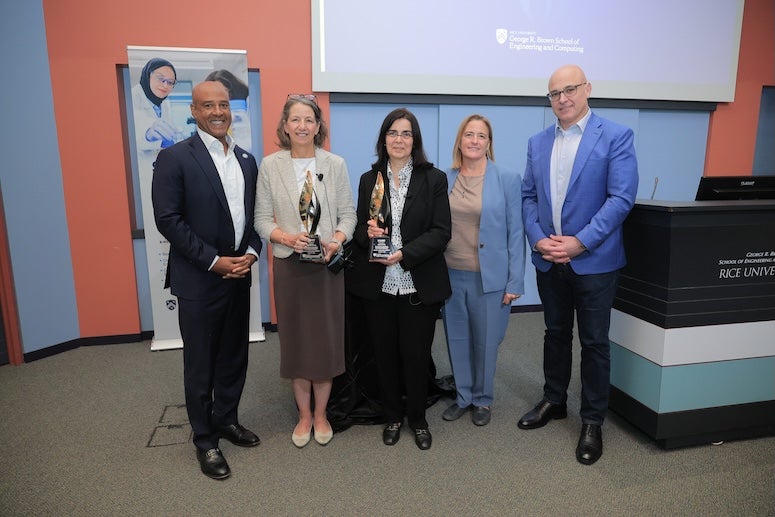
Rice University celebrated two of its most accomplished scholars Aug. 27, honoring Lydia Kavraki and Rebecca Richards-Kortum for an achievement shared by fewer than 35 researchers nationwide.
Kavraki and Richards-Kortum are the first two faculty members in Rice history to be elected to all three U.S. national academies — the National Academy of Sciences, National Academy of Engineering and National Academy of Medicine. They are also the only two scholars in Texas to hold membership in all three.
The George R. Brown School of Engineering and Computing marked the achievement with a “Triple Crown of Discovery” celebration that brought together university leaders, colleagues, mentors, friends and students to reflect not only on the rarity of the honor but also on the careers behind it.
“Lydia and Rebecca have each spent their careers asking difficult questions and refusing to accept the boundaries of a single discipline as the boundaries of what is possible,” said Luay Nakhleh, the William and Stephanie Sick Dean of the School of Engineering and Computing. “They have built collaborations, mentored students and helped create new ways of thinking about what engineering and computing can do.”
Nakhleh said the distinction reflects something central to Rice’s ambitions: pairing intellectual rigor with a commitment to solving consequential problems.
“Their paths are different, but both demonstrate something we believe deeply at Rice — that our best work begins with rigorous thinking and curiosity, and that its greatest value comes when we use it to address problems that matter,” he said.
Kavraki, University Professor and director of Rice’s Ken Kennedy Institute, is a leader in robotics, artificial intelligence and computational biomedicine. Her pioneering development of randomized algorithms for robot motion planning transformed how machines navigate complex environments with applications ranging from manufacturing and space exploration to medicine. She later extended computational approaches into biology and medicine, including work on protein interactions, cancer immunotherapy and drug discovery.
Richards-Kortum, the Malcolm Gillis University Professor and co-director of the Rice360 Institute for Global Health Technologies, has spent her career developing technologies and systems aimed at improving health in resource-limited settings. Her work has helped advance affordable tools for cervical cancer diagnosis, newborn care and other health challenges while building the training and health care networks needed to put those technologies into practice.
Rice President Reginald DesRoches said membership in all three academies signals contributions that have transcended the traditional divisions among scientific discovery, engineering innovation and human health.
“The greatest challenges facing society do not respect those boundaries,” DesRoches said, pointing to problems such as cancer, Alzheimer’s disease, climate change and AI. “Lydia and Rebecca are extraordinary examples of just how powerful that mindset can be.”
Their achievement is also significant for future generations, he said, particularly young women considering careers in science, engineering and computing.
“Their achievement tells our students that there is no ceiling on the scope of the questions they ask or the impact that they can have,” DesRoches said.
The program also offered a more personal look at the paths that brought the two scholars to Rice.
Kavraki reflected on entering computer science when the field was rapidly expanding and discovering as a graduate student at Stanford University that computing could engage not just numbers and data but the physical world.
“There was a palpable sense that the field would change the world, opening entirely new possibilities for science, engineering, medicine and society,” Kavraki said.
She chose robotics before having much direct experience with robots because she said she was captivated by the idea that computation could interact with physical problems. She credited mentors, students, collaborators and family members with shaping her career and described the honor as one she wanted to share with them.
“I have had extraordinary fortune,” Kavraki said. “I benefited from an excellent education, from a family and mentors who gave me opportunities, from students who trusted me.”
She also reflected on the importance of universities remaining open to people and ideas from beyond their traditional boundaries.
“Looking back, I find two things: strong foundations, a clear sense of where we come from and what we stand for, and an openness to the world — to different people, fresh ideas and possibilities we may not yet be able to see,” she said.
Christopher Jermaine, chair of the Department of Computer Science, praised Kavraki not only for her research but also for her service to Rice, particularly her leadership of the Ken Kennedy Institute. He said Kavraki transformed the institute into an engine for large-scale collaboration across the university.
“Lydia is also a service superstar,” Jermaine said. “She’s dedicated to making Rice a better place.”
Richards-Kortum described joining Rice in 2005 as one of the most consequential decisions of her career.
“It’s turned out to be an amazing decision that opened up areas of research that I never would have imagined possible,” she said. “Being immersed in such a vibrant city and medical center opened up so many doors. I thought it would be good. I had no idea how extraordinary it would be.”
Cynthia Reinhart-King, chair of the Department of Bioengineering, highlighted Richards-Kortum’s ability to adapt engineering solutions to the needs of the communities they are intended to serve.
“She bridges the gap between complex and accessible better than anyone in our field,” Reinhart-King said.
But Richards-Kortum’s influence extends far beyond the devices her laboratory has developed, Reinhart-King said. She pointed to generations of students trained to think about engineering in terms of both technical excellence and human need.
“She doesn’t just teach students how to engineer,” Reinhart-King said. “She teaches them why we are engineers. And that ‘why’ is rooted in her profound humanity.”
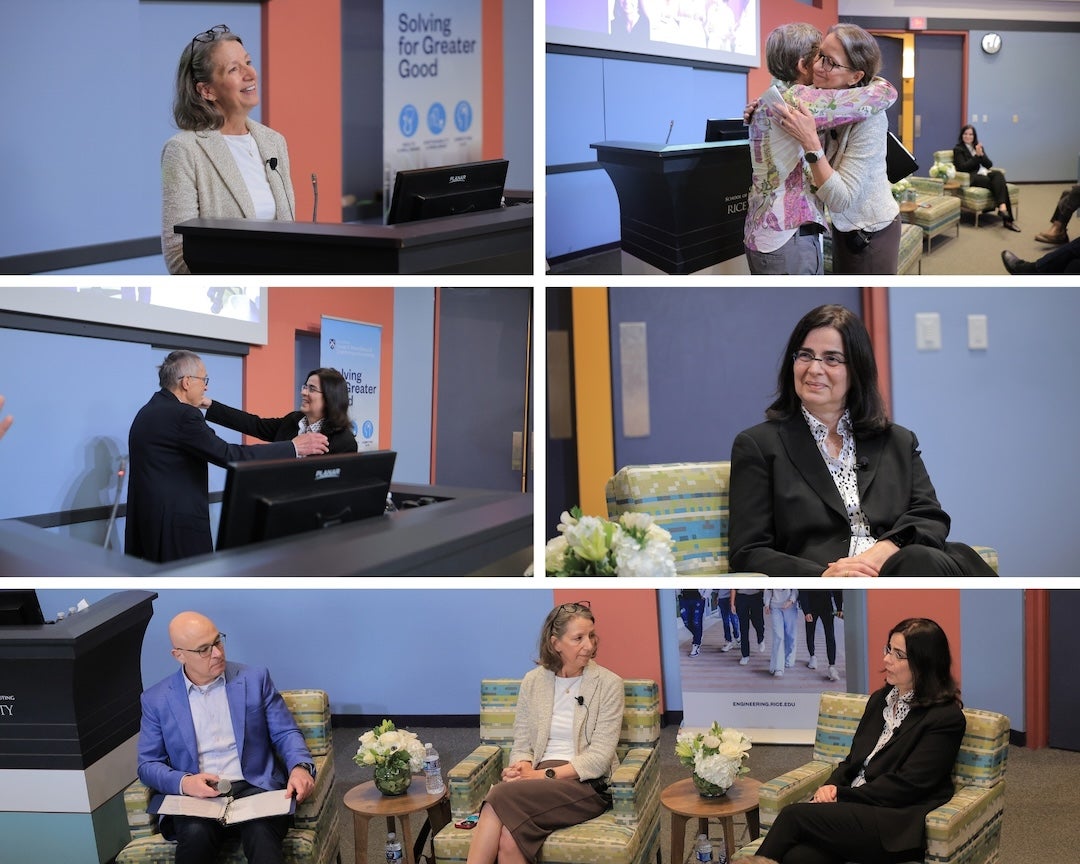
Surprising both honorees were special guests who also spoke about their impact on their respective fields, including Kavraki’s doctoral adviser, Jean-Claude Latombe, a professor emeritus at Standford, and Deb Niemeier, a longtime friend of Richards-Kortum’s and a distinguished engineering professor at the University of Maryland.
During a conversation with Nakhleh, both professors discussed their long-standing embrace of interdisciplinary work.
Richards-Kortum said her research tends to begin not with a particular technology or academic discipline but with a problem.
“I’m really interested in thinking about big questions and big problems,” she said. “Whatever the problem calls for.”
She pointed to maternal health in Texas as an example: Improving outcomes requires consideration not only of technology and health care but also economics and equity.
“How do you get all those people together in the same room?” she said. “That’s how I approach it and what gets me excited.”
That problem-driven approach has translated into measurable impact. Richards-Kortum cited NEST, a program that grew from an undergraduate educational initiative into a large-scale effort to improve newborn care. In 2025 alone, she said, an estimated 2,300 babies were alive because of the program.
“The opportunity for that kind of impact makes it easy to stay curious and to keep asking, ‘How do we improve things?’” she said.
Kavraki similarly spoke about the challenge of preparing students for a rapidly changing world, particularly as AI reshapes computer science and society.
For both scholars, membership in the national academies also carries responsibilities beyond recognition. Academy members contribute expertise to studies and recommendations addressing questions of national importance.
Richards-Kortum urged scientists and engineers not to take the institutions supporting scientific research for granted.
“I want to leave people with a sense of hope and optimism that science can be used for change,” she said. “But I think we all have to recognize that there’s a fragility in the systems that support the work we do. If we take it for granted, it may not be there. And it is up to us to advocate and to illustrate why it is important.”
Rice provost Amy Dittmar closed the celebration by noting that for all the prestige associated with the three academies, Kavraki and Richards-Kortum’s careers began with something more fundamental: curiosity and a willingness to pursue difficult questions.
“Their careers remind us that the greatest scholarship is rarely driven by a pursuit of recognition,” Dittmar said. “Recognition follows from the pursuit of something else — a compelling question, an unsolved problem, an idea that will make a difference.”
That spirit, she said, is one Rice hopes to pass on to the next generation.
“We want our students and faculty to remain curious, to take intellectual risks, to work across disciplines and to believe the questions they pursue are ultimately changing lives,” Dittmar said.