
As artificial intelligence moves from buzzword to boardroom priority, Houston’s business community is wrestling with a question that has less to do with technology than leadership. At the second annual Innovation and AI Summit, Rice Business faculty led conversational panels on how artificial intelligence will affect digital transformation, finance and human capital.
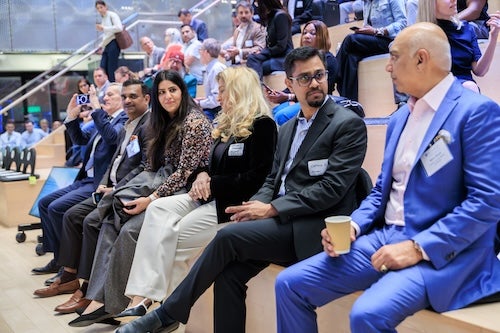
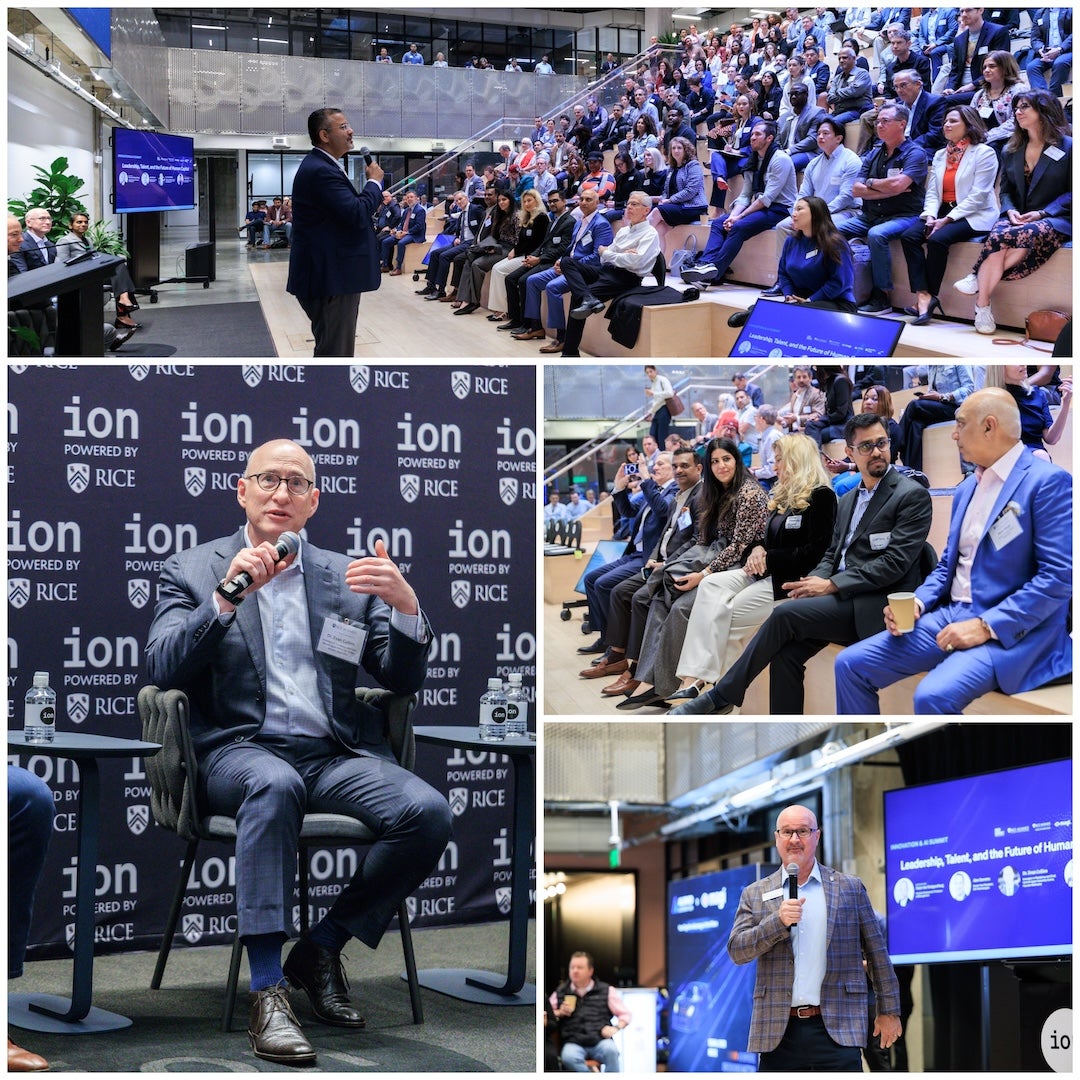
The summit was a chance for corporate leaders, startup founders and anyone interested in the future of AI in business to learn, connect and be inspired. More than 400 people packed into the Ion, Houston’s innovation hub powered by Rice University, to glean insights from executives at Microsoft, Houston Methodist, Hewlett-Packard Enterprises, Dell Technologies and more.
Anup Sharma, managing partner at ASynapse and chief growth officer at ARTIS Magi, welcomed the audience and asked for a show of hands from CEOs and C-suite executives in attendance. More than half raised their hand.
“It is your responsibility to frame the ‘art of the possible,’ because this is no longer a technology capability. It is a leadership transformation, and my view is you have to be the one to create an environment that encourages novel ideas, reduces the fear of retaliation, of failure,” Sharma said. “Because when you start to create that environment and create a bold vision about what this can do for your business, for your nonprofit, that is when the magic starts.”
AI’s ability to interact through natural language, he explained, levels the playing field in ways previous technologies never could. “Talent is everywhere in the world, but unfortunately, opportunity is not,” he said, adding that by meeting people where they are with their own language and context, AI has the potential to unlock innovation, expand entrepreneurship, accelerate medical discovery and reshape industries.
So how do leaders manage change? Alex Barretto, senior vice president at Dell Technologies, said that structural change becomes real structure.
“If we think about our companies — it doesn’t matter if it’s a government, a nonprofit, corporate America — we are basically a system with functions and finance, accounting, marketing services,” Barretto said. “It’s a collection of systems. Humans organized in certain ways deliver a certain value. And that system has a fabric, it has a DNA that it operates. We call that thing culture.”
Dr. Evan Collins, innovator-in-residency and chief of the Hand and Upper Extremity Center at Houston Methodist, shared a similar systems-focused approach with health care. “Technology has been and will continue to be central to health care innovations, and AI can be used to provide specialist data to patients who might ordinarily have to wait six months for an available specialist appointment. Ensuring AI uses correct data is important,” he said.
People are an important part of the implementation of AI, too. Marie Myers, executive vice president and CFO of Hewlett-Packard Enterprise, shared that “reskilling” the organization with structured programs is key.
“You really need to keep your skills fresh and modern,” Myers said. “But you need to equip folks with a host of tools. Now, some of those are personal productivity tools and others are more developing an understanding of workflows and business processes, but we’ve been very intentional about reskilling and education. And I believe that’s probably one of the tools for success for all of us.”
AI has been pitched to take care of tasks that would otherwise be handled by an entry-level employee. However, entry-level roles give young employees an insight into the nuances of business. As some organizations have decided to replace jobs with AI, others have ramped up their learning opportunities for fresh graduates. Myers noted that she has encouraged multiple internship cohorts each year at Hewlett-Packard.
“It’s those young people that are going to learn and drive the change as well,” she said. “They are actually some of the fastest learners in companies, so I think you need to look at it as a change agent role too.”
At Rice, conversations about AI have been happening in classrooms and research labs for years. The university has steadily woven AI into its curriculum — even a major — to ensure students graduate with the skills and perspective to lead in any industry. That commitment spans disciplines. For example, Professor Fred Oswald received support from the National Science Foundation to examine how AI is shaping hiring practices and how it can impact fairness and equity in the process.
The conversation continues this spring at Rice Business. On April 30, business leaders from across industries are invited to a virtual webinar focused on AI’s practical impact — from streamlining decision-making to improving communication and generating real-time, actionable insights. The goal: helping leaders move from curiosity to confident implementation.
And this summer, that hands-on approach deepens. Haiyang Li, the H. Joe Nelson III Professor of Management, will lead “Driving Growth Through AI and Digital Transformation,” an immersive June 1-3 program through Rice Business Executive Education. Designed for executives and senior leaders, the course explores how AI and machine learning can power sustainable growth and guide organizations through digital transformation.
The 2026 Innovation and AI Summit was co-sponsored by Rice Business Executive Education, the Ion, Rice Alliance, MAGI, Aligned Automation and CenterPoint Energy. For future Ion events, visit iondistrict.com/events.