

Rice University materials scientist Geoffroy Hautier has joined a team led by the University of Houston in the search for next-generation permanent magnets. These components are essential for electronics, energy and transportation.
The initiative aims to reduce the U.S. reliance on vulnerable foreign mineral supplies that are critical to national security, according to a press release from the University of Houston. The project has received a three-year, $2.9 million grant from the U.S. Department of Energy’s Advanced Research Projects Agency-Energy under its Magnetic Acceleration Generating program.
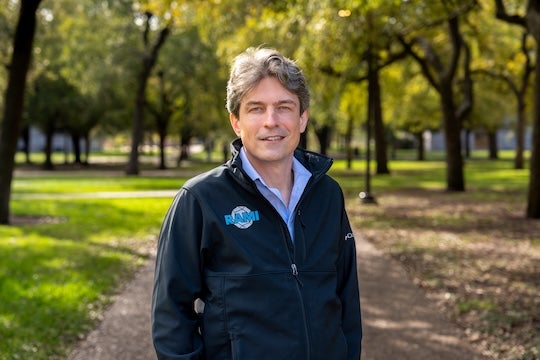
“More powerful magnets could improve the efficiency of technologies that account for a significant part of U.S. electricity use,” said Hautier, who is a member of the Rice Advanced Materials Institute and the Ken Kennedy Institute at Rice. “Magnets are everywhere, from air conditioning systems to all our electronic devices, electric vehicles and anything else with an electrical motor.”
Building a stronger magnet
The coalition led by Jakoah Brgoch, principal investigator and the Eby Nell McElrath Professor of Chemistry at UH, includes researchers from Rice, Colorado State University, Carrier Global, and Houston startup Newfound Materials.
Together, the research team aims to outperform neodymium iron boron, which is currently the industry standard for high-performance magnets used in electric vehicles, industrial motors, generators and cooling systems.
“This has been a long-standing challenge to think about how we replace these magnets with high-performing and more reliable materials, and optimization by just replacing elements is not working,” Brgoch said in the release. “Our goal is to use artificial intelligence to find entirely new materials while simultaneously balancing these supply constraint concerns.”
Research role and commercial impact
Hautier, a professor of materials science and nanoengineering, is leading Rice’s efforts on this project. His research team will employ AI, atomistic modeling and high-throughput computing to identify promising magnetic materials for testing.
Using AI and computer modeling can accelerate the search to find materials that outperform today’s state of the art, Hautier said.
“If you improve the quality of these magnets, that translates into an efficiency gain everywhere, across different technologies,” he said. “But our optimized search strategy may enable us to also better utilize the types of raw materials here in the U.S. and to spur domestic manufacturing.”
Since ARPA-E prioritizes applications in the commercial market, the ultimate goal of the project is to bring these new magnets to market, either by establishing a new startup or by expanding Newfound Materials.