
Rice University researchers have demonstrated a way to split carbon dioxide using visible light at room temperature, overcoming a major energy obstacle in sustainable chemical manufacturing.
Conventional carbon dioxide conversion requires scorching industrial temperatures between 700 and 1,500 degrees Celsius or intense electrical discharges, which often generate carbon emissions during the process because of the molecule’s extreme stability. Previous attempts at direct splitting suffered from severe operational limits: Freed oxygen atoms rapidly recombine with carbon monoxide or degrade the catalytic material driving the reaction.
Carbon monoxide is a key raw material used to make synthetic fuels, plastics and everyday industrial chemicals. Turning waste carbon dioxide into that same ingredient using light gives chemical manufacturers and industrial facilities a way to move toward net-zero production and cut overall emissions.
“What makes this advance so important is that it turns carbon dioxide straight into carbon monoxide, a major value-added product for industrial use,” said Naomi Halas, University Professor and senior author of the study. “That shift could make carbon capture genuinely profitable.”
The study, published in the Proceedings of the National Academy of Sciences, details how the Rice team resolved this challenge by developing a multifunctional material system. The design pairs light-harvesting copper nanoparticles with cerium oxide, an “oxygen sponge” similar to components used in automotive catalytic converters.
When hit with visible light, the copper nanoparticles act as microscopic antennas that channel high-energy electrons into ruthenium reaction sites, breaking carbon dioxide into carbon monoxide and oxygen. The cerium oxide temporarily traps the freed oxygen within its crystal structure to prevent recombination, allowing the catalyst to be easily regenerated with nitrogen gas under light for subsequent cycles.
“Our approach makes it easy to break chemical bonds using light; however, that is not enough,” Halas said. “The ‘oxygen sponge’ properties of cerium oxide prevent the recombination of oxygen back to reform carbon dioxide.”
Driven by light rather than furnace heat, the system achieved peak performance under blue light at a wavelength of 475 nanometers, producing carbon monoxide at a rate of 15,000 micromoles per hour per gram.
The light-driven process maintained steady production for nearly four hours, or specifically 238 minutes. That is almost seven times longer than traditional heat-driven controls, which degraded within 35 minutes. The new system also yielded nearly three times more carbon monoxide than test materials lacking the cerium oxide “oxygen sponge.”
While catalyst surface temperatures reached 300 to 386 degrees Celsius (572 to 726 degrees Fahrenheit) under laser illumination, externally cooling the reaction chamber to 10 degrees C (50 degrees F) increased carbon monoxide production even further. The lower temperature improved how effectively carbon dioxide molecules attached to the catalyst surface, boosting overall efficiency.
“Plasmonic photocatalysis provides a much more energy-efficient approach than conventional thermocatalysis,” said Peter Nordlander, Rice’s Wiess Chair in Physics and Astronomy and professor of electrical and computer engineering and materials science and nanoengineering. “While the overall temperature of the catalyst only reaches a few hundred degrees, the electrons driving the reaction, which equal less than 0.05% of the total mass, are heated in excess of 10,000 degrees Fahrenheit.”
Transitioning this breakthrough from laser-powered laboratory reactors to commercial-scale manufacturing represents the next major milestone for the technology.
The underlying antenna-reactor system developed at Rice has been licensed to Syzygy Plasmonics, a Houston-based clean-technology spinoff co-founded by Rice researchers. Syzygy is currently engineering light-driven chemical reactors designed to scale the process for industrial lighting arrays.
“Converting carbon dioxide directly into carbon monoxide with light turns underutilized industrial emissions into valuable chemical feedstocks. The process cuts energy demand, complexity and infrastructure costs,” said Hossein Robatjazi, lead scientist and director of catalyst research at Syzygy Plasmonics and Rice adjunct professor of chemistry. “Combined with Syzygy Plasmonics’ scalable, modular photoreactors, the method could enable cost-effective carbon reuse across diverse industrial operations.”
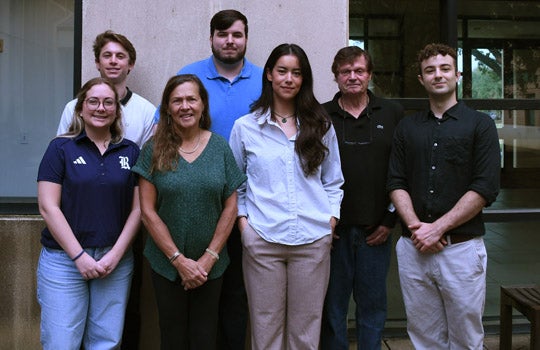
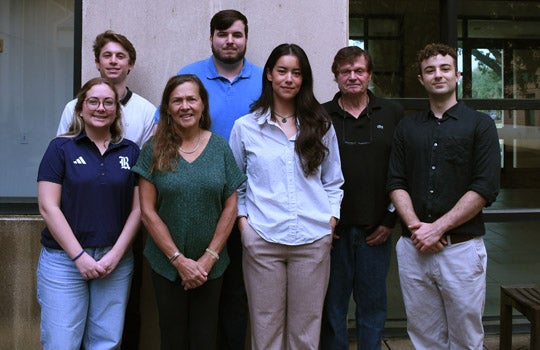
Graduate students Shan Z. Deneen and Catherine J. Fabiano served as co-lead authors of the study. Co-authors include Alexander Ahrens, Matheus Laureano Nunes Barbosa, Luke Kay, Andrés B. Sánchez-Alvarado and Nolan Craft.
This research was supported by the Robert A. Welch Foundation (Nos. C-1220 and C-1222), the Air Force Office of Scientific Research (No. FA9550-24-1-0178) and the Department of Defense SMART Scholarship Program. Additional support was provided by Rice’s Ken Kennedy Institute Computational Science and Engineering Recruiting Fellowship, with instrumentation access provided by the Rice Shared Equipment Authority.