
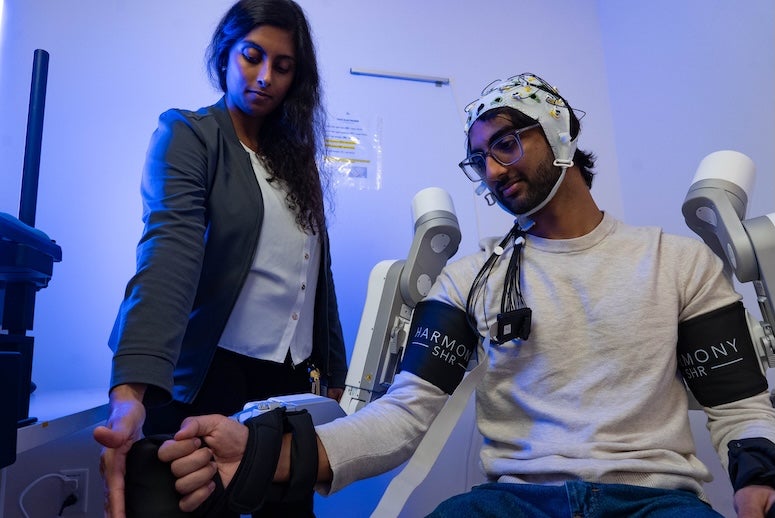
A new Rice Brain Institute collaboration is bringing together robotics, neuroscience and clinical expertise to explore a more active approach to stroke rehabilitation.
Led by Keya Ghonasgi, assistant professor of mechanical engineering, and Simon Fischer-Baum, associate professor of psychological sciences, the project will use a full-arm bilateral wearable exoskeleton robot to examine whether allowing a stroke patient’s dominant arm to guide movement in the more affected arm can better activate the damaged motor system and improve movement quality and rehabilitation. Dr. Sheng Li, professor and director of the Neurorehabilitation Research Laboratory at UTHealth Houston and an expert in stroke recovery, will provide clinical support for the study.
“The main goal is to understand whether this self-driven or mirror-mode therapy can be beneficial for stroke survivors,” Ghonasgi said. “This exoskeleton gives us a unique opportunity to test that because it is a bimanual device with a high degree of joint-level control. There really are not many upper-limb systems that can assist both arms in this way.”
Many robotic rehabilitation systems move a patient’s affected limb passively, helping them complete repetitive movements. These systems, however, don’t necessarily engage the patient’s own neural networks in order to complete the movements. The exoskeleton’s self-driven mode instead maps movement from one arm directly onto the other at the joint level, allowing the patient to help drive the therapy.
“Simply moving someone’s affected arm with an exoskeleton is not enough,” Ghonasgi said. “It is a little like trying to learn tennis by having a coach move your arm for you. We want the participant to be engaged in the movement, but we also know they may be limited by strength, fatigue, range of motion or coordination. This approach could give them support while still asking them to actively drive the movement.”
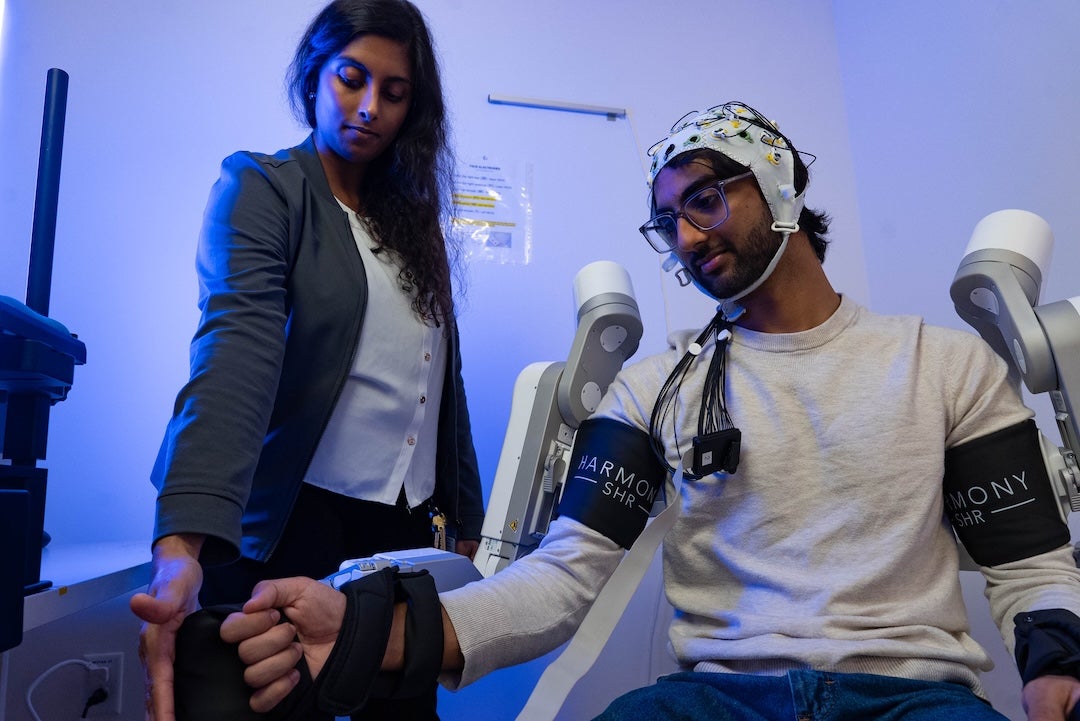
The pilot study will recruit 10 people in the chronic phase of stroke recovery, defined as six months or more after stroke. Participants will complete movement tasks under several conditions, including no exoskeleton, active movement, passive robot-assisted movement and self-driven bilateral movement.
During each condition, the researchers will collect synchronized measurements of brain activity, muscle activation and movement quality. EEG will track neural activity linked to motor planning and engagement, while EMG will measure activity in key arm and shoulder muscles and motion data will capture range of motion, coordination and smoothness.
Fischer-Baum said the project offers a way to look beyond whether a movement is completed and instead study how the brain is participating in that movement.
“We are trying to understand the basic science of recovery — what happens in the brain after damage and what kinds of activity may support rehabilitation,” Fischer-Baum said. “With EEG, we can measure brain activity in real time and look for signatures of motor engagement, even before we see clear behavioral changes. That is what makes this project exciting: We can ask whether the brain is processing the movement differently when the patient is actively involved.”
The study will also compare how self-driven therapy performs across different types of movement, from individual joint motions to more coordinated reaching tasks. Because this exoskeleton operates at the joint level, the researchers hypothesize that the self-driven mode may be especially useful for rebuilding healthier joint-level control and reducing compensatory movements that can lead to fatigue or injury.
For Fischer-Baum, the project reflects the kind of interdisciplinary work the Rice Brain Institute was created to support.
“This is a great example of what becomes possible when we see the full constellation of brain-related expertise across Rice,” Fischer-Baum said. “We have engineering approaches, cognitive neuroscience approaches and strong clinical connections through the Texas Medical Center. Projects like this allow us to bring those strengths together in ways that can make all of our research better.”
The pilot study, which was recently awarded a Founders Award for Neurotrauma Research from the TIRR Foundation, is designed as a first step toward larger clinical trials. By identifying the immediate neural, muscular and movement-related effects of self-driven robotic therapy, the team hopes to generate preliminary data that could support larger studies of whether the approach leads to lasting improvements in stroke recovery.
“Our hope is that self-driven bilateral assistance will produce more brain activity than passive robotic movement alone,” Ghonasgi said. “We do not yet know whether that will translate into long-term rehabilitation gains, and that is exactly why this study is important.”