

Many senior engineering projects end in a binder on a shelf, but recent Rice University-led student ventures took top national wins at this year’s Biomedical Engineering Society and Medtronic Student Design Competition.
Guided by Rice faculty mentor Bilal Ghosn, the teams’ awards highlight how undergraduate engineering design courses can move directly into real-world startups to become commercial ventures capable of competing on a national stage.
A team of four recent graduates, Patrick Bednarz, Jacob Lei, Mira Srinivasa and bioengineering major Suran Somawardana, won first place in the Best in Show category for the project titled InhalAIR: a smart inhaler clip-on to transform asthma care.
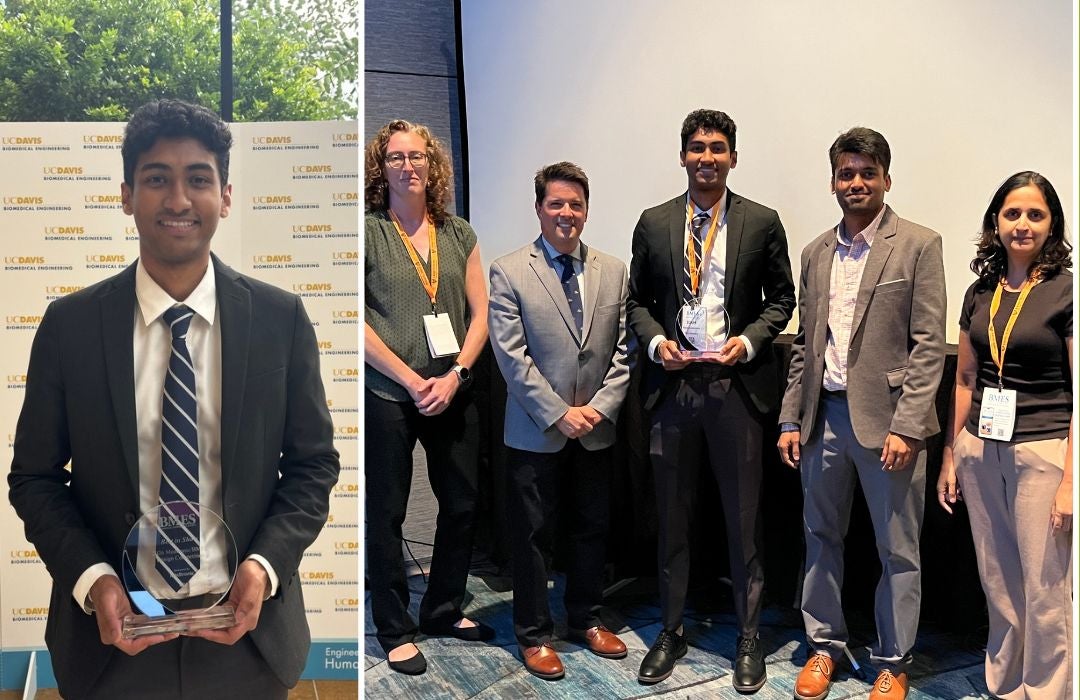
“This project is especially personal to me because I have lived with asthma since fifth grade,” Somawardana said. “It means a great deal to develop technology that could improve care for millions of patients like myself. We’re excited to continue this momentum in developing a classroom project into a growing venture.”
Another Rice team of two sophomores, Tyler Neilson and Shashank Kamal from the George R. Brown School of Engineering and Computing, won first place in the Electrical/Computer Science/AI category for their project, Hemodynamic Assessment by Light-Based Optics (HALO) for prehospital large vessel occlusion stroke triage.

“This recognition provides valuable credibility for HALO as we pursue additional funding, partnerships and clinical validation,” said Neilson, a bioengineering student. “Competing alongside talented engineering teams from across the country was incredibly rewarding and reinforced our confidence in HALO’s potential to address a critical gap in prehospital stroke triage.”
The Biomedical Engineering Society and Medtronic Student Design Competition serves as a premier showcase for undergraduate and graduate biomedical engineering design projects.
These projects are created during a required yearlong engineering design course. In this class, student teams design, build and test solutions for real-world health care needs.
Recognition of top honors reflects early-stage validation by a panel of academic and industry experts who evaluated competing engineering programs from across the country. The national award benchmarks Rice’s bioengineering programs against those of top institutions nationwide.
“We are incredibly grateful to Rice’s Liu Idea Lab for Innovation and Entrepreneurship (LILIE), particularly its Summer Venture Studio, and Bilal Ghosn for continued mentorship and encouragement,” Somawardana said. “The support and guidance have been instrumental in helping us turn a classroom project into a growing venture.”
Neilson echoed the importance of the support to his team. “LILIE and the mentorship from Omid Veiseh and Bilal Ghosn helped us secure crucial funding and enable us to continue building toward more future success.”
Winning national design competitions provides helpful validation for young projects and startups. However, moving an early-stage venture into a commercial market requires additional regulatory testing and future investment rounds.