
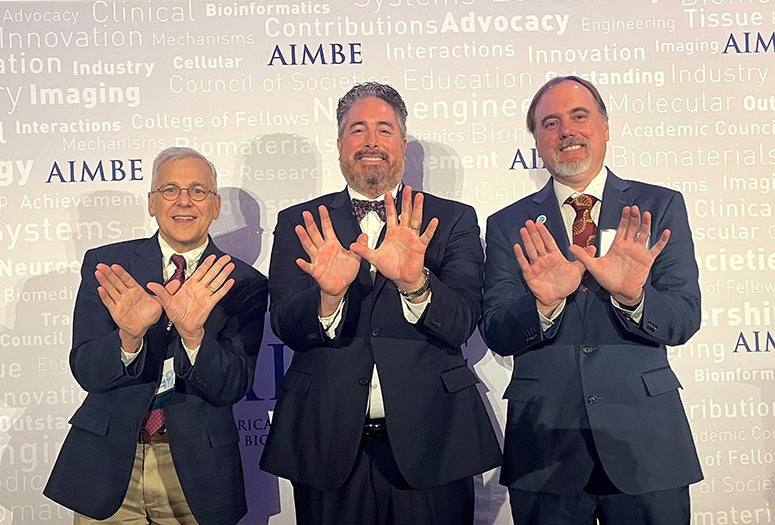
Scientists and engineers in biomedical engineering gathered in Washington, D.C., for the annual meeting of the American Institute for Medical and Biological Engineering (AIMBE) April 11-13. AIMBE’s College of Fellows represents some of the most accomplished individuals in medical and biological engineering, selected through a highly competitive nomination and peer-review process.
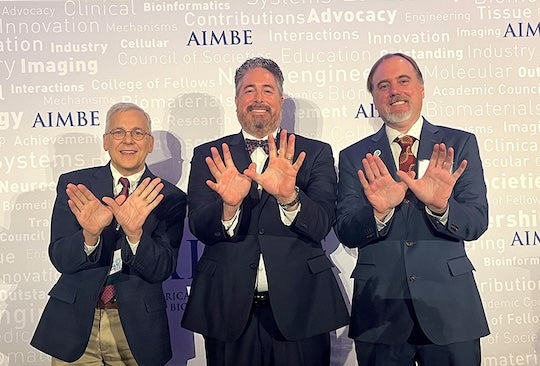
This year, Rice University’s Department of Bioengineering helped host the event, including sponsoring the awards banquet. The contribution highlights the department’s leadership in the field, with many among its faculty recognized as AIMBE Fellows, including Lydia Kavraki and Rebecca Richards-Kortum, who are among 21 AIMBE Fellows that are members of all three national academies. To note, only Massachusetts Institute of Technology and Stanford University have more, while California Institute of Technology and Harvard University are tied with Rice.
Two Rice faculty newly inducted as AIMBE Fellows at the meeting are B.J. Fregly, a professor of mechanical engineering and bioengineering at Rice and a Cancer Prevention and Research Institute of Texas Scholar, and Todd Treangen, associate professor of computer science and member of the Ken Kennedy Institute at Rice.
The meeting also marks a leadership transition, as Michael King steps into the role of AIMBE president, placing him at the forefront of national conversations on biomedical research and policy.
“To serve as president of AIMBE for the next two years is a great honor, especially since I was elected to this office by my fellow members of the AIMBE College of Fellows,” said King, Rice’s E.D. Butcher Professor of Bioengineering and special adviser to the provost on life science collaborations with the Texas Medical Center. “I truly believe that the role of AIMBE has never been more important, as we work to strengthen the trust in, and support of, science among the American people and lawmakers.
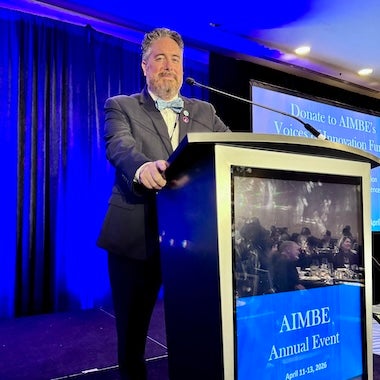
“AIMBE provides expert guidance on matters related to biomedical research, and strives to quantify and communicate how biomedical innovations benefit the nation and the world: by extending and improving life, growing the economy and creating high-quality, well-paying tech jobs. We will hold many events and workshops to bring cutting edge research to decision makers and their staffs, to encourage preservation and growth of the investment in medical research at the federal and state levels.”
The meeting typically brings together leaders from across biomedical engineering along with policymakers to talk about where the field is headed and how to support it. This year’s program touched on fast-moving areas like AI in drug discovery, continuing the tradition of direct engagement between experts and decision makers. On the last day, more than 100 fellows went to Capitol Hill to make the case for federal research funding, including support for the National Institutes of Health and the National Science Foundation. Treangen also joined the advocacy effort.
The event punctuated a tumultuous period for federal research funding, which has seen recent cuts and growing scrutiny under the current administration. For King, this context made direct engagement with lawmakers and staff on Capitol Hill ever more critical. He said the goal is to connect federal investment directly to outcomes that matter to policymakers and the public.
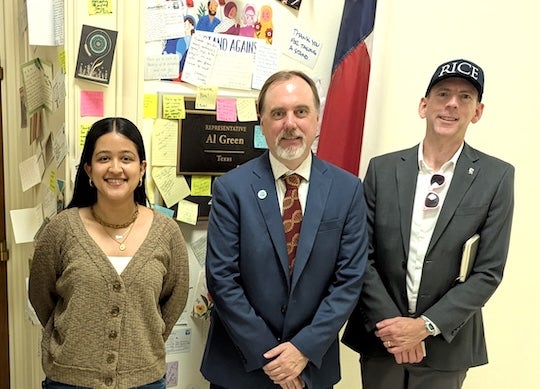
“Our fellows and their research collaborators are making groundbreaking discoveries, supported by taxpayer investment into the National Institutes of Health and National Science Foundation,” said King, who is also a CPRIT Scholar. “These include medical imaging technologies that identify tumors earlier and with greater accuracy; therapies delivered exactly to the tissues that need it, minimizing side effects; and point-of-care diagnostics that serve rural communities that may be far from a major medical center. There is an art to telling these inspiring stories to nonspecialists, and AIMBE provides training in this style of communication to all new fellows.”
As incoming president of AIMBE, King will play a leading role in those conversations, supported by other members of Rice faculty committed to ensuring that scientific expertise continues to inform national decisions on funding and innovation.
“I hope to contribute to securing an ambitious, well-funded and stable NIH extramural funding portfolio, and to help catapult the best and brightest bioengineers to even greater success in whatever sector they work in: academia, industry or government labs,” King said.