
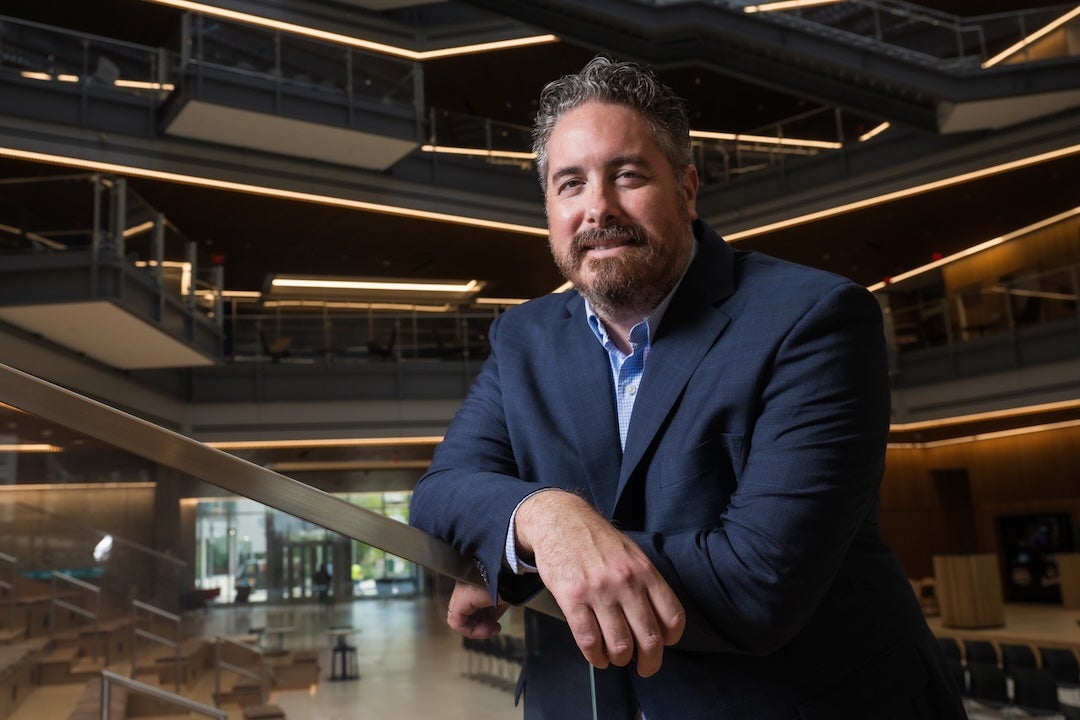
Michael King, a bioengineering professor at Rice University who focuses on the behavior of cancer and immune cells in the bloodstream, was selected in August as a founding member of a new state advisory committee examining the use of artificial intelligence in cancer research.
The Cancer Prevention and Research Institute of Texas (CPRIT) established the 11-member Advisory Committee on AI (ACAI) as the technology increasingly plays a role in biomedical research. The committee will advise CPRIT on the potential of AI to accelerate cancer research, prevention and the proposal process, while ensuring that its use is responsible and ethical.
“AI provides cancer researchers with new ways to work with complex biological data, automate laboratory experiments and even generate hypotheses, but its value will depend on how carefully we apply and evaluate these tools,” King said. “Through this committee, we have an opportunity to help Texas advance innovation while keeping rigorous science and responsible use at the center of the work.”
Research focus
King is the E.D. Butcher Professor of Bioengineering at Rice and a CPRIT Scholar. He also acts as a special adviser to Rice’s provost, Amy Dittmar, on life science collaborations with the Texas Medical Center, and serves as associate vice president for research.
This appointment aligns with Rice’s 10-year strategic plan, Momentous, which identifies responsible AI as a key catalyst for the university’s ambitions in teaching and research with health innovation as one of its primary research priorities.
King’s research zeroes in on the forces affecting cancer and immune cells as they circulate through the bloodstream and migrate through the body. His laboratory investigates the transport of circulating cells, the delivery of anticancer therapies through the blood and how cells respond to the mechanical forces generated by fluid flow or focused ultrasound.
For over two decades, his laboratory has used the biology and physics of blood circulation to explore how cancer spreads throughout the body. King’s team also develops three-dimensional laboratory models of bloodborne metastasis, enabling them to study cancer cells as they migrate from one part of the body to another or respond to therapeutic interventions.
Collaborative expertise
King will contribute this expertise to a committee composed of members from academic institutions in El Paso, Austin, College Station, Houston and Dallas. CPRIT’s Oversight Committee voted to create the panel Aug. 19.
The committee will take a comprehensive approach to assess emerging computational tools while positioning King’s work in cancer bioengineering within a broader context. Rather than focusing solely on a single research project, the committee will explore how AI can be integrated into various cancer research efforts across Texas.
This panel is part of a larger state investment in cancer research. CPRIT was created in 2007 with voters approving its funding in the same year. In 2019, voters authorized an additional $3 billion, bringing the state’s total commitment to cancer research and prevention to $6 billion.
CPRIT has allocated over $4.2 billion to Texas institutions and organizations through academic research, prevention and product development programs. It has also recruited 362 cancer researchers to 20 research institutions throughout Texas.