
By Raji Natarajan
Special to Rice News
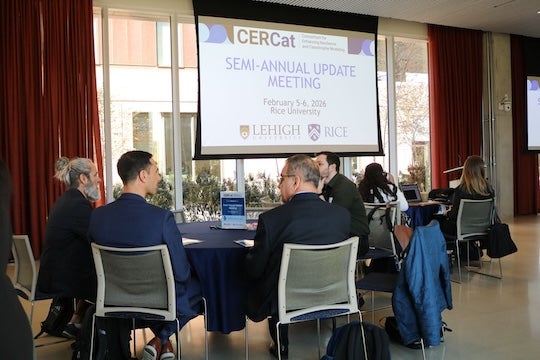
The Consortium for Enhancing Resilience and Catastrophe Modeling (CERCat) — a landmark partnership between Lehigh University and Rice University — convened at Rice Feb. 5-6 for its semiannual meeting.
Established in April 2025, CERCat is a dynamic research hub uniting academia and industry to advance the science of catastrophic risk modeling and resilience assessment. By bridging the gap between academic innovation and the practical needs of the private and public sectors, CERCat ensures the next generation of catastrophe models are grounded in the latest science and offer practical solutions to real-world scenarios.
This meeting featured comprehensive midyear updates on six projects launched at the inaugural meeting of CERCat held at Lehigh in August 2025 and served as a critical touchpoint to ensure the consortium’s research remains aligned with the evolving catastrophe modeling and resilience assessment needs of its industry partners.
The meeting commenced with opening remarks by Jamie Padgett, deputy director of CERCat and the Stanley C. Moore Professor in Engineering and chair of the Department of Civil and Environmental Engineering at Rice’s George R. Brown School of Engineering and Computing. “CERCat is very appreciative of the strong support from top leadership at Rice and Lehigh,” Padgett said. “We have embarked on an exciting journey with our universities and industry partners — one that will accelerate innovation in catastrophe risk modeling.”
In his welcome address, Rice President Reginald DesRoches, a renowned earthquake engineer who has made hallmark research and service contributions to seismic risk modeling and mitigation, added, “These projects address some of the most challenging issues of our times. This meeting has brought together experts from academia, industry and practice in the same room. When rigorous research meets real-world needs, we build knowledge that can be applied and lead to real progress. CERCat represents the finest example of how deep expertise in engineering and hard sciences can be translated to positive impact for communities, infrastructure, business owners and decision-makers.”
CERCat research projects combine knowledge from various disciplines and use computational modeling approaches to predict extreme weather hazards and assess vulnerability and postdisaster damage to infrastructure and structural systems and other threats to the regional economy and community. This knowledge is central to the work in critical sectors like insurance, reinsurance, brokerage, engineering consulting and climate tech and risk modeling firms, among many others.
Among the projects presented at this CERCat meeting, the following two exemplified how a combination of physics-based and artificial intelligence-based models are now being used to advance research in disaster risk and resilience.
AI-driven damage assessment
Led by Maryam Rahnemoonfar, associate professor of computer science and engineering and civil and environmental engineering at Lehigh, the AI-Driven Damage Assessment project integrates AI and remote sensing to advance post disaster response by developing machine learning systems that process diverse data sources in real time, enabling timely and reliable damage assessments.
“Most AI systems rely on large amounts of labeled data for training, yet after a disaster, we must perform damage assessment in real time, often when no labeled data are available,” Rahnemoonfar said. “In addition, current AI approaches do not generalize well across different disaster types, data sources or operational needs. Our work addresses this gap by developing multimodal foundation models that can operate across different sensors and image modalities, enabling rapid and scalable analysis in evolving disaster environments.”
Recent advancements in the work include the development of an AI-based surrogate model for rapid and accurate flood depth estimation and the design of machine learning algorithms to classify post disaster damage— none, minor, major or destroyed — following hurricanes and floods. Using Hurricane Melissa as a case study — a recent event lacking labeled data — the research mirrors unpredictable real-world conditions.
By developing machine learning models capable of analyzing multimodal data in real time, the project allows authorities and insurers to conduct rapid, accurate damage assessments immediately following a catastrophe.
AI-driven hazard modeling
Led by Avantika Gori, assistant professor of civil and environmental engineering at Rice, another CERCat project aims to develop a multiscale framework to understand how changes in regional climate affect the probability and severity of damaging hurricane winds and rainfall at the local level.
“Since there is limited observational data for hurricanes, we are using a multipronged approach that combines reanalysis data and climate model simulations and leverages reduced-physics models and state-of-the-art artificial intelligence models to generate large ensembles of synthetic hurricane tracks,” Gori said. “Using these track ensembles, we can understand which climate factors drive the year-to-year differences in hurricane landfalls and hazards. Our eventual goal is to understand how changes in sea surface temperatures, and complex climate patterns such as El Niño and La Niña, determine if a tropical storm will turn into a hurricane, what its potential speed and path will be and finally how it will make landfall and die out.”
Recent advancements in the work include benchmarking the ability of large AI foundation models to simulate tropical cyclones and developing self-organizing maps, a machine learning technique, to predict hurricane paths and landfall patterns and how they vary from year to year depending on overall climate conditions.
The improved weather and hazard models resulting from this work will offer precise hyperlocal simulations that will greatly benefit communities, authorities and decision-makers in disaster preparedness and protect lives and structures from hurricane and flood damage.
Ensuring the future of catastrophe modeling and resilience
In addition to advancing research, CERCat also supports a vital talent pipeline, ensuring that the work it has initiated will be carried forward by future generations of multidisciplinary scholars and practitioners and propelling rising subject matter experts into leadership roles where they will shape resilience strategies across the private and public sectors.
A poster session at the end of the first day provided opportunities for students and postdoctoral researchers from Rice, Lehigh and partner universities to showcase their research and network with academic and industry leaders. Attendees cast votes for the most compelling projects with top honors awarded to two researchers. The winners included Jainish Patel, a doctoral student from Rice, for the presentation “Risk Assessment of Coastal Structural Portfolios: Accounting for the Effects of Neighboring Structures,” and WoongHee Jung, a postdoctoral researcher from Lehigh’s Center for Catastrophe Modeling and Resilience, for the presentation “Development of Empirical Wildfire Fragility Curves for Residential Buildings in California.”
“The establishment of the consortium is a milestone for both Lehigh and Rice,” said Paolo Bocchini, professor of civil engineering and director of CERCat and Lehigh’s Center for Catastrophe Modeling and Resilience. “By uniting the intellectual capital of premier R1 research institutions with the operational context and practical needs of industry leaders, we are turning academic discovery into pragmatic solutions for society’s most complex challenges.”
Guided by industry expertise
Providing strategic guidance for the consortium is the CERCat Industry Advisory Board (IAB), consisting of representatives from nine partner companies spanning insurance, reinsurance, catastrophe modeling vendors and engineering and consulting firms. This distinguished group of experts provides essential governance, helping to shape and prioritize CERCat’s research portfolio. The inaugural board members represent:
- Arch Insurance
- Ariel Reinsurance
- Chubb Insurance
- CLIMET Consulting
- Erie Insurance
- Everest Reinsurance
- Moody’s
- Private Client Select
- Simpson Gumpertz & Heger
By fostering direct collaboration between academic researchers and the IAB, CERCat ensures that its scientific advancements are actionable and transformative for global resilience efforts.
“Through the IAB, industry partners are not just observers; they are active collaborators,” added Kurtis Malone, CERCat IAB chair and senior research catastrophe analyst at Arch Insurance. “This group ensures that research frontiers — from AI to structural engineering — yield the most critical solutions for the global risk community.”
For more information about CERCat and its research projects, please visit www.catmodeling.org.