
By Kristin Puhl Krueger, Rice ENRICH
Special to Rice News
Rice University and Houston Methodist have selected interdisciplinary research teams for the inaugural Houston Methodist-Rice Center for Human Performance seed grant program, advancing pilot studies that aim to transform rehabilitation, injury prevention and human performance across clinical and athletic settings. The awards, supported by Rice’s Office of Educational and Research Initiatives for Collaborative Health (ENRICH), reflect the university’s growing leadership in health-focused research and its deepening partnership with Houston Methodist.
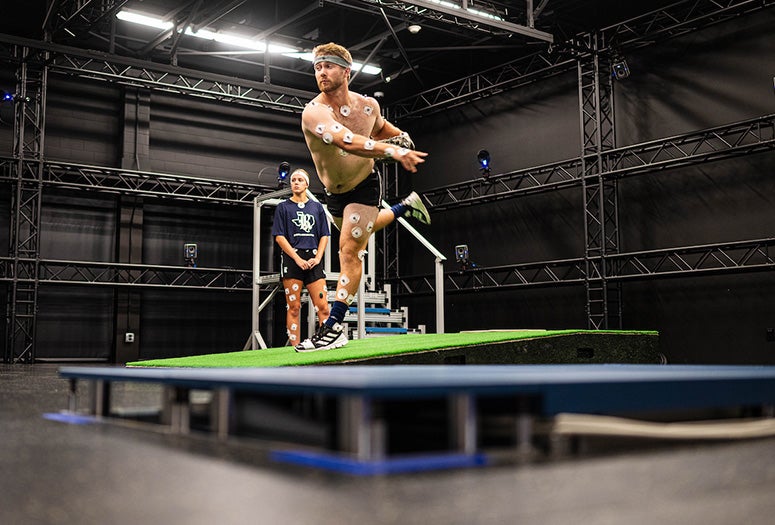
Launched in 2022, the Center for Human Performance (CHP) serves as a joint innovation hub where physicians, researchers, trainers, coaches and students work together to understand and enhance human physical capability. The CHP is co‑directed by Augusto Rodríguez, chair of Rice’s Department of Kinesiology, and Dr. Patrick McCulloch, orthopedic surgeon at Houston Methodist, who together guide the center’s collaborative vision and research strategy. Its state‑of‑the‑art facilities on Rice’s campus support biomechanics, exercise physiology, imaging, wearable‑technology evaluation and translational research. This enables teams from both institutions to study movement, recovery and performance in ways that directly inform clinical practice and athletic training.
Building on this mission, the seed grant program supports collaborative pilot studies that leverage the center’s facilities to advance research in musculoskeletal regeneration, orthopedic innovation and human performance. Each project is jointly supported through a co‑funding model in which Rice and the Houston Methodist Academic Institute each sponsor their institution’s principal investigator, reinforcing the collaborative structure of the CHP.
“Since the conception of this idea, our goal for the Center for Human Performance was to create a space where Rice researchers and Houston Methodist clinicians don’t just coexist but truly innovate together,” Rodríguez said. “These seed grants, made possible through the support of the Office of ENRICH, serve as the essential facilitator for that collaboration. By strengthening the pathways for our faculty to collaborate with clinical partners, we are taking deep, interdisciplinary expertise from across Rice, bridging sports medicine, natural sciences, public health sciences and sport management, and applying it directly to challenges like muscle preservation and injury prevention. It’s about moving discoveries from the research lab into the training room and the clinic to deliver a transformative impact on society.”
The seed grants follow the multidisciplinary research and networking event organized by the two institutions, which brought together Rice faculty and Houston Methodist clinicians to explore collaborative opportunities and learn about the center’s capabilities. The newly funded projects represent several Rice departments and highlight the university’s breadth in human performance research, spanning health and well-being, sports management and psychological sciences.
The three awarded projects demonstrate the power of Rice-Houston Methodist collaboration highlighting innovative approaches to rehabilitation, injury prevention and human performance. They are:
Combatting Muscle Loss in Obese Adult Patients on GLP‑1 Medications Through Dietary Counseling and Exercise During Treatment
Primary Investigators:
- Anatolia Vick-Kregel, senior assistant director of health and well-being and director of the Lifetime Physical Activity Program in the Department of Health and Well-Being at Rice
- Bradley Lambert, assistant research professor of orthopedic surgery, orthopedics and sports medicine at Houston Methodist
Addressing a growing clinical challenge, this study focuses on muscle and bone‑density loss associated with GLP‑1 medications used for weight management. As GLP‑1 use expands across diverse patient populations, the project responds to an increasing need for evidence‑based strategies that protect musculoskeletal health and long‑term function during treatment. Through targeted dietary counseling and structured exercise interventions, the study will evaluate strategies to preserve muscle and bone mass and improve metabolic health in nondiabetic obese adults undergoing GLP‑1 treatment.
The project underscores Rice’s commitment to translational research by combining pharmacologic treatment with supervised diet and exercise interventions, enabling researchers to evaluate how these therapies work together to support muscle and bone health in adults using GLP‑1 medications.
Utilizing Ultrasound‑Based Shear Wave Elastography to Assess UCL Changes in Collegiate Pitchers
Primary Investigators:
- Scott Powers, assistant professor of sport analytics and director of the Hutchinson Leadership Initiative in Sport Analytics, Department of Sport Management at Rice
- Robert Jack, orthopedic surgeon, orthopedics and sports medicine at Houston Methodist and assistant professor of clinical orthopedic surgery at the Houston Methodist Academic Institute
This project uses shear wave elastography, a noninvasive imaging method that measures ligament stiffness, to examine how a single pitching session affects the ulnar collateral ligament (UCL) in NCAA Division I collegiate baseball pitchers. By tracking UCL stiffness over a 96‑hour recovery window and pairing those measurements with athletes’ self‑reported elbow health and fatigue, the study will provide insight into how the ligament responds to acute workload and how quickly it recovers.
The findings could help shape individualized workload‑management and injury‑prevention strategies for pitchers, with implications for athlete health and performance at both collegiate and professional levels. The project supports CHP’s mission to advance evidence‑based approaches to performance optimization and reduce injury risk.
Exercise‑Induced Blood‑Derived Exosomes: Metabolic Profiling and Therapeutic Potential for Postsurgical Recovery and Aging Populations
Primary Investigators:
- Christopher Fagundes, professor of psychological sciences and director of the Institute of Health Resilience and Innovation, Department of Psychological Sciences at Rice
- Francesca Taraballi, associate professor of orthopedic surgery and director of the Center for Musculoskeletal Regeneration at Houston Methodist
This project examines how different types of exercise — such as aerobic, resistance and combined training — prompt the body to release blood‑derived exosomes, tiny vesicles that carry molecular signals known as exerkines. These signals may help regulate inflammation, support tissue repair and shape the body’s response to stress and recovery. The team aims to identify which exercise‑induced signals have the strongest regenerative and anti‑inflammatory potential.
The long‑term goal is to uncover the body’s natural “exercise signals,” so they can inform the development of exercise‑mimetic therapies for people who cannot engage in sufficient physical activity, including older adults and individuals recovering from surgery. This work directly supports the center’s mission to advance targeted biological therapies and improve musculoskeletal health.
Together, the selected projects illustrate the growing momentum of the Rice-Houston Methodist partnership and the expanding research anchored by the CHP. Each study brings a distinct disciplinary lens to shared challenges in recovery, injury prevention and performance optimization, reflecting the strength of the collaboration and the breadth of expertise across both institutions.
Over the next year, award recipients will advance their pilot studies and generate the foundational data needed to pursue larger external funding and broader clinical or translational impact. Investigators are expected to share their findings through peer‑reviewed publications and national conference presentations, extending the reach of the program beyond the initial award period.
As Rice continues to grow as a leading nonmedical institution in health research, the university remains committed to supporting interdisciplinary work that accelerates health discovery and, through the CHP, improves mobility and performance outcomes across diverse populations. Rice is strengthening pathways for faculty to collaborate with partners across the Texas Medical Center through the Office of ENRICH, supporting research that delivers transformative societal impact.