
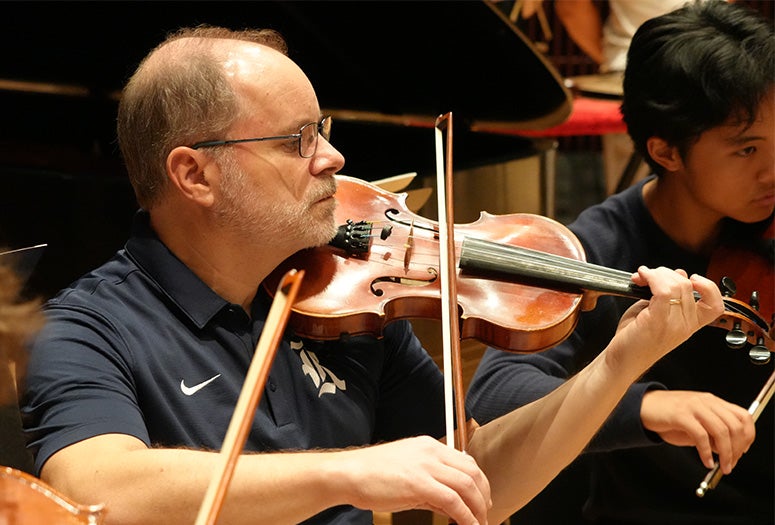
On weekdays, David Sholl helps steer one of the nation’s leading research universities as Rice University’s executive vice president for research. He leads the Office of Research at a time of record growth, his days running from meetings with institute directors to searches for senior leaders, often with a lunch meeting in between.
But his Saturday mornings belong to Rice’s Campanile Orchestra, an ensemble for nonmusic majors hosted at the Shepherd School of Music, in which Sholl plays violin. At a university built on research, Campanile gives students with bright futures in other fields a place to keep making music.
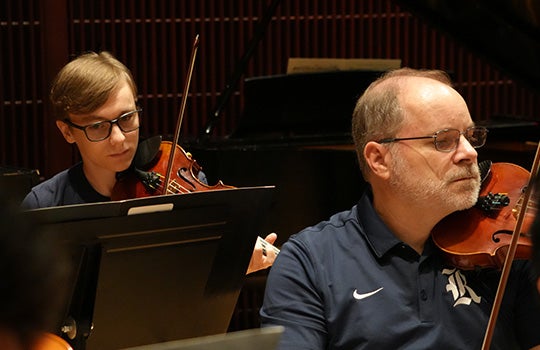
At the first rehearsal of the fall semester in August, Sholl shared a music stand with one of them: Andrew Cherry, a senior majoring in chemistry.
“I wasn’t expecting that,” Cherry said. “The thing that’s so cool about Campanile is that it includes community members and professors as well as students. I thought that was a really unique experience.”
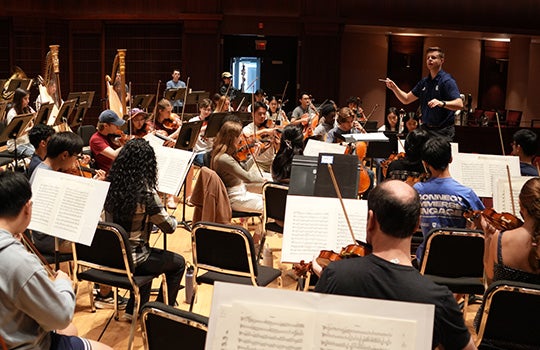
Sholl, who arrived at Rice in January, said he found his way to the orchestra through Matthew Loden, the Lynette S. Autrey Dean of Music, who encouraged him to join Campanile.
“I’ve played the violin since I was 5 years old, so I’ve played it far longer than any of the students in the orchestra have been alive,” Sholl said.
Miguel Harth-Bedoya, the orchestra’s music director and the Shepherd School’s distinguished resident director of orchestras and professor of conducting, said the roster also includes staff, alumni who want to keep playing and people across the Houston area who studied music earlier in life and still want an outlet for it.
“The person you sit with becomes your music partner,” Harth-Bedoya said. “Having David sitting next to a student is the best thing for both of them.”
Harth-Bedoya counts his time with nonmusic majors among his points of pride at Rice. His conversations with them, he said, shape what he brings back to his music majors.
Cherry has played violin on and off since third grade but had it in mind when he transferred to Rice from Cal Poly.
“One of the main reasons I chose Rice was the opportunity to play in an orchestra for nonmusic majors,” Cherry said. “A lot of schools only have orchestras for majors or students in a music school.”
The ensemble also serves as a training ground for the Shepherd School’s graduate conductors. Three master’s students in orchestral conducting, Ana Spasovska, Kyle Haake and Clayton Hinton, serve as associate conductors this year and lead rehearsals and concerts alongside Harth-Bedoya.
“The student conductors treat us like a professional-quality orchestra, and the standard they get from all the musicians makes it really fun,” Sholl said. “It’s a testament to the talent of our students that, in addition to everything they’re studying, they are also skilled musicians.”
Audiences can hear those musicians at 4 p.m. Nov. 22 in Stude Concert Hall at Alice Pratt Brown Hall. The program features Brahms’ Hungarian Dance No. 5, Copland’s “An Outdoor Overture,” Tchaikovsky’s “The Nutcracker Suite” and Rimsky-Korsakov’s “Capriccio espagnol.” Admission is free, but tickets are required. The concert will also be livestreamed.
Cherry said his favorite piece is the Rimsky-Korsakov, for its whimsy. Sholl picked the Tchaikovsky. It may be a Christmastime staple, he said, but the skill and detail the composer put into it make it beautiful music and fun to play.
“When members of the orchestra are touched by the power of music that they themselves produce, it’s the most rewarding thing,” Harth-Bedoya said.