

As workplaces become more religiously diverse, many organizations still struggle with how to navigate conversations about faith. Experts say religion is too often ignored, misunderstood or treated as too divisive for professional life.

Rice University sociologist Elaine Howard Ecklund has spent years studying that challenge. Through surveys of more than 15,000 workers and job seekers, focus groups with religious leaders and employees, in depth interviews and extensive analysis of existing scholarship, Ecklund has explored how religion shapes people’s experiences at work and how organizations can better support employees of all faiths as well as those with no religious affiliation.
“Whether or not you are personally religious, religion still matters in society,” said Ecklund, professor of sociology, the Herbert S. Autrey Chair in Social Sciences and director of Rice’s Boniuk Institute for the Study and Advancement of Religious Tolerance. “Most workplaces don’t quite know what to do with faith. It often gets simplified, avoided or treated as something too divisive to bring into professional life.”
Her research suggests that religion is often viewed as a workplace problem to manage rather than an important part of many employees’ identities. Yet conversations about faith can reveal broader questions about ethics, belonging and inclusion that affect everyone in an organization.
“Faith is a window into bigger tensions around ethics, identity, belonging and the struggle to feel fully present at work,” Ecklund said. “Designing workplaces that work well for people of faith can teach us about designing work that works better for everyone.”
Rather than limiting her findings to academic journals, Ecklund wanted to make the research useful for the people most likely to encounter these challenges in their everyday lives.
“We imagined people sitting around in a book group reading the research,” she said. “I’ve even led a book group in my home with neighbors, a mix of academics and nonacademics. That’s really humbling because you quickly see where you could have done better.”
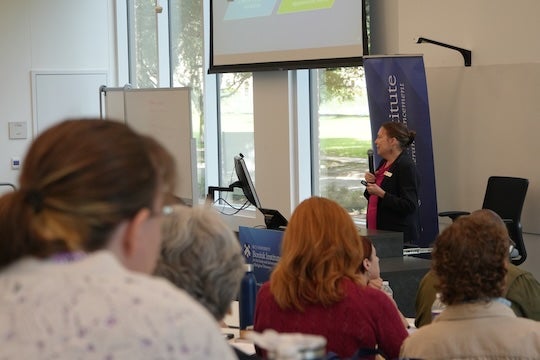
That commitment to public scholarship reflects Ecklund’s broader work at Rice and the Boniuk Institute, where researchers examine issues including religious discrimination, violence, tolerance and pluralism.
“I care deeply about doing research that matters to everyday people,” Ecklund said. “Leading the Boniuk Institute has been an amazing opportunity to join colleagues across disciplines in addressing issues of religious violence, discrimination and researching how societies can move toward greater religious tolerance and pluralism. Those are some of the most important issues in our world today, and all of that is happening in workplaces.”
The research has resonated well beyond academia. Ecklund has been invited to discuss her findings with religious organizations, faith based colleges and universities, major research institutions and professional associations, reflecting growing interest in how organizations can better navigate faith in today’s workplaces.
The research is detailed in Ecklund’s book “Working for Better: A New Approach to Faith at Work,” which she co-authored with Denise Daniels of Wheaton College.
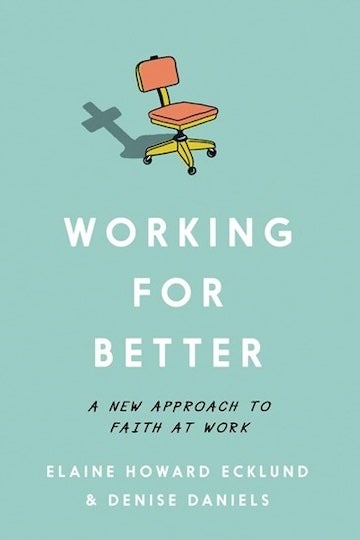
The book recently received the 2026 Outstanding Applied Research Award from the Religious Research Association, an international organization which recognizes scholarship on religion that is innovative, accessible and has meaningful public impact. The association cited the authors’ success in translating rigorous research into an engaging resource for a broad audience.
“I knew the book had been submitted, but you never think you’ll actually win something like this,” Ecklund said. “You don’t do the work to get recognized, but being recognized by peers in the field whose opinions you value is a huge encouragement.”
The award will be presented at the Religious Research Association’s annual meeting in Denver this fall. This research was funded by the Lilly Endowment Inc. (2017 0021).