
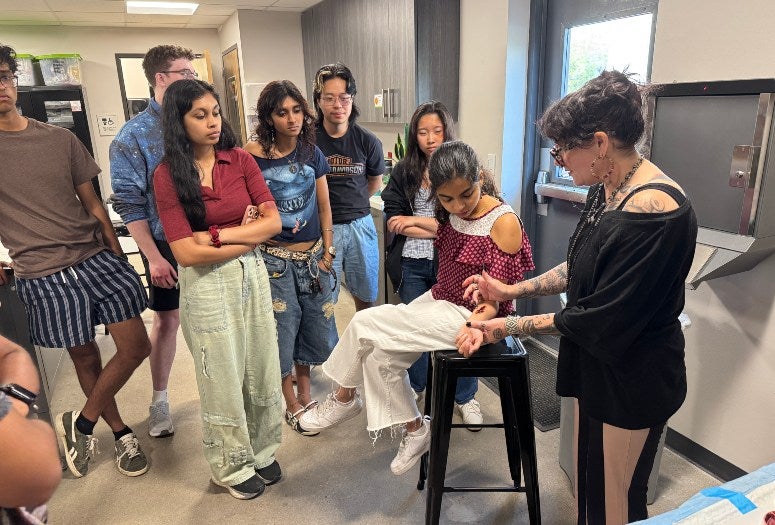
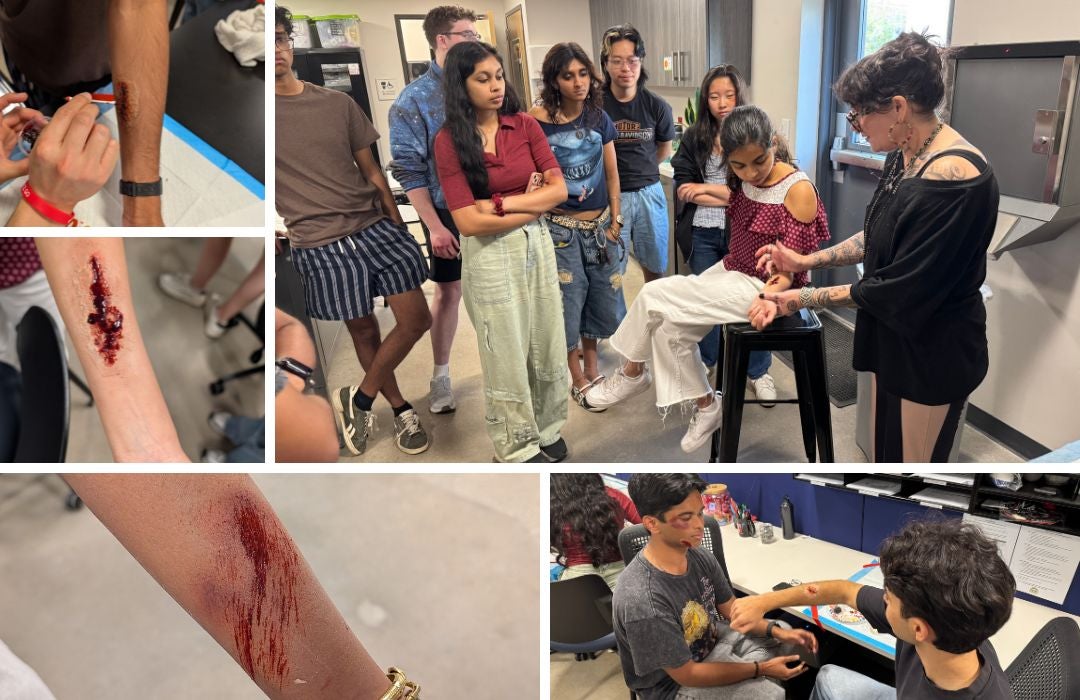
Rice University Emergency Medical Services (REMS) recently welcomed moulage artist Katie McKinney to campus for a hands-on workshop designed to enhance the realism of emergency response training. Through the use of special effects makeup, McKinney taught students how to recreate lifelike injuries — transforming standard simulations into immersive, high-impact learning experiences.
Moulage, the art of simulating wounds and medical conditions, plays a vital role in preparing future emergency responders. By allowing students to visualize injuries directly on a person rather than relying on descriptions or images, moulage deepens understanding and improves reaction time. Seeing a wound on skin makes scenarios feel more immediate and urgent, helping trainees better grasp the seriousness of patient care.
“It really helps students to have something a little more realistic,” McKinney said. “The realism really helps to give empathy and have less shock when they’re actually out in the field and experience those situations.”
REMS hosts moulage workshops every two to three years to ensure a steady group of trained volunteers capable of contributing to large-scale training scenarios. These simulations often mirror complex emergency situations — such as car accidents, significant falls or tool-related injuries — where responders must quickly assess wounds, evaluate vital signs and make critical decisions under pressure.
During the workshop, participants learned techniques to create a range of realistic conditions, equipping them with skills they can apply in future training exercises. The goal is not just visual accuracy but also to build an environment where responders must think and act as they would in real emergencies.
“As an EMS provider responding to scenes, when you see obvious trauma, you need to act promptly to address wounds, and learning how to do this while speaking to the patient about what occurred and checking vital signs are complex skills to do simultaneously,” said Lisa Basgall, REMS director. “When we can train with these visual cues of trauma, it makes it more realistic and helps us hone our skills.”
The REMS volunteers who attended the training immediately recognized its value.
“It helped me understand how you can tell slight differences between similarly categorized wounds, which is super helpful in REMS,” junior Akshara Sankar said. “This class was an amazing way to further understand injury as well as how it presents,” sophomore Dia Gupta said.
By incorporating moulage into these exercises, REMS enhances the authenticity of its training. The added realism challenges students to engage more fully, sharpening both their technical skills and their ability to manage high-stress situations. Ultimately, workshops like this help prepare volunteers for the unpredictable nature of emergency response, ensuring they are ready to provide effective care when it matters most.