
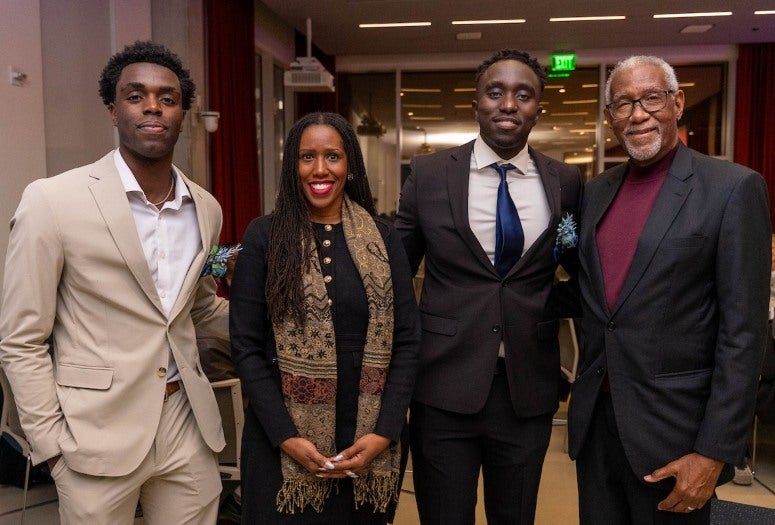
A Martin Luther King Jr. vigil and reflection event at Rice University opened with a powerful moment of collective voice as attendees rose together to sing “Lift Every Voice and Sing.” Filling the space with shared sound and purpose, the community joined in what is often called the Black national anthem — honoring its history, its spiritual weight and its enduring message of resilience and unity. The moment set a reflective tone for the evening, inviting participants to hold King’s legacy of justice, dignity and solidarity at the center of their thoughts as the program began.
Sponsored by the Rice Black Men’s Association, multicultural community relations in the university’s Office of Public Affairs and the Office of Access and Institutional Excellence, the evening hosted speakers including Alexander Byrd, vice provost for the office of access and institutional excellence; student poet Daijah Wilson; Roland B. Smith Jr., former associate provost and professor of education and sociology; and Elizabeth Hordge-Freeman, associate professor and associate chair of sociology.
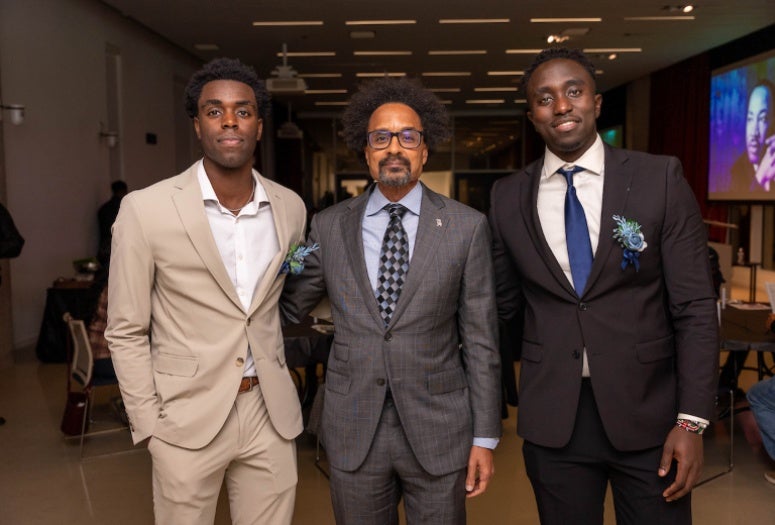
Byrd offered remarks that framed the vigil as more than a commemorative event, mentioning that it is, in his view, a central tradition in the life of the university. He described the vigil as “a ritual gifted to the university by its students" and placed it alongside hallmark campus moments like matriculation and commencement.
What distinguishes the vigil, he noted, is its ability to hold hope and tragedy together, creating a truer sense of what’s possible for Rice, Houston, the nation and the world.
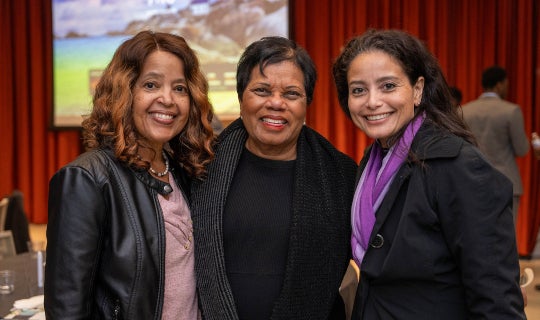
The evening’s theme came into sharp focus in comments by Wilson, a rising junior studying political science and social policy analysis. Wilson emphasized that nonviolence is not passivity or silence; instead, it is “discipline and courage guided by vision.”
She challenged the audience to recognize forms of harm that often go unnamed, arguing that violence can be systemic and structural: poverty, deprivation, environmental injustice, inaccessible housing and hyper-surveillance in workplaces. From that honesty, she made the case that nonviolence is not weakness; rather, it is strategy, and it requires that “the way we fight has to look like the world that we’re trying to create.”
Wilson named the places and ways she envisioned to create and sustain a vibrant future:
● In classrooms: the courage to teach truth and defend academic freedom.
● In careers: choosing work that heals, committing to service, organizing, providing mutual aid and reinvesting in communities.
● On campus: coalition-building across differences and showing up with solidarity and not relying solely on performance.
She closed with a poem, “A Truth Teller,” affirming that courage can be a two-edged sword balancing between refusing silence while also repeatedly choosing community over self.
Smith, who was introduced as a foundational leader in Rice’s diversity efforts, took the podium to describe a personal history and a lesson shaped by lived experience. He reflected on attending the 1963 march on Washington, D.C., as a high school student, describing it as serene, peaceful and transformative.
As a juxtaposition, he recounted his time as a student leader at Bowie State College, where students organized in response to threats to funding. In describing their strategy, he referenced King’s framework from the “Letter from Birmingham Jail”: collecting facts, negotiation, self-purification and direct action along with the community-building required to sustain it.
Smith’s most jarring memory arrived when he described being jailed with fellow student activists and learning, in that moment, that King had been killed. He shared the rage he felt and the hard decision to keep faith with nonviolent change rather than abandon it, believing that abandoning it would make King’s death meaningless.
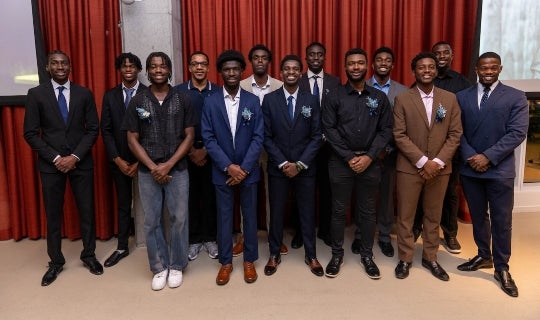
He then returned to a message he wanted students to carry: Their journey brought them to Rice for a reason. “You’re supposed to be here,” he repeated, urging students not only to belong at Rice but to “take Rice with you” into the work they do beyond campus.
The keynote delivered by Hordge-Freeman centered on a powerful metaphor that tending history is like a flame that must be cared for. She told a story from a recent family trip to Atlanta to visit the Martin Luther King Jr. National Historical Park. There, she expected to see King’s eternal flame, yet she found it extinguished alongside an emptied reflecting pool with cracked tiles.
For Hordge-Freeman, the image became a warning about how memory erodes. She underscored that it happens not all at once but through neglect, disrepair and selective remembrance. She connected that neglect to the present, naming how civil rights can be rolled back in real time, even while King is frequently quoted in ways that sanitize his message. She challenged the audience to consider whether society is honoring King’s legacy or attempting to neutralize it.
She also reframed what a vigil demands: the vigilance to tend to the ongoing threats dating not only to King’s time in history but beforehand as well.
In another key turn, she urged the community to remember the movement as more than a single leader’s story. She lifted up the broader infrastructure of change — including organizers, students, women, children and those whose names are often minimized or omitted — and emphasized that unity must be built with truth instead of avoidance.
Finally, she returned to the extinguished flame with a deeper conclusion. Movements endure not because a flame is always visible but because embers survive long after the flames dissipate.
“These embers are flecks of hope and possibility that exist even when the flames are gone, and these embers aren’t passive,” Hordge-Freeman said. “These are the things that we hold, that we pass on hand to hand, generation to generation.”
Her closing was a clarion call to the community to embrace the possibility to change the world around them.
The organizer’s final message echoed the night’s throughline: The vigil serves as a reminder to responsibly carry intention, to thoughtfully listen to and be present for those around us, to act with courage and to choose compassion even when it is difficult.