
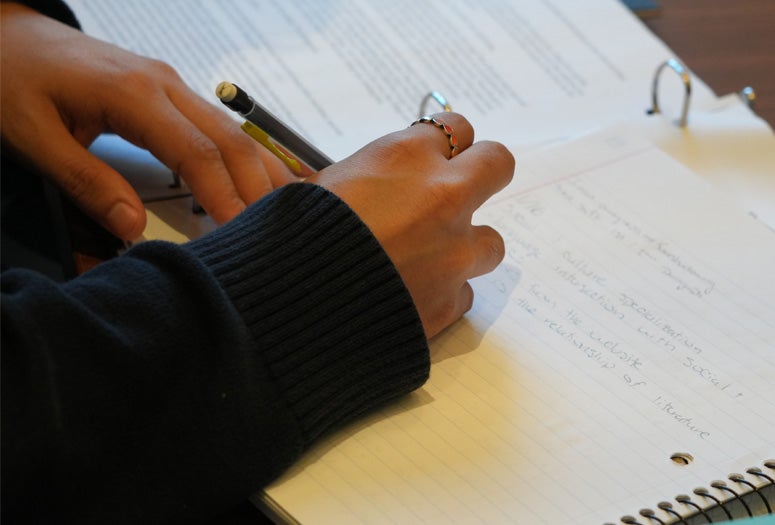
In an era when classroom technology is often treated as synonymous with innovation, a small number of faculty in Rice University’s School of Humanities and Arts are moving deliberately in the opposite direction.
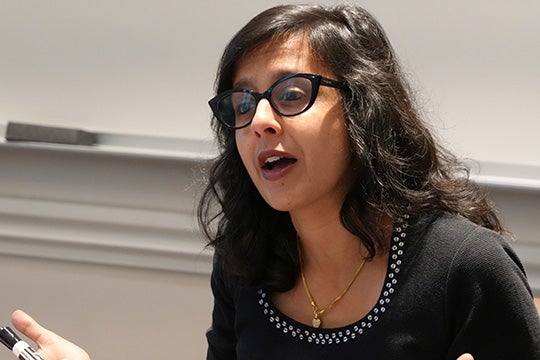
For English and creative writing assistant professors Ragini Tharoor Srinivasan and Benjamin Parris, the decision to limit or eliminate screens in certain courses isn’t nostalgic, reactionary or rooted in a fear of new tools. It reflects instead a carefully considered belief that reading, writing and discussion in the humanities demand conditions that are increasingly rare in students’ daily lives: sustained attention, physical engagement with texts — not text messages — and direct, unmediated conversation.
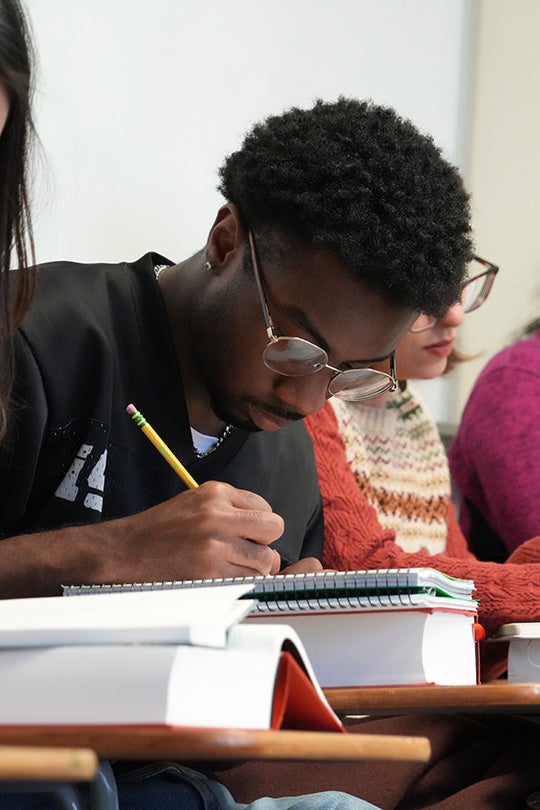
For years, Srinivasan encouraged students to read on paper and take notes by hand. Eventually, she stopped treating that approach as a suggestion. In several undergraduate courses, screens are set aside entirely.
“I have always aspired to create a low- or no-tech classroom,” Srinivasan said. “But it took me a while to make that an official policy because I wanted to be thoughtful about access, accommodations and what students actually needed to succeed.”
What ultimately pushed her to draw a firmer line wasn’t entirely the technology but what she saw slipping away in screen-heavy classrooms. Students struggled to remember what they had read even in recent semesters. Class discussions felt thinner. The tactile and cognitive experience of reading a book — its cover, its margins ready for annotation and its physical presence — had been replaced by a blur of digital PDFs.
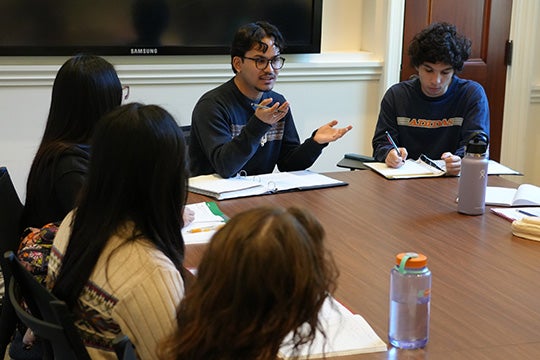
“I started realizing we were doing students a real disservice by not creating the conditions for optimal learning, reading, writing and thinking,” Srinivasan said. “They would read a lot online, but they couldn’t tell you what they had read or who wrote it.”
Srinivasan began printing course readings herself to make a screen-free classroom workable for all students, including those who didn’t have easy or affordable access to printing. She’s seen the payoff in the form of deeper discussion, stronger retention and a clear shift in how students engage with the material and with each other.
“Our students deserve a space where they can practice other modes of meaning-making,” Srinivasan said. “A humanities classroom should feel distinct. It’s a place where you slow down and build an intimate relationship to texts and ideas.”
Parris arrived at Rice with a similar philosophy. Having taught for more than two decades, he witnessed the gradual normalization of screens in classrooms and the subtle ways they reshaped student behavior.
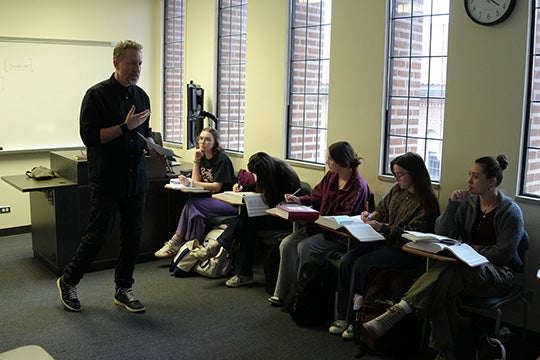
“When laptops first appeared, it wasn’t a problem,” Parris said. “But over time, I started seeing students fixated on screens. They were disengaging from me and from each other.”
By the early 2010s, Parris began banning screens in his classes. What followed surprised him.
“Without fail, students respond really effectively,” Parris said. “They appreciate having a screen-free environment. It creates a more supportive, deeply human way of engaging with each other and with the material.”
Parris is candid about the discomfort some students feel at first. For students used to working behind a laptop, the adjustment can be noticeable. He treats that discomfort not as a drawback but as an important part of learning how to be present in the room.
“If there’s an initial moment of anxiety when the screen goes down, that tells me something important,” Parris said. “It means they’re not used to direct, face-to-face engagement. And that’s exactly what we need to practice.”
Both professors emphasize that “low-tech” does not mean anti-technology. Course materials remain available on Canvas. Projectors are used selectively. Digital tools are still examined critically, especially when they themselves become objects of study.
“Being low-tech doesn’t mean banishing technology,” Srinivasan said. “It means being vigilant about the atmosphere we create for discussion and collaboration.”
That vigilance has taken on new urgency in the years following the COVID-19 pandemic when many faculty adopted digital practices out of necessity and compassion. Srinivasan, who has written widely about pandemic discourse and its lingering effects, noted that some of those habits (such as posting lecture notes in full) may now undercut the very skills students need to develop.
“We did a lot during COVID to make things easier for our students,” Srinivasan said. “But that didn’t always translate to learning. In some cases, it took away the work students needed to do to process and remember the material.”
For Parris, the broader stakes are ethical as much as pedagogical.
“Our world is already mediated through screens,” Parris said. “I want my classroom to resist that tendency and model something else: proximity, attention and genuine connection.”
Neither professor claims this approach is universal or appropriate for every discipline. But within the humanities, they see low- and no-tech classrooms as an affirmation of what their fields do best.
“We shouldn’t chase every new tool just because it exists,” Srinivasan said. “Our responsibility is to teach what we know: how to read closely, think critically and write with embodied intention.”