
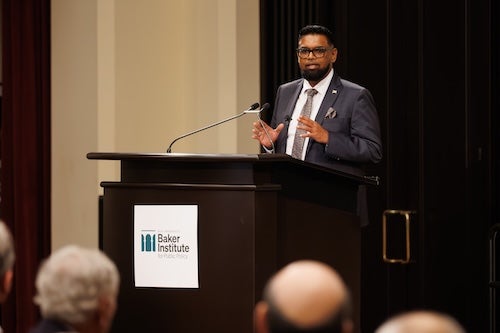
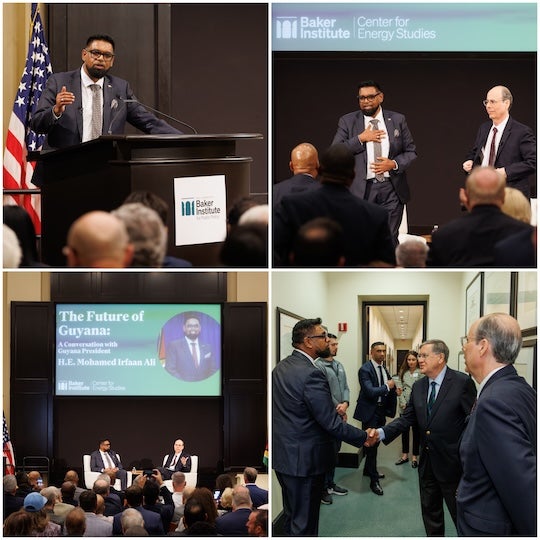
Rice University’s Baker Institute for Public Policy welcomed the President of Guyana Irfaan Ali May 4 for a discussion on Guyana’s rapid emergence as one of the world’s fastest-growing energy producers and its long-term development strategy. The program convened policymakers, academics and industry leaders to examine the country’s role at the intersection of energy security, shifting global dynamics and economic transformation.
Ali described Guyana’s strategy as centered on “energy balance,” emphasizing that the goal is not only to expand oil production but to leverage hydrocarbons to drive diversification, human capital development and long-term resilience.
“We see Guyana as utilizing this advantage to demonstrate to the world that there is a way in creating a balanced framework for national and global development,” he said.
Ali stressed that energy development must coexist with broader economic progress, noting that global frameworks have not sufficiently addressed how resource-rich developing countries can equitably benefit.
“President Ali’s visit underscores the Baker Institute Center for Energy Studies’ role as a global convening space where heads of state, industry leaders and researchers engage on the most pressing energy challenges of our time,” said Kenneth Medlock, director of the center. “Guyana sits at the intersection of rapid energy expansion, evolving global dynamics and structural economic transformation — raising complex questions we are well positioned to help explore.”
Francisco Monaldi, fellow and director of the Baker Institute’s Latin American Energy Program, highlighted the broader relevance amid geopolitical and market uncertainty.
“Latin America is increasingly central to global energy markets,” Monaldi said. “Guyana is a key case; its rapid rise as a major producer offers timely insights into energy security, investment flows and how resource-rich economies navigate volatility in a fragmented global system.”
A central theme of the discussion was managing rapid resource-driven growth. Ali acknowledged risks linked to the so-called “resource curse” and emphasized the need to invest in institutions, infrastructure and human capital.
“We are not interested in being a sacrificial lamb on the altar of global energy demand,” he said. “We are interested in being a model.”
In an armchair conversation with Monaldi, Ali addressed implementation challenges, including hydrocarbon expansion, investment attraction, infrastructure development, macroeconomic management and local content policy.
He also pointed to strategies Guyana is pursuing that align with ongoing Baker Institute research, including energy market design, resource governance, infrastructure investment and economic diversification, laying the groundwork for continued collaboration between Guyana and the Center for Energy Studies.
Since 1992, the Baker Institute has convened world leaders in Houston for rigorous, nonpartisan dialogue. The institute has hosted heads of state, ministers and senior officials from around the globe, serving as a trusted forum for discourse on the most pressing challenges facing Texas, the U.S. and the world.
The full discussion is available online, and highlights are available on the Baker Institute’s “Energy Forum” podcast.