
Before Kimberlé Crenshaw became an influential legal scholar whose ideas would reach far beyond academia, she was a 5-year-old girl trying to understand why she was never chosen to play the princess in her kindergarten classroom.
The experience would become one of many that taught Crenshaw to pay attention to patterns, question accepted explanations and find language for experiences that had not yet been named.
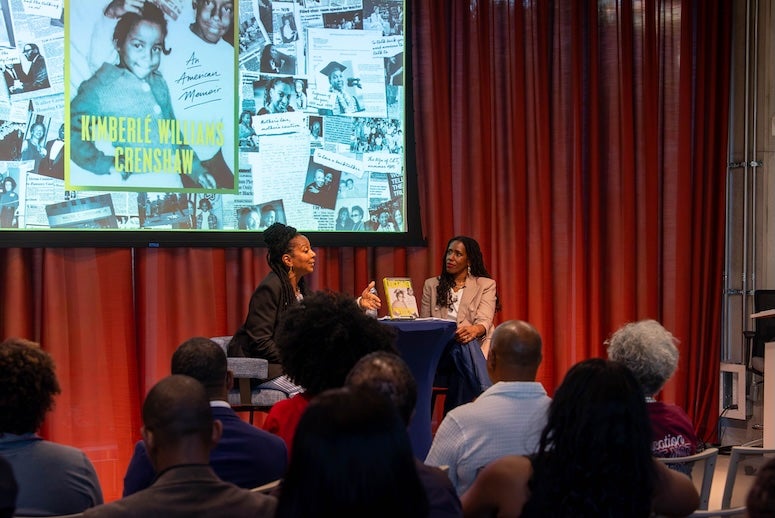
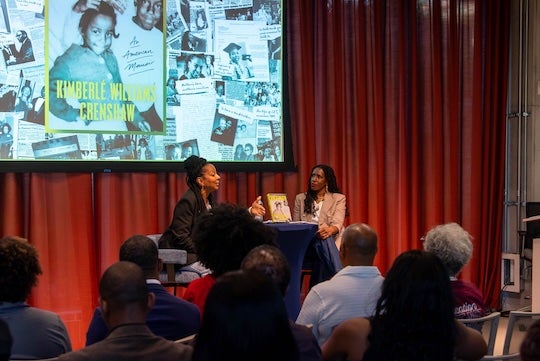
Decades later, Crenshaw brought that same approach to Rice University, where a packed audience gathered Sept. 14 for a wide-ranging conversation about race, gender, law, education and the experiences behind her new memoir, “Backtalker: An American Memoir.”
Hosted by Rice’s Department of Sociology, the event featured a conversation between Crenshaw and Elizabeth Hordge-Freeman, associate professor and associate chair of sociology with a joint appointment in the Center for African and African American Studies. Their discussion traced the personal and intellectual experiences that shaped Crenshaw’s scholarship, including her development of the concept of intersectionality and her role as a pioneering scholar of critical race theory.
For Hordge-Freeman, who described the chance to sit down with Crenshaw as an opportunity of a lifetime, the conversation also offered students a window into how lived experience can inform scholarship.
“This conversation gave students a front-row seat to see that our scholarship is not separate from our biographies,” Hordge-Freeman said. “When we bring our experiences and feelings into our work, lean into contradictions and unsettling moments and question what we think we know, this can become the foundation for rigorous, transformative scholarship.”
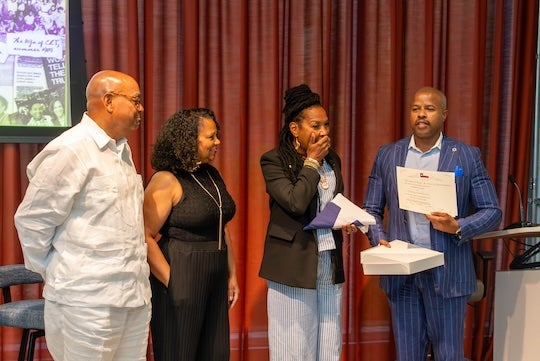
The evening also drew community members and local and state leaders, including state Rep. Ron Reynolds (D-Missouri City), Harris County Commissioner Rodney Ellis and Houston City Council member Monica Riley.
Reynolds presented Crenshaw with a Texas flag that had flown over the state Capitol and spoke about the significance of her appearance in Texas amid ongoing public debate surrounding critical race theory and diversity, equity and inclusion. He also recognized Rice for hosting the conversation.
For Jenifer Bratter, professor and chair of sociology, bringing Crenshaw to Rice reflected both the department’s academic mission and its commitment to bringing scholarship into conversation with the public.
“Our goal as sociologists is to do transformative work, and an important part of that is engaging the public,” Bratter said. “We are so excited to accomplish this by hosting a conversation with a trailblazing intellectual of professor Crenshaw’s stature.”
Crenshaw’s work, Bratter said, also speaks directly to questions at the heart of sociology.
“She reminds us that centering race and gender is an essential part of understanding how inequality works,” Bratter said. “This message is both needed right now and resonates with audiences within and beyond Rice.”
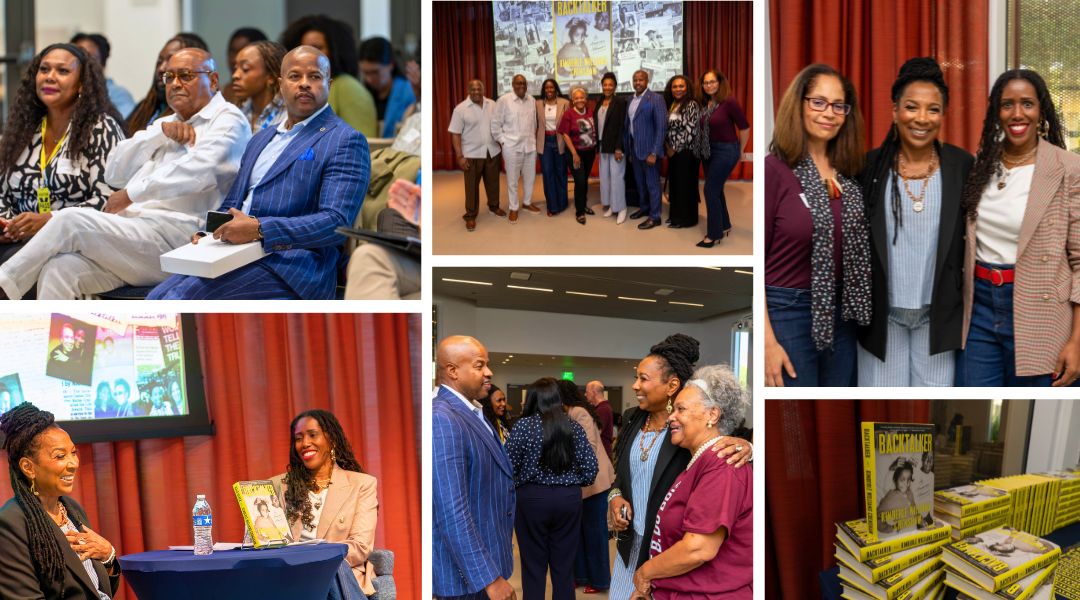
The event was presented in partnership with the W.E.B. Du Bois Legacy Foundation and the African American Policy Forum, which Crenshaw co-founded and directs. Crenshaw is also a professor of law at Columbia University and UCLA. Rice co-sponsors included the School of Social Sciences, Department of Anthropology and Center for African and African American Studies.
Crenshaw said the public debate surrounding ideas associated with her scholarship was part of what prompted her to write “Backtalker.” Rather than respond with another academic paper, she turned to the personal stories and experiences behind her thinking.
“The only way you can really get at that is to tell the stories,” she said.
For Crenshaw, those stories are also about “backtalking,” which she described not simply as disagreement or defiance but as questioning assumptions and the logic behind institutions and accepted ways of thinking.
“Backtalking is how we got to where we are as a people,” Crenshaw said. “We talk back against the logics that said we have no right to expect anything other than second-class citizenship.”
That idea also shaped her message to the audience about engaging with the world around them: Ask questions, develop ideas and don’t be afraid to challenge assumptions.
“Don’t accept the logics,” Crenshaw said. “Don’t accept the edicts.”