
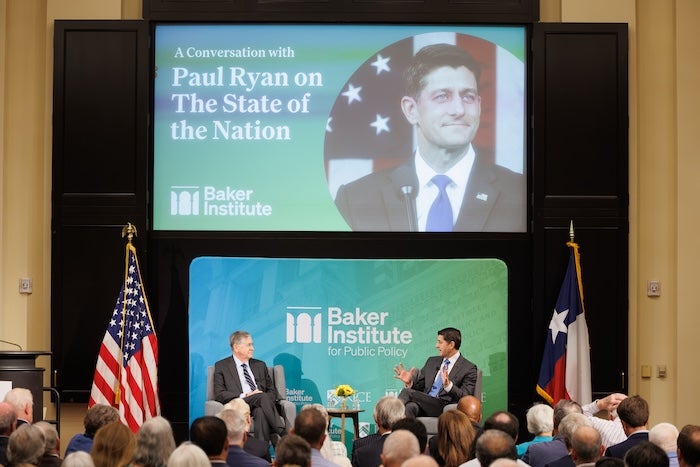
With the 2026 midterm elections approaching, former U.S. House Speaker Paul Ryan joined Rice University's Baker Institute for Public Policy for a conversation about the challenges shaping America’s economic outlook, political institutions and role in the world.
The event reflected the Baker Institute’s mission to bring experienced leaders and informed perspectives into public discussion of complex policy issues. In a wide-ranging exchange with Baker Institute director David Satterfield, Ryan drew on his two decades in Congress and experience as House speaker to examine the nation’s mounting fiscal challenges, the future of the Republican Party, trade policy and U.S. foreign relations.
Satterfield opened the discussion by outlining the questions facing voters and policymakers, from the country’s fiscal trajectory and economic competitiveness to the strength of American alliances and the prospects for bipartisan cooperation. He also highlighted the institute’s interest in evidence-based approaches to public policy, including efforts to reduce poverty and expand economic opportunity.
Ryan, who served as House Budget Committee chairman and later chaired the House Ways and Means Committee before becoming speaker in 2015, began with a warning about the federal government’s long-term finances. Although he described the economy as resilient, he argued that persistent deficits and rising costs for Social Security, Medicare and Medicaid threaten the country’s fiscal stability.
The challenge, Ryan said, is not a lack of potential solutions but a lack of political will to enact them. He called for presidential and congressional leadership to pursue reforms before a debt crisis forces action, including changes to future retirement and health care benefits. He also argued that tax reform could increase federal revenue without undermining economic growth, though spending on entitlement programs remains central to the problem.
Ryan also took the time to recognize the Baker Institute’s John Diamond – whose economic research and modeling resources Congress has been using for 20 years.
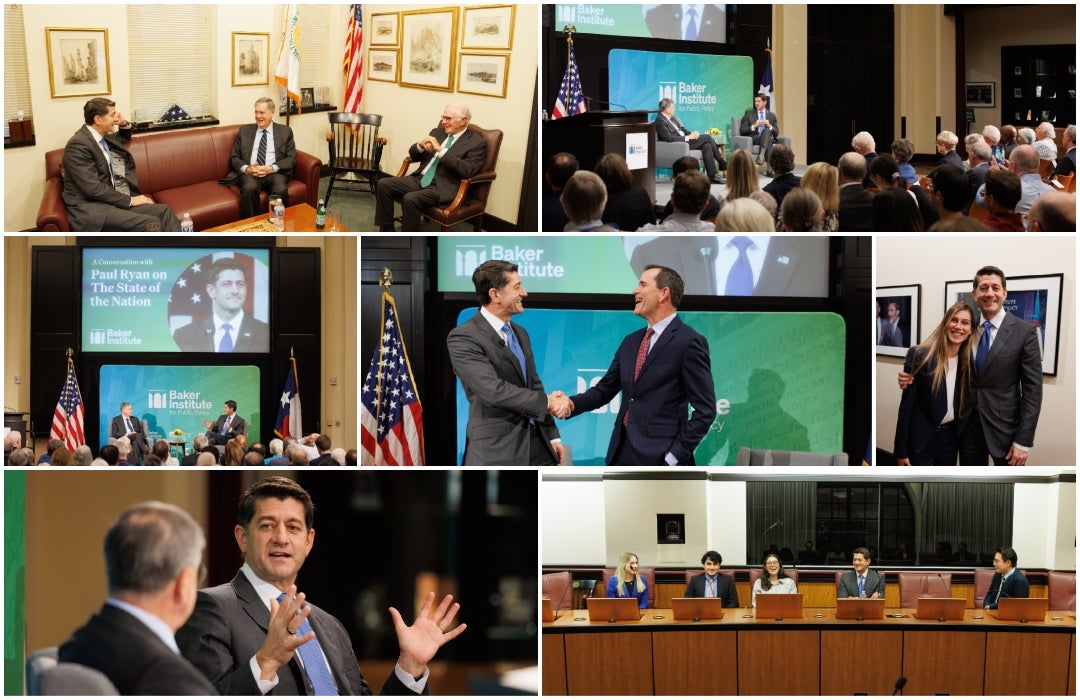
Turning to the midterm elections, Ryan predicted that a divided government would make major legislation difficult and could lead to a period dominated by congressional investigations. He also discussed the future of the Republican Party after President Donald Trump, describing an ongoing debate over whether the party will continue its nationalist-populist direction or return to a more traditional conservative philosophy.
Ryan said he believes the country could eventually move beyond the grievance-driven politics that currently shape both major parties. He suggested that voters’ frustration with polarization and unfulfilled promises could create an opening for leaders who emphasize practical problem-solving and bipartisan cooperation.
The conversation also explored America’s international standing. Ryan criticized broad-based tariffs, arguing that trade can benefit both sides and that trade conflicts risk raising consumer prices, weakening domestic industries and pushing U.S. allies closer to China. He advocated working with allies to address the national security challenges China poses while preserving trade where it does not compromise critical interests.
On foreign policy, Ryan expressed concern that recent U.S. decisions have weakened the country’s credibility on democracy and sovereignty. He also defended foreign assistance as an instrument of American influence, pointing to initiatives such as the President’s Emergency Plan for AIDS Relief as examples of how assistance can save lives and build goodwill. He argued that such programs should be accountable and clearly connected to U.S. interests rather than abandoned altogether.
Despite his concerns, Ryan closed on an optimistic note, citing the country’s resilience and the potential for future leaders to restore a more constructive political climate.