
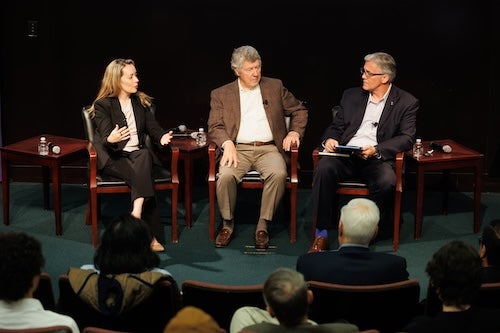
The Center for Energy Studies at Rice University’s Baker Institute for Public Policy hosted its annual Sustainability Summit, emphasizing the importance of systems thinking in addressing complex sustainability challenges. As sustainability efforts continue to evolve in response to global challenges, the event gathered researchers, industry leaders, policymakers and students to examine sustainability challenges through a systems-level perspective — the integration of economic, social and environmental factors as well as the role of policy, partnerships and innovation.
“What I want to say first about sustainability, and what differentiates us, is the fact that we look at this differently,” said Rachel Meidl, fellow in energy and sustainability and CES deputy director. “We look at entire systems. We recognize the complexity of the system and we look at it from a systems point of view, where we understand the dynamics between the three critical pillars of sustainability and the necessary balance that it requires to look at this. We are all familiar with the sustainable development goals; it’s something that’s familiar and that we see quite often. But what we don’t quite understand as a society is which one of these are the priority, how they interact with one another and who decides which is more important than the other.”
Sustainability can be thought of as a stool; it requires three legs to successfully stand. By looking at the “legs” of social, economic and environmental factors, CES argues that this systems-level perspective of sustainability can function as a core organizing principle for the economic advancement and welfare improvement of society as a whole.
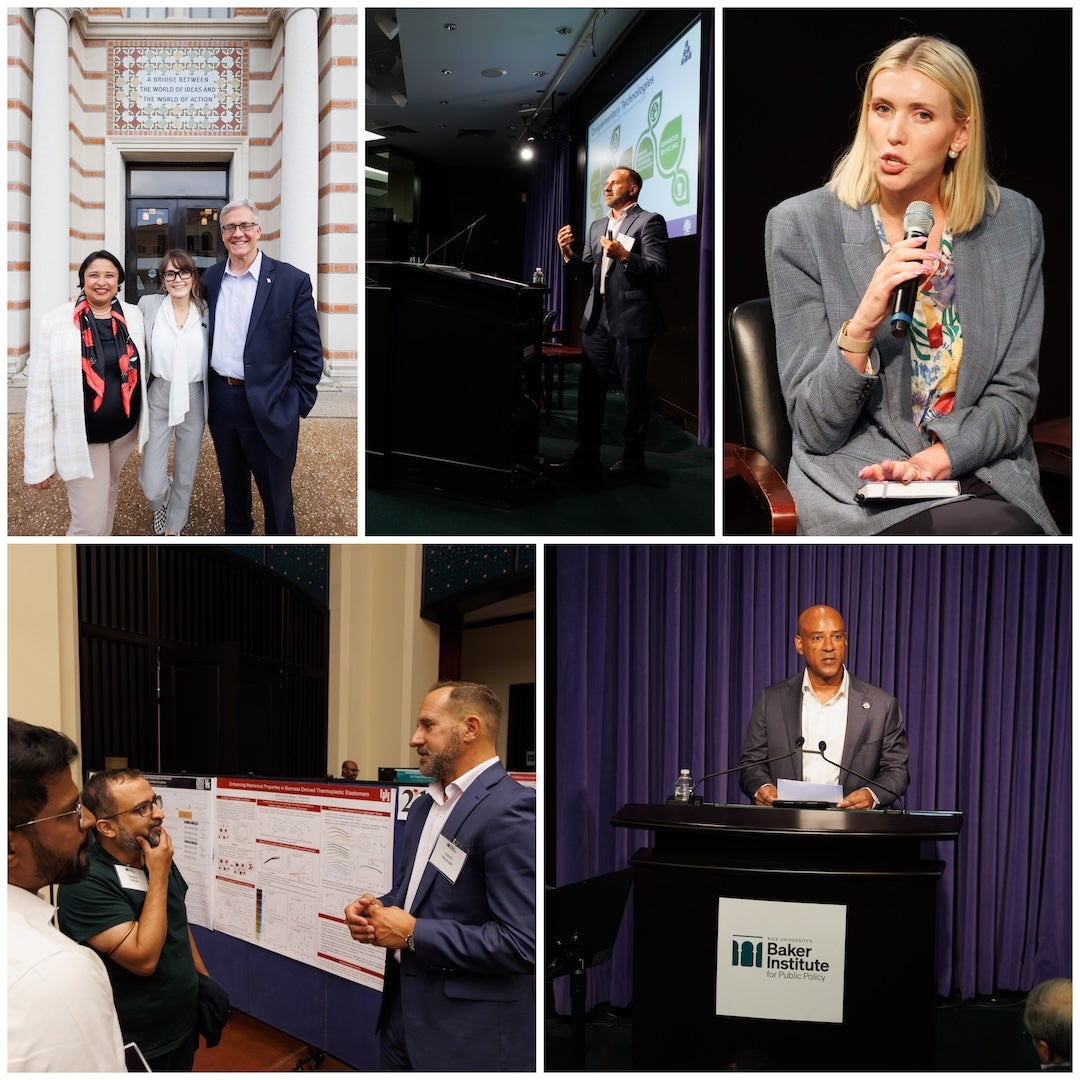
“The Baker Institute has long been a place where rigorous scholarship meets real-world impact,” Rice President Reginald DesRoches said, “where complex challenges are examined not in isolation but through the lens of policy, economics and society. This summit reflects that tradition at its very best: Sustainability is one of the defining challenges and opportunities of our time, and it is, by its nature, a systems problem as Rachel mentioned. It requires us to think across boundaries, across disciplines, across sectors and across communities.
“It asks us to consider not only the environmental conditions or dimensions but also the economic and social realities that shape how solutions are developed and adopted. The systems-level thinking is something Rice is deeply committed to advancing through our strategic plan Momentous: Personalized Scale for Global Impact. We are investing in research and education that brings together engineers, scientists, social scientists, humanists and policy experts to address complex global challenges whether we are working to generate sustainable energy solutions, develop new materials or design resilient infrastructure to better understand the human dimensions of environmental change.”
This idea is exemplified by the partnerships co-hosting the summit, Meidl said. The Recycling Science Council, of which Meidl is a member, and the University of Houston are thought partners of CES — creating greater impact together. CES and UH’s Energy Transition Institute recently signed a memorandum of understanding launching a strategic partnership to advance scalable, real-world solutions for plastics circularity. This collaboration marks the beginning of a broader effort that aligns research, technology innovation and cross-sector engagement to address systemic challenges.
“We’ve been really building the relationship with the University of Houston for years,” Meidl said. “We have so many crossover interests between the two institutions, and we see each other at many similar events. We do a lot of work on plastics and advanced recycling and circularity and all things sustainability, and so it made sense to me to conjoin these efforts. Instead of working as competitors, let’s lean into our competitive advantages. We could do greater things together — we are really taking a leadership role in a circular plastics economy, and that is our first initiative that we are working on. I mean, there’s no better place to do this than Houston, Texas.”
The summit also emphasizes the vital role of student-driven initiatives in addressing today’s most pressing multidisciplinary challenges. Graduate students from Rice and UH participated in a poster session, where they showcase their sustainability research in a visual medium to discuss with industry leaders. To cap off CES’ commitment to sustainability, Rice’s official certified vendor for responsible e-waste management, RAKI, was stationed at the event to help attendees recycle old electronics such as laptops, phones, keyboards and batteries.
CES provides data-driven insights on the role of economics, policy and regulation in the performance and evolution of energy markets. Its research and nonpartisan analysis are rooted in fundamental principles, making CES a trusted voice that investigates the drivers of energy market evolution. Learn more about the program, experts and research.