
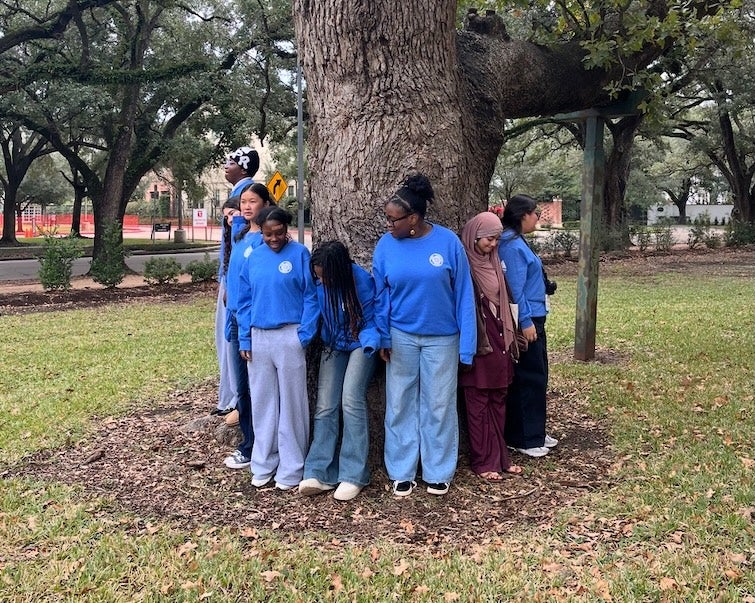
In the southwestern corner of Rice University’s campus, tucked between athletic fields and the Houston Medical Center, lies the Harris Gully, a detention basin built to divert runoff now being restored into a native wetland. It has a relatively new pond whose edges are covered in mulch and small grasses, a small batch of woody plants through which birds flitter and an open-air pavilion designed by associate professor Jesús Vassallo. It’s also the site of Cassidy Johnson’s Teaching in Restoration, Ecological and Environmental STEM (TreeSTEM) class, which uses the gully as its laboratory and the pavilion, called the Owl Deck, as its lecture hall.
TreeSTEM is a small class in which undergraduate students learn ecology field assays from graduate or upperclassmen mentors. Based in a community of practice model, the mentors teach students techniques ranging from soil analysis to pitfall invertebrate collection as they collectively gather data on the gully’s restoration process.
“Holding our TreeSTEM class at Harris Gully helps the students to realize that nature is everywhere, even in a major urban center,” said Johnson, an associate professor of biosciences. “This location empowers the students to be more aware of their local environment while training them on the tools used to study it.”
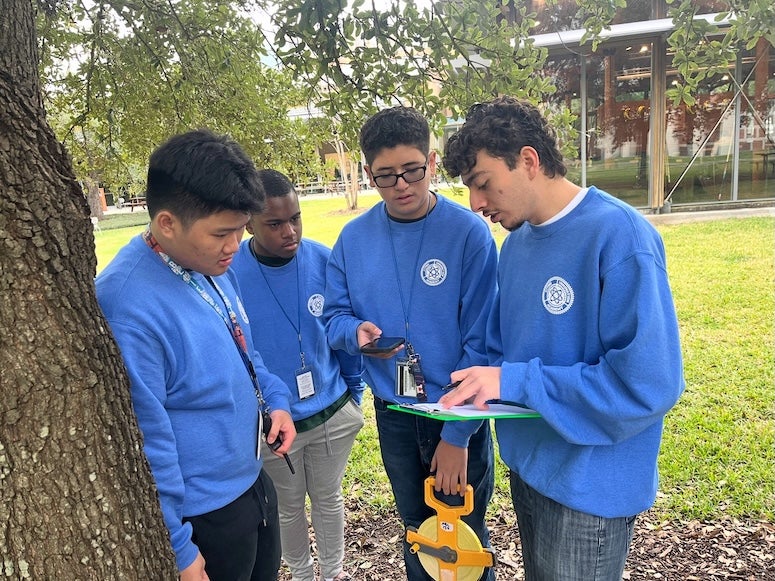
In a class as equally focused on pedagogy as it is on ecology, Johnson serves as a facilitator and guide, providing resources and support to the mentors and students as they engage with learning, doing and teaching the assays. The course finishes with a half-day workshop with Alief Early College High School students, in which the Rice students transition into a mentorship role, teaching the assays they’ve learned to the visiting scholars.
In preparation for the workshop, the Rice students practice teaching each other, gathering feedback on their lectures, presentations and demonstrations. The mentors, drawing on their experiences from the semester, provide advice and support.
On the day of the workshop, hosted in the same gully as the class, each Rice student explains and demonstrates an ecological assay to a small group of Alief scholars. The visiting students then examine the recovering wetlands, select a location for their assay and, supported by their undergraduate mentor, set it up.
During fall 2025, the second iteration of the TreeSTEM class saw several returning Alief students who took on a peer tutor role during the workshop, answering questions and demonstrating what they had learned last year.
“A major goal of this class, and the restoration of the gully, is to provide a sense of community rooted in the native ecology of Houston,” Johnson said. “When visiting Alief scholars voluntarily stepped into a peer tutor role, they were choosing to join and grow that community, inviting in others as they learned and worked in Rice’s living laboratory.”