
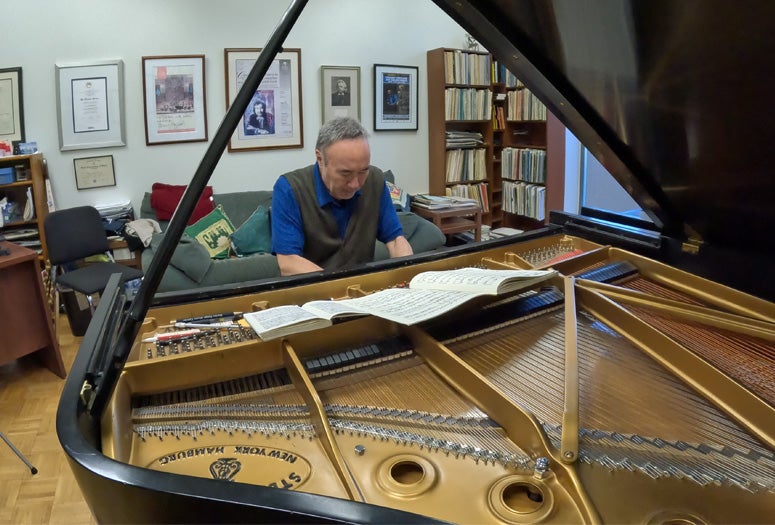
Johannes Brahms was 43 when his First Symphony premiered in 1876, more than two decades after his first attempt at writing one. Pianist Jon Kimura Parker believes audiences have been hearing that first attempt for more than 160 years under another name.
“Honestly, this is Brahms’ first symphony,” Parker said. “He so desperately wanted to write a symphony, but the shadow of Beethoven was looming and he was nervous. So he hid it in a piano concerto.”
Parker, the Walter Kris Hubert Chair of Keyboards and professor of piano at Rice University’s Shepherd School of Music, will perform that concerto, Brahms’ Piano Concerto No. 1, with the Shepherd School Symphony Orchestra at 7:30 p.m. Dec. 4 in Stude Concert Hall at Alice Pratt Brown Hall. Miguel Harth-Bedoya, the school’s distinguished resident director of orchestras and professor of conducting, will conduct. The performance marks the school’s final orchestra concert of the fall semester, anchoring a three-night set of concerts that includes the Shepherd School Chamber Players Dec. 3 and Spirit of the Season Dec. 5.
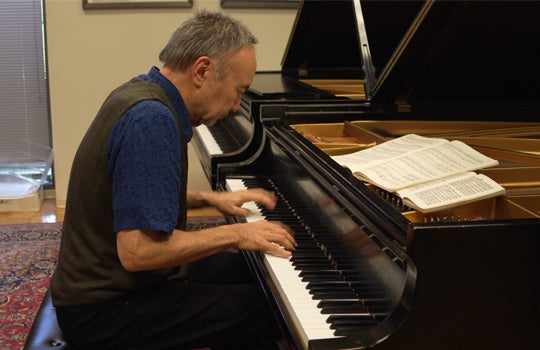
Brahm’s piece began in 1854 as a sonata for two pianos and grew into a symphony before he reshaped it as a concerto. Brahms was a great pianist who knew how to write for the instrument, Parker said, and the result is a masterpiece.
Parker learned the concerto for the finals of the 1984 Leeds International Piano Competition, rehearsing with his friend, pianist Norman Krieger, at a second piano, so he could hear how the solo part fit with the orchestra. Parker won and went on to perform it with orchestras across the U.K., Europe and Asia. Then about a decade passed without it in his repertoire.
“It’s remarkable to come back to it now because I’m a different person,” Parker said. “I experience music differently. I tell my students all the time that they will have a different experience with the same piece of music at different times in their lives.”
Brahms was 25 when he played the solo part at the concerto’s 1859 premiere. Parker was 24 when he won Leeds with it.
“This is a young person’s piece,” Parker said. “There are moments of unbelievable quiet and stillness, but the exciting moments feel like they were written by a young person. And I get to play it with a whole stage of young people.”
Parker’s advice for listeners starts with the orchestra, which plays alone for about three minutes and lays out the material for a 20-minute first movement. When the piano enters, he said, it comes in quietly and poetically before turning to fireworks. The second movement slows everything down.
“I feel like I’ve just sat down in church and the organ has started playing,” Parker said. “The very first thing I play feels like a prayer, and it’s just so special to me.”
In that movement, the piano is often set as accompanist, primarily to a pair of clarinets and a pair of oboes. The finale then lets loose, Parker said, with soloist and orchestra trading material all the way to a huge conclusion.
“It is one of the epic piano concertos,” Parker said.
The evening continues with another composer’s long-delayed first symphony. Bohuslav Martinů was 51 when he wrote his Symphony No. 1 in 1942 after fleeing Europe for the United States.
Tickets start at $5 with reserved seating and are available online. The performance will also be livestreamed for free.
The night before Parker’s performance, the Shepherd School Chamber Players present The Art of Shifting Colors at 7:30 p.m. Dec. 3 in Stude Concert Hall. The program includes Brahms’ Serenade No. 1, which he wrote while working on the concerto, arranged for the nine players he first scored it for. Mixed instrumental ensembles will also perform works by Jennifer Higdon, Marcel Tournier and Paul Terracini. Admission is free, but tickets are required.
To cap the three-day run, Shepherd School voice and instrumental students will take the stage for Spirit of the Season, a sold-out concert of holiday favorites and classic musical theater selections, at 7:30 p.m. Dec. 5 in Morrison Theater at Brockman Hall for Opera.