
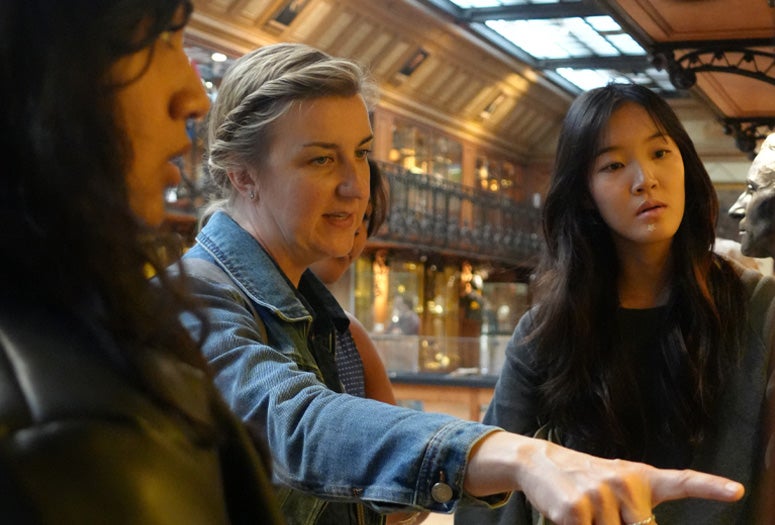
Deep beneath the streets of Paris in tunnels stacked with the bones of more than 6 million people, a group of Rice University undergraduates paused in the middle of their summer physiology course. The catacombs excursion was optional and turned a science class toward a question no lecture had posed.
“The catacombs represent the end of all human physiological processes, and while that can be difficult, it became a chance to reflect on how beautiful life is and how much we appreciate it,” said Laura Kabiri, associate teaching professor of kinesiology. “It was more impactful on my students than I anticipated.”
The course was Human Physiology, one of the natural sciences offerings in a Rice Global Paris Summer Program catalog often weighted with the humanities and social sciences. Many of its students are headed for medicine and the health professions, and all of them earned the same Rice credit they would in Houston while spending three weeks in Paris. Recorded lectures and coursework filled the morning class periods. Evenings were filled with course-related excursions and journallingin situ, then once a week the group gathered in person at the Rice Global Paris Center, where Kabiri linked the day’s material to the history around them.
“I wasn’t sure about the asynchronous format at first, but it turned out really well,” Kabiri said. “Students could complete their assignments on their own time, which gave them the flexibility to be adults and to enjoy the city they were living in.”
Paris gave the course a backdrop no American campus could match. Long regarded as a cradle of modern physiology, the city was home to Claude Bernard, often called the father of the field, and to earlier anatomists such as Joseph-Guichard Duverney, whose public dissections once drew crowds at Versailles and whose lessons reached Louis XIV. The class followed that lineage in person from the cadaveric studies behind Renaissance art at the Louvre to the Musée d’Histoire de la Médecine, whose collection reaches back to the 18th century.
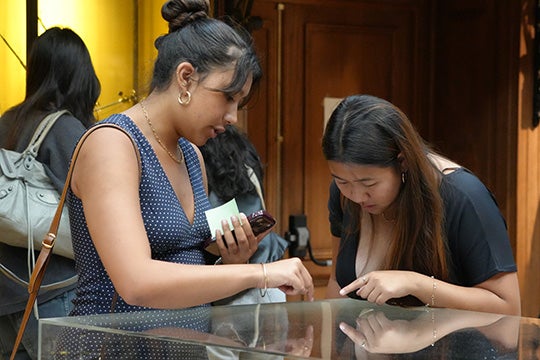
“It turned out to be one of the best excursions we had,” Kabiri said of the Musée d’Histoire de la Médecine. “To see the original stethoscope and what it meant to listen to the body directly instead of relying on a patient’s description of symptoms is something you can’t get anywhere else.”
For Kabiri, who teaches the same physiology course in Houston, Paris changed what the material meant to her students. The history they had read in a textbook, Kabiri said, took on new context and perspective once they encountered it in the places where it happened.
“This is a fantastic opportunity that I’m so thrilled Rice has developed, and I hope to teach it again in the future,” Kabiri said.
The Paris Summer Program is open to Rice undergraduates, who earn academic credit alongside an international experience. Learn more on the Rice Global website.