
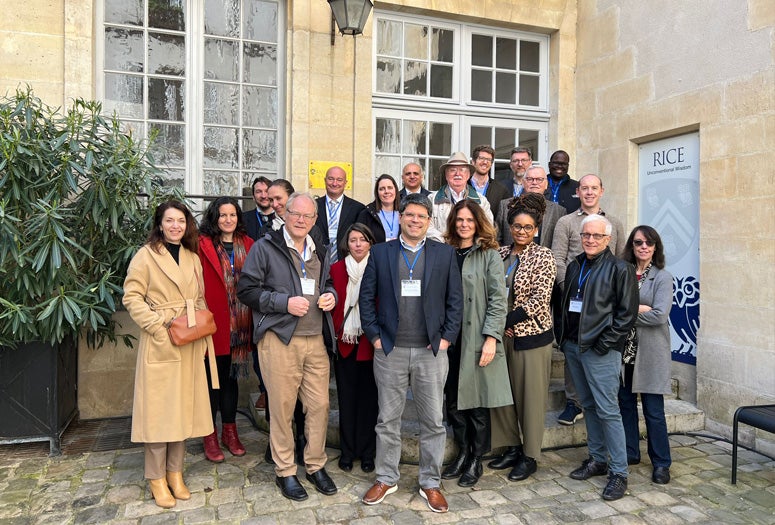
When Daniel Domingues da Silva organized a 2024 workshop at the Rice Global Paris Center, he was responding to a persistent imbalance in the field of slavery studies. Despite decades of scholarship labeled “global,” he saw the same geographic center of gravity holding firm.
“Global slavery studies have expanded tremendously, but the Atlantic world still sets the terms of the debate,” said Domingues, an associate professor of history at Rice University. “Asia and the Indian Ocean are often treated as side conversations rather than as places where coercion and enslavement shaped global systems in their own right.”
That concern became the intellectual foundation for “Hidden Archives and the Commerce of Enslavement in the Indian Ocean and Asia,” a special issue of the Journal of Global Slavery. Edited by Domingues alongside Richard B. Allen, Jane Hooper and Matthew S. Hopper, the issue grew directly out of the Paris workshop, which brought together scholars working across regions, languages and archival traditions who rarely intersect.
Rather than staging a comparative exercise with the Atlantic world as an implicit benchmark, Domingues designed the workshop to foreground local dynamics of coercion in Asia and the Indian Ocean, including systems that predated European expansion as well as those that developed alongside it.
“One of the goals was to move away from the idea that these regions only matter insofar as they resemble Atlantic slavery,” Domingues said. “That framing obscures the economic significance, the scale and the internal logics of coercive systems that operated independently of Europe.”
The resulting volume challenges long-standing assumptions about the supposed marginality or “mildness” of bondage in Asian societies. Contributors examine enslavement, forced mobility and coerced labor across regions including China, Mozambique, the Mascarenes and Southeast Asia, demonstrating how deeply embedded these practices were in local economies and global exchanges.
“A truly global history of coerced labor requires more than just adding new Asian case studies; it necessitates integrating these studies into the historiographical mainstream,” said Claude Chevaleyre, a research fellow at the French National Centre for Scientific Research’s Institute of East Asian Studies. “Asia is too often mobilized as a static comparand. This special issue thus contributes to demarginalizing the region, illuminating the global driving forces of coerced mobility beyond European networks and inviting area studies specialists to engage more deeply with labor history.”
For Chevaleyre, the implications extend well beyond historiographical correction.
“The data demonstrates that claims regarding the ‘mildness’ or ‘noneconomic’ nature of bondage in Asian societies do not hold up under rigorous investigation,” Chevaleyre said. “Dispelling these myths matters today because it allows us to recognize Asian coercive systems as dynamic, economically significant and integral to global history.”
A second unifying thread of the special issue is its methodological focus on so-called “hidden archives,” sources that have long existed but were overlooked due to linguistic barriers, institutional practices or narrow research questions. These include legal records, commercial documentation and personal correspondence preserved across fragmented archival systems.
“Archives aren’t hidden just because they’re hard to access,” Domingues said. “They’re hidden because scholars sometimes fail to understand their relevance. Once you start asking different questions, entire documentary worlds open up.”
Gabrielle Robilliard-Witt, a postdoctoral researcher on the Prize Papers Project at Carl von Ossietzky University of Oldenburg in Germany whose contribution examines the Prize Papers collection at The National Archives in London, said the methodological diversity showcased in the issue creates new possibilities for understanding the lives of enslaved people themselves.
“One very important development made possible in part through this breadth of sources is perhaps the increased visibility of the agency and audibility of the voices of the enslaved,” Robilliard-Witt said. “Digitisation and cataloguing of sources paired with digital humanities methods will permit systematic analysis of large source corpora on a hitherto unknown scale. For example, it will be possible to search thousands, even tens of thousands, of letters in the Prize Papers collection for references relating to uprisings of the enslaved, work that would have taken a historian years if not decades. This furthers not only a multiperspectival approach but also greater potential for switching between macro and micro scales.”
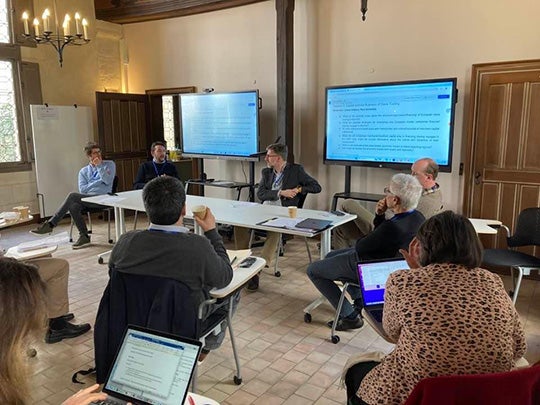
The Paris workshop was deliberately structured to foster sustained, in-person exchange among scholars who rarely have the opportunity to engage across regional and disciplinary boundaries. Participants said those conversations exposed both shared patterns of coercion and the limits of Eurocentric conceptual frameworks that still shape global history.
“Engaging in an English-speaking environment using concepts derived from European experiences reveals how Eurocentric global history remains,” Chevaleyre said. “The terms of the debate are often framed by Western categories that create distortions when rendering the complexities of Asian bondage.”
“Putting these scholars in the same room made it impossible to ignore how fragmented the field still is,” Domingues said. “If we want a genuinely global history of slavery, Asian and Indian Ocean histories can’t remain specialized knowledge. They have to become common knowledge.”
The publication of the special issue marks a milestone, but Domingues sees it as part of a longer process rather than a final statement. The work that began in Paris, he said, demonstrates what can emerge when scholars are given the space to question inherited frameworks and to build new ones collaboratively.
“This is about changing the center of gravity of the field,” Domingues said, “not by replacing one dominant narrative with another but by expanding what we collectively understand as central to global history.”
Click here to read “Hidden Archives and the Commerce of Enslavement in the Indian Ocean and Asia.”