

The group chats are heating up. The office pools are filling fast. And suddenly, everyone has a strategy.
If you are hoping to outsmart the madness, a Rice University professor may have a tiny mathematical edge for you.
The NCAA Division I Men’s Basketball Tournament, known as March Madness, features 63 games from the round of 64 to the title game. That means there are roughly 9.2 quintillion possible ways to fill out a perfect bracket. Yes, that is a real number, and no, most of us have never used it in a sentence before.
In other words, your odds are not great.
No one has ever done it.
The longest a verified bracket has stayed perfect is 39 games. Even with basketball knowledge, the odds of picking all 63 games correctly are about 1 in 28 billion.
And yet, every year, millions of fans try.
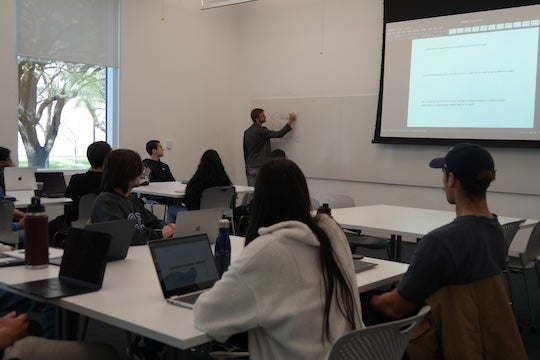
At Rice, Scott Powers has spent nearly a decade building a model designed to improve those odds, even if only slightly.
The idea began as a graduate school project.
As a student at Stanford, Powers and his friend Eli Shayer were tasked with building a software package that others could use.
“It was a really fun project I did in grad school,” said Powers, assistant professor in sports analytics and statistics, and director of the new Hutchinson Leadership Initiative in Sport Analytics. “The final project was to create a software package that others could use. Eli and I are both big sports fans, so we decided to build a package to simulate the tournament.”
Nearly a decade later, it is still running.
“It’s been going for close to a decade,” Powers said. “It really speaks to the value of doing work that relates to what people do in real life.”
The tool does not promise perfection. Nothing can. Instead, it simulates thousands of possible tournaments and evaluates how your bracket would perform against your specific competition.
“If you’re in a pool of 100 people and everyone has an equal probability, that’s like a 1% probability of winning,” Powers said. “By using our software, you can get up to maybe like a 2.5% probability. March Madness is entirely unpredictable. We’re just trying to make slightly better bets.”
Slightly better bets. That is the essence of sports analytics.
“Sport analytics is competitive,” Powers said. “It’s about winning. You’re trying to find ways to maximize that little edge.”
In larger pools, that edge often means resisting the crowd.
“Generally, if it’s a large pool, it helps to be contrarian,” he said. “You don’t just want to pick the most likely winners. You also want to pick winners that are chosen by fewer of the other participants in your pool.”
Still, Powers,who has extensive experience in professional sports, including one season as the assistant general manager of the Houston Astros, is quick to add that overthinking can backfire.
“The more time I spend filling out my bracket, the more disappointed I am with the results,” he said. “You’re going to be wrong, so don’t put too much stock in trying to get that perfect bracket.
“I think it’s less about spending a ton of time on the picks and more about having a bracket, having a rooting interest once the tournament starts.”
The bracket math now applies to both men’s and women’s tournaments.
“The one thing I’m really excited about is just the greater attention that’s being paid to the women’s tournament,” he said. “If you’ve got two different tournaments, then you’ve got twice the chance of having a winning bracket.”
Nearly a decade after it began as a classroom assignment, the model still draws interest each spring. Powers has even heard from fans who credit it with helping them win their pools.
“We’ve gotten some comments saying, ‘Hey, I won a pool. I used this package,’ which was really fun to see,” he said.
In a tournament built on buzzer-beaters, Cinderella stories and inevitable heartbreak, no model can eliminate the madness.
But if you can find even a small edge, it might be enough to win the group chat.