
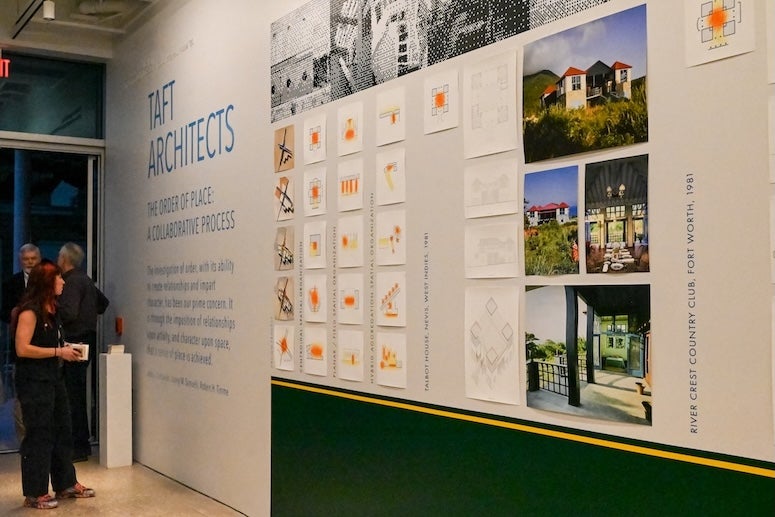
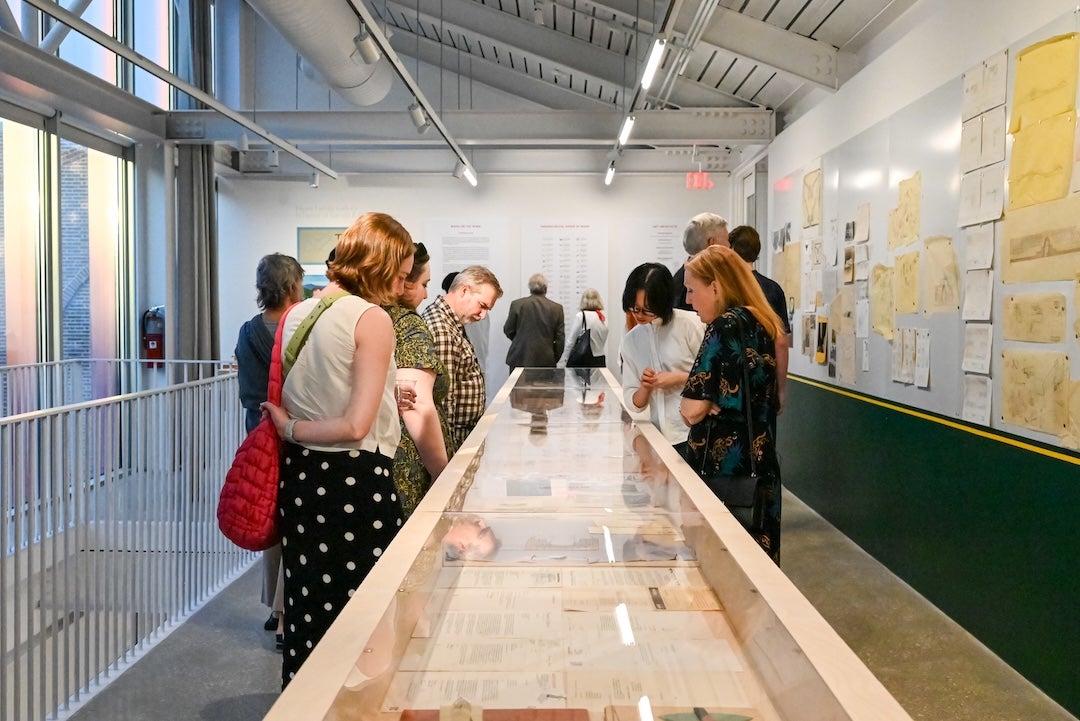
A crowd gathered Feb. 27 at the Rice University School of Architecture’s MD Anderson Hall to celebrate the legacy of Houston-based Taft Architects, as co-founders John Casbarian and Danny Samuels delivered a public lecture followed by the opening of the exhibition “The Order of Place: A Collaborative Process.”
The evening began with a talk in MD Anderson Hall, where students, alumni and local practitioners heard stories spanning five decades of practice and pedagogy. The celebration continued with a reception and exhibition opening in Cannady Hall, where drawings, models and photographs trace the firm’s evolution and design methodology. The show remains on view in Cannady Hall.
Dean Igor Marjanović framed the event as both homecoming and milestone, noting the firm’s deep ties to the school.
“It is a profound honor to welcome you all for this milestone event — an exhibition that began as a simple lunch-hour conversation just a year ago and tonight has become a reality,” he said. “Taft Architects is more than a practice. It is a vital part of the DNA of the Rice School of Architecture.
“In a discipline that too often celebrates the lone genius, they stand as a powerful argument for the collective. The most significant architecture grows out of sustained dialogue and collaboration.”
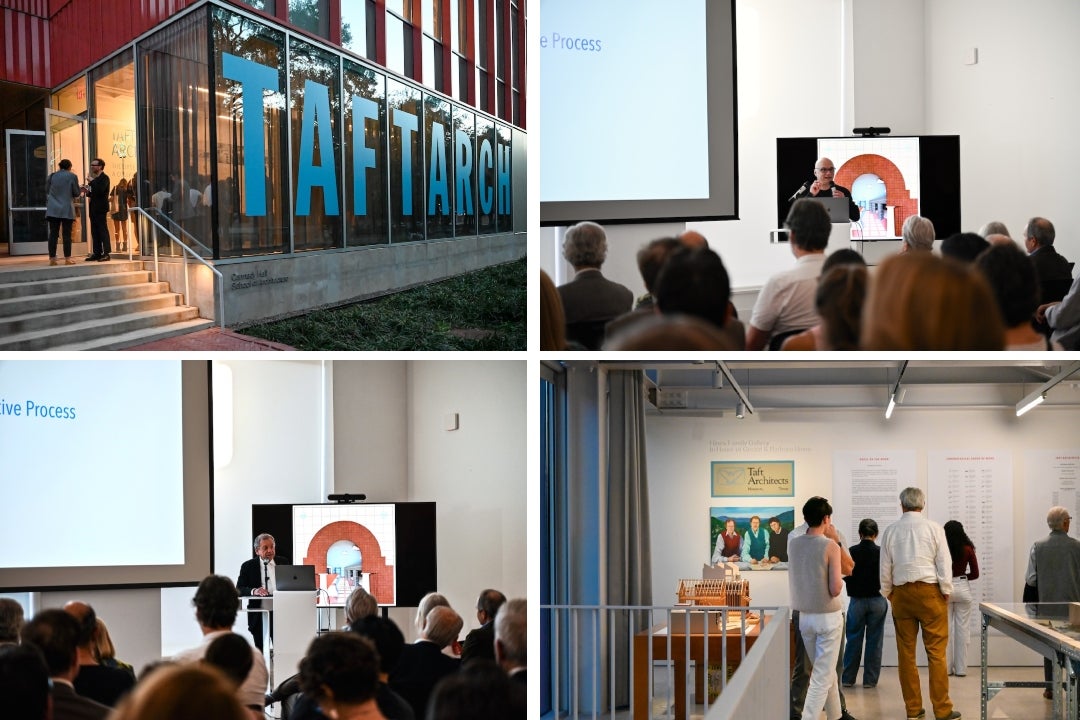
Casbarian echoed that spirit in his remarks, as he reflected on the partnership’s origins.
“This is quite overwhelming. I decided today to do this without notes — after 50-odd years, I figured I should remember the story,” he told the audience with a laugh. “This isn’t a lecture. It’s really an architectural adventure between four people who came to Rice on a fateful day in August 1965.”
That “adventure” would become Taft’s distinctive process: generating multiple schemes at a project’s outset, testing ideas and ultimately synthesizing them into hybrid solutions shaped by context, history and use.
“From the very beginning, we learned that architecture wasn’t just about objects,” Casbarian said. “It was about experimentation, collaboration and learning how to see differently.”
Samuels noted the contrast between the two parts of the exhibit: on the first floor, the close examination of 15 projects from Taft’s built work that exemplify the organizational strategies: centroidal, planar/field, and hybrid; the second floor is all about the process, showing how ideas are initially proposed and discussed in sketch models and drawings, developed and recombined into specific designs, translated into technical drawings for construction, and presented to the public in publications.
“The Order of Place: A Collaborative Process” remains open to the public in Cannady Hall until May 30, 2026. The show is presented through Exhibitions at Rice, the curatorial program of the Rice School of Architecture that uses the lens of design research to look at the world differently. Mobilizing a full spectrum of architectural representation—including drawing, imaging, making, and prototyping—this program weaves together scholarly inquiry, visual experimentation, and public engagement. Across all scales, from objects to buildings, cities, and the planet, Exhibitions at Rice engages the discipline of architecture as a cultural practice with a civic mandate, creating new discourses for both local and global audiences.